所屬科目:研究所、轉學考(插大)◆普通物理學
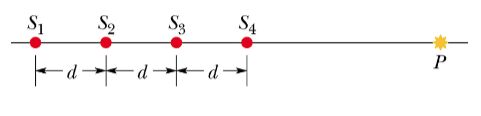
1. (15%) The figure shows four isotropic point sources of sound that are uniformly spaced on an \( x \) axis. The sources emit sound at the same wavelength \( \lambda \) and same amplitude \( s_m \), and they emit in phase. A point \( P \) is shown on the \( x \) axis. Assume that as the sound waves travel to \( P \), the decrease in their amplitude is negligible. What multiple of \( s_m \) is the amplitude of the net wave at \( P \) if distance \( d \) in the figure is (a) \( \lambda/4 \), (b) \( \lambda/2 \), and (c) \( \lambda \)? Explain.
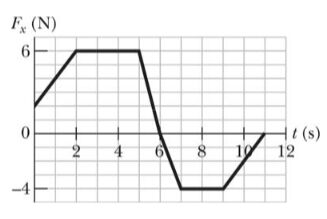
2. (15%) The figure gives, as a function of time \( t \), the force component \( F_x \) that acts on a 3.00 kg ice block that can move only along the \( x \) axis. At \( t = 0 \), the block is moving in the positive direction of the axis, with a speed of 3.00 m/s. What are its (a) speed and (b) direction of travel at \( t = 11.0 \) s?
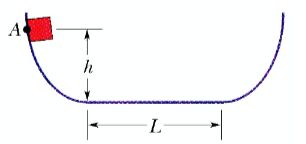
3. (10%) A particle can slide along a track with elevated ends and a flat central part as shown. The flat part has length L=40 cm. The curved portions of the track are frictionless, but for the flat part the coefficient of kinetic friction is $\mu_k=0.20$. The particle is released from rest at point A, which is at height h=L/2. How far from the left edge of the flat part does the particle finally stop?
(a) At what radial distance from the axis will the direction of the resulting magnetic field be at $45.0^\circ$ to the axial direction?
(b) What is the magnitude of the magnetic field there?
(a) What is the speed of the spring gun after the ball stops in the barrel?
(b) What fraction of the initial kinetic energy of the ball is stored in the spring?
(a) Find the charge on C1.
(b) Now the switch is opened. After many milliseconds, by how much has the charge on $C_2$ changed?
(a) What multiple of $\lambda$ gives their phase difference after they both have emerged from the layers?
(b) If the waves later arrive at some common point with the same amplitude, is their interference fully constructive, fully destructive, intermediate but closer to fully constructive, or intermediate but closer to fully destructive?
 阿摩線上測驗
登入