所屬科目:研究所、轉學考(插大)◆普通物理學
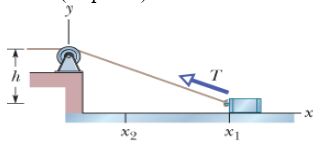
Figure 1 shows a cord attached to a cart that can slide along a frictionless horizontal rail aligned along an \( x \) axis. The left end of the cord is pulled over a pulley, of negligible mass and friction and at cord height \( h = 1.25 \text{ m} \), so the cart slides from \( x_1 = 3.00 \text{ m} \) to \( x_2 = 1.00 \text{ m} \). During the move, the tension in the cord is a constant \( 28.0 \text{ N} \). What is the change in the kinetic energy of the cart during the move? (15 points)
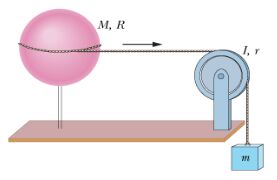
A uniform spherical shell of mass \( M = 4.5 \text{ kg} \) and radius \( R = 8.5 \text{ cm} \) can rotate about a vertical axis on frictionless bearings. A massless cord passes around the equator of the shell, over a pulley of rotational inertia \( I = 3.0 \times 10^{-3} \text{ kg}\cdot\text{m}^2 \) and radius \( r = 5.0 \text{ cm} \), and is attached to a small object of mass \( m = 0.60 \text{ kg} \). There is no friction on the pulley's axle; the cord does not slip on the pulley. What is the speed of the object when it has fallen 82 cm after being released from rest? Use energy considerations. (15 points)
3.In Fig. 3, a French submarine and a U.S. submarine move toward each other during maneuvers in motionless water in the North Atlantic. The French sub moves at speed \( v_{\text{F}} = 50.00 \text{ km/h} \), and the U.S. sub at \( v_{\text{US}} = 70.00 \text{ km/h} \). The French sub sends out a sonar signal (sound wave in water) at \( 1.000 \times 10^{3} \text{ Hz} \). Sonar waves travel at \( 5470 \text{ km/h} \). (a) What is the signal's frequency as detected by the U.S. sub ? (b) What frequency is detected by the French sub in the signal reflected back to it by the U.S. sub ? (15 points)
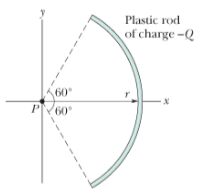
4. Fig. 4 shows a plastic rod having a uniformly distributed charge -Q. The rod has been in a 120O circular arc of radius r. We place coordinate axes such that the axis of symmetry of the rod lies along the x axis and the origin is at the center of curvature P of the rod. In term of Q and r, what is the electric field E due to the rod at point P ? (15 points)
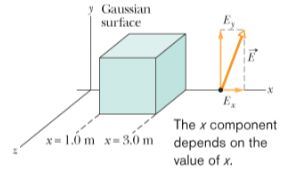
A nonuniform electric field given \( \vec{E} = 3.0x\hat{i} + 4.0\hat{j} \) pierces the Gaussian cube shown in Fig. 5. (\( E \) is in newtons per coulomb and \( x \) is in meters.) What is the electric flux through the right face and the top face? (10 points)
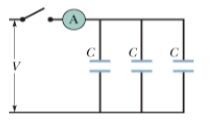
6. Each of the uncharged capacitors in Fig. 6 has a capacitance of 25.0 μF. A potential difference of V = 4200 V is established when the switch is closed. How many coulombs of charge pass through meter A ? (15 points)
(a) index of refraction n3 and
(b) angle θ.
(c) If θ is decreased, does light refract into material 3 ? (15 points)
 阿摩線上測驗
登入