所屬科目:研究所、轉學考(插大)◆無機化學
1. What is the symmetry point group for cis-PtBr$_2$Cl$_2$$^{-2}$? (Hint: square planar) (3 points) (A) D$_{2h}$? (B) C$_{2v}$? (C) C$_{2h}$? (D) D$_{4h}$? (E) C$_1$.
2. For N$_2$, the following molecular orbital is described as: (3 points) (A) $\sigma_p$? (B) $\sigma_{p^*}$? (C) $\pi$? (D) $\pi^*$? (E) $\sigma_{\pi^*}$
3. Which of the following is not expected to exist according to molecular orbital theory? (3 points) (A) H$_2$? (B) He$_2$? (C) H$_2$? (D) He$_2$? (E) Be$_2$?
4. In which case would the equilibrium be expected to lie to the right? (3 points) □□□□□ (A) \( \mathrm{MgF_2 + HgI_2\rightleftharpoons MgI_2 + HgF_2} \) (B) \( \mathrm{AgBr} + \mathrm{NaCl}\rightleftharpoons \mathrm{AgCl} + \mathrm{NaBr} \) (C) \( \mathrm{Hg_2I_2 + MgF_2\rightleftharpoons Hg_2F_2 + MgI_2} \) (D) \( \mathrm{CuO} + 2\mathrm{Cu}_{2}\mathrm{S}\rightleftharpoons \mathrm{CuS} + 2\mathrm{Cu}_{2}\mathrm{O} \) (E) \( \mathrm{CdCl}_2 + \mathrm{K}_2\mathrm{S} \rightleftharpoons \mathrm{CdS} + 2\mathrm{KCl} \)
5. Which of the following complex does not obey the 18-electron rule? (3 points) (A)(B)(C)(D)
6. Which of the following complex has the lowest energy of CO stretching frequency in the IR region (3 points)? (A) $[\mathrm{V}(\mathrm{CO})_6]^+$ (B) $\mathrm{Cr}(\mathrm{CO})_6$ (C) $[\mathrm{Mn}(\mathrm{CO})_6]^+$ (D) $\mathrm{Fe}(\mathrm{CO})_5$
7. Which of the following is an example of lattice energy? (3 points) (A) \( \mathrm{M}^{+n}(\mathrm{g}) + n\mathrm{X}^{-}(\mathrm{g})\longrightarrow \mathrm{MX}_{n}(\mathrm{g}) \) (B) \( \mathrm{M}^{+n}(\mathrm{g}) + n\mathrm{X}^{-}(\mathrm{g})\longrightarrow \mathrm{MX}_{n}(\mathrm{s}) \) (C) \( \mathrm{MX}_n(\mathbf{s})\longrightarrow \mathrm{M}^{+n}(\mathbf{g}) + n\mathrm{X}^{-}(\mathbf{g}) \) (D) \( \mathrm{MX}_n(\mathbf{g})\longrightarrow \mathrm{M}^{+n}(\mathbf{g}) + n\mathrm{X}^{-}(\mathbf{g}) \) (E) \( M(s) + n / 2X_{2}(g)\longrightarrow MX_{n}(s) \)
8. A p-type semiconductor might consist of a lattice of silicon with a trace of (3 points) (A) gallium. (B) $\mathrm{Na}^+$ . (C) phosphorus (D) potassium metal(E) copper, silver or gold
9. Which would have the largest crystal field stabilization energy? (3 points) (A) octahedral complex with \( d^3 \) configuration (B) octahedral complex with \( d^4 \) low spin configuration (C) tetrahedral complex with \( d^5 \) configuration (D) octahedral complex with \( d^6 \) low spin configuration (E) octahedral complex with \( d^6 \) high spin configuration
10. In which of compounds is the one most likely to be high spin listed first? (3 points) (A) \( \mathrm{Ru(H_2O)_6^{+3}} \) and \( \mathrm{Fe(H_2O)_6^{+3}} \) (B) \( \mathrm{Mn(Cl)_6^{-3}} \) and \( \mathrm{Mn(Cl)_6^{-4}} \) (C) \( \mathrm{Fe(Cl)_6^{-3}} \) and \( \mathrm{Fe(Cl)_4^-} \) (D) \( \mathrm{Ni(NH_3)_4^{+2}} \) and \( \mathrm{Pt(NH_3)_4^{+2}} \) (E) \( \mathrm{Fe(CN)_6^{-3}} \) and \( \mathrm{Fe(H_2O)_6^{+3}} \)
11. The number of unpaired electrons in $\mathrm{K}_4[\mathrm{Co}(\mathrm{CN})_6]$ is: (3 points) (A) 0 (B) 1 (C) 2 (D) 3 (E) None of these
12. What is the ground state term symbol of $p^2$? (3 points) (A) $^1\mathrm{D}$? (B) $^1\mathrm{S}$? (C) $^3\mathrm{P}$? (D) $^3\mathrm{D}$? (E) $^5\mathrm{P}$
13. The Jahn-Teller distortion is greatest in: (3 points) (A) \( \mathrm{Fe(CN)_6^{-4}} \) (B) \( \mathrm{Cr(CN)_6^{-3}} \) (C) \( \mathrm{Cu(F)_6^{-4}} \) (D) \( \mathrm{V(NH_3)_6^{+2}} \) (E) \( \mathrm{Mn(H_2O)_6^{+2}} \)
14. Given the trans-director series, predict the product of these reactions of $\mathrm{Pt(Cl)_3(I)^{-2}}$ with two equivalents of $\mathrm{NH_3}$ . (3 points) $$ \text{trans series: } \mathrm{I}^- > \mathrm{Br}^- > \mathrm{Cl}^- > \mathrm{NH_3} > \mathrm{H_2O} $$ (A) cis-Pt(NH3)2(I)(Cl) (B) trans-Pt(NH3)2(I)(Cl) (C) cis-Pt(NH3)2(Cl)2 (D) trans-Pt(NH3)2(Cl)2 (E) trans-Pt(NH3)(I)(Cl)2
15. Which of these involves reductive elimination? (3 points) (A) \( \mathrm{Rh(Cl)(PPh_3)_3 + CH_3I\rightarrow trans - Rh(Cl)(PPh_3)_3(CH_3)(I)} \) (B) \( \mathrm{NH_4[Re(CO)_5] + CH_3I\rightarrow Re(CO)_5CH_3 + NH_4I} \) (C) \( (\mathrm{C_5H_5})\mathrm{Fe}(\mathrm{CO})_2\mathrm{CH}_2\mathrm{CH}_3\rightarrow \mathrm{CO} + (\mathrm{C_5H_5})\mathrm{Fe}(\mathrm{CO})(\mathrm{H})(\pi -\mathrm{CH}_2\mathrm{CH}_2) \) (D) \( (\mathrm{C_5H_5})\mathrm{Mn(CO)_3 + PPh_3}\rightarrow \mathrm{CO} + (\mathrm{C_5H_5})\mathrm{Mn(CO)_2(PPh_3)} \) (E) \( \mathrm{NH_4[Ni(CH_3)(CO)_3] + HI\rightarrow CH_4 + NH_4[Ni(CO)_3I]} \)
16. Compare the bond angle by putting ">" or "<" between the following molecules (5 points). (A) \( \mathrm{OSF}_2 \) \( \mathrm{OSCl}_2 \) (halogen-S-halogen angle) (B) \( \mathrm{NH}_3 \) \( \mathrm{PH}_3 \) (H-N-H angle) (C) \( \mathrm{H}_2\mathrm{O} \) \( \mathrm{H}_2\mathrm{S} \) (H-O-H angle) (D) \( \mathrm{PF}_3 \) \( \mathrm{PCl}_3 \) (X-P-X angle) (E) \( \mathrm{ClO}_3^- \) \( \mathrm{BrO}_3^- \) \( \mathrm{IO}_3^- \) (O-X-O angle)
 阿摩線上測驗
登入
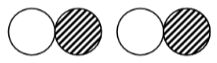 (A) $\sigma_p$? (B) $\sigma_{p^*}$? (C) $\pi$? (D) $\pi^*$? (E) $\sigma_{\pi^*}$
 (B)
 (C)
 (D)
