所屬科目:研究所、轉學考(插大)◆會計原理
1.Which of the following statements is false? (A) A statement of cash flows summarizes information about the cash inflows (receipts) and outflows (payments) for a specific period of time. (B) A statement of financial position reports the assets, liabilities, and equity at a specific date. (C) An income statement presents the revenues, expenses, changes in equity, and resulting net income or net loss for a specific period of time. (D) A retained earnings statement summarizes the changes in retained earnings for a specific period of time.
2.External users of accounting information include all of following except (A) the shareholders of Air Italy. (B) the management of Pirelli. (C) a potential customers of Olivetti. (D) All of these answer choices are correct.
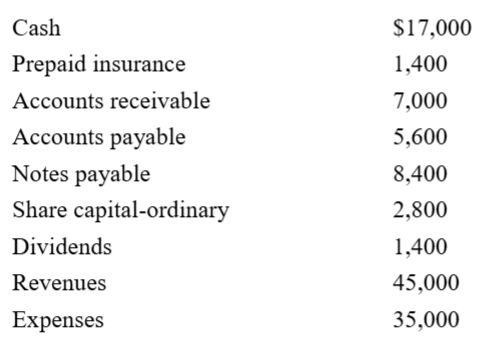
3.Rusthe Company showed the following balances at the end of its first year: |What did Rusthe Company show as total credits on its trial balance? (A) $63,200 (B) $61,800 (C) $60,400 (D) $64,500
4.An adjusting entry (A) affects two statement of financial position accounts. (B) affects two income statement accounts. (C) affects a statement of financial position account and an income statement account. (D) is always a compound entry.
5.If Income Summary has a credit balance after revenues and expenses have been closed into it, the closing entry for income Summary will include a (A) debit to Retained Earnings. (B) debit to Dividends. (C) credit to Retained Earnings. (D) credit to Dividends.
6.A credit sale of £3,200 is made on April 25, terms 2/10, N/30, on which a return of £200 is granted on April 28. What amount is received as payment in full on May 4? (A) £2,940 (B) £3,136 (C) £3,200 (D) £3,000
7.Blosser Company's goods in transit at December 31 include: Which items should be included in Blosser's inventory at December 31? (A) (2) and (3) (B) (1) and (4) (C) (1) and (3) (D) (2) and (4)
8.The control principle related to not having the same person authorize and pay for goods is known as (A) establishment of responsibility. (B) independent internal verification. (C) segregation of duties. (D) rotation of duties.
9.The collection of an account that had been previously written off under the allowance method of accounting for uncollectibles (A) will increase income in the period it is collected. (B) will decrease income in the period it is collected. (C) requires a correcting entry for the period in which the account was written off. (D) does not affect income in the period it is collected.
10.Mattox Company is building a new plant that will take three years to construct. The construction will be financed in part by funds borrowed during the construction period. There are significant architect fees, excavation fees, and building permit fees. Which of the following statements is true ? (A) Excavation fees are capitalized but building permit fees are not. (B) Architect fees are capitalized but building permit fees are not. (C) Interest is capitalized during the construction as part of the cost of the building. (D) The capitalized cost is equal to the contract price to build the plant less any interest on borrowed funds.
11.From the standpoint of the issuing company, a disadvantage of using bonds as a means of longterm financing is that (A) bond interest is deductible for tax purposes. (B) interest must be paid on a periodic basis regardless of earnings. (C) income to shareholders may increase as a result of trading on the equity. (D) the bondholders do not have voting rights.
12.Which of the following statements is not considered a disadvantage of the corporate form of organization ? (A) Additional taxes (B) Government regulations (C) Limited liability of shareholders (D) Separation of ownership and management
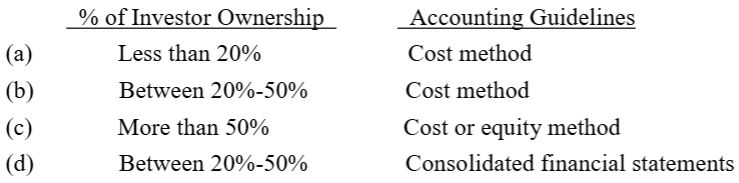
13.Which of the following is the correct matching concerning the appropriate accounting for longterm share investments?
14.The best measure of a company's ability to generate sufficient cash to continue as a going concern is net cash provided by (A) financing activities. (B) investing activities. (C) operating activities. (D) processing activities.
15.Which one of the following is not a tool in financial statement analysis? (A) Horizontal analysis (B) Circular analysis (C) Vertical analysis (D) Ratio analysis
 阿摩線上測驗
登入
 |