所屬科目:轉學考-物理
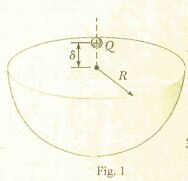
1. A particle with charge \( Q \) is located a small distance \( \delta \) immediately above the center of the flat face of a hemisphere of radius \( R \) as shown in Fig. 1. What is the electric flux (a) through the curved surface and (b) through the flat face as \( \delta \rightarrow 0 \)? (5 points for each)
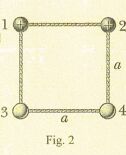
2. Four balls, each with mass \( m \), are connected by four nonconducting strings to form a square with side \( a \) as shown in Fig. 2. The assembly is placed on a nonconducting, friction-less, horizontal surface. Balls 1 and 2 each have charge \( q \), and balls 3 and 4 are uncharged. After the string connecting balls 1 and 2 is cut, what is the maximum speed of balls 1 and 2? (10 points)
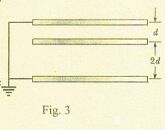
3. Two large, parallel metal plates, each of area \( A \), are oriented horizontally and separated by a distance \( 3d \). A grounded conducting wire joins them, and initially each plate carries no charge. Now a third identical plate carrying charge \( Q \) is inserted between the two plates, parallel to them and located a distance \( d \) from the upper plate as shown in Fig. 3. Find: (a) What induced charge appears on each of the two original plates? (4 points) (b) What potential difference appears between the middle plate and each of the other plates? (3 points) (c) What is the capacitance? (3 points)
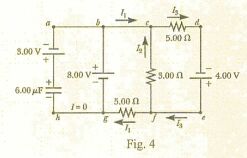
4. The circuit in Fig. 4 has been connected for several seconds. Find the current (a) in the \( 4.00\mathrm{-V} \) battery, (b) in the \( 3.00\mathrm{-}\Omega \) resistor, (c) in the \( 8.00\mathrm{-V} \) battery, and (d) in the \( 3.00\mathrm{-V} \) battery. (e) Find the charge on the capacitor (2 points for each). (以科學記號表示且四捨五入至小數點3位)
5. Please briefly explain (a) Faraday's Law of Induction (5 points), and (b) Lenz's Law (5 points).
6. Explain (a) the origin of the magnetic field and (b) what the Eddy Currents is (5 points for each).
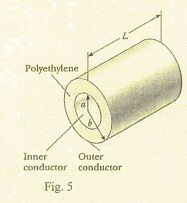
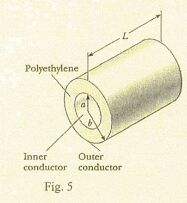
7. Find the resistance between inner and outer conductors of a coaxial cable (shown in Fig. 5) with the following parameters: \( a = 0.500 \, \text{cm} \), \( b = 1.75 \, \text{cm} \), \( L = 30.0 \, \text{cm} \), and \( \rho = 1.0 \times 10^{13} \, \Omega \cdot \text{m} \) (resistivity of polyethylene (聚乙烯)) (以科學記號表示且四捨五入至小數點3位) (10 points)
8. Find the capacitance of a coaxial cable (shown in Fig. 5) with the following parameters: \( a = 0.500 \, \text{cm} \), \( b = 1.75 \, \text{cm} \), \( L = 30.0 \, \text{cm} \), and \( \kappa = 2.3 \) (dielectric constant of polyethylene). (\( k{\nu} = 8.9876 \times 10^{9} \, \text{Nm}^2/\text{C}^2 \) or \( \varepsilon0 = 8.8542 \times 10^{-12} \, \text{C}^2/\text{Nm}^2 \)) (以科學記號表示且四捨五入至小數點3位) (10 points)
9. Please explain the Hall effect. (10 points)
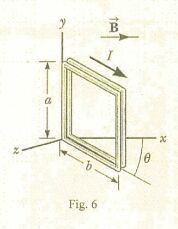
10. A rectangular coil consists of N = 1000 closely wrapped turns and has dimensions a = 0.400 m and b = 0.300 m. The coil is hinged along the y axis, and its plane makes an angle θ = 30.0° with the x axis (Fig. 6). (a) What is the magnitude of the torque exerted on the coil by a uniform magnetic field B = 0.800 T directed in the positive x direction when the current is I = 1.20 A in the direction shown? (8 points) (b) What is the expected direction of rotation of the coil? (2 points) (以科學記號表示且四捨五入至小數點 3 位)
 阿摩線上測驗
登入