所屬科目:研究所、轉學考(插大)◆普通物理學
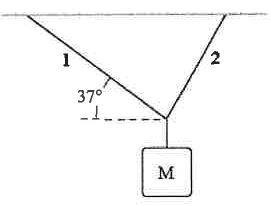
1. An object of unknown weight is suspended as shown. The tension in rope 1 is 25 lb, and the tension in rope 2 is 31 lb. What is the weight of the suspended object?
(A) 31 lb (B) 23 lb (C) 47 lb (D) 39 lb (E) 56 lb
2. A 0.40-kg mass attached to the end of a string swings in a vertical circle having a radius of 1.8 m. At an instant when the string makes an angle of 40 degrees below the horizontal, the speed of the mass is 5.0 m/s. What is the magnitude of the tension in the string at this instant? (A) 9.5 N (B) 3.0 N (C) 8.1 N (D) 5.6 N (E) 4.7 N
3. The coefficient of static friction for the tires of a race car is 0.950 and the coefficient of kinetic friction is 0.800. The car is on a level, circular track of 50.0-m radius on a planet where g = 2.45 m/s² compared to Earth's g = 9.80 m/s². If the car is to be able to travel at the same speed on the planet as on Earth, the radius of the track on the planet must be ____ times as large as the radius of the track on Earth. (A) 0.250 (B) 0.500 (C) 1.00 (D) 2.00 (E) 4.00
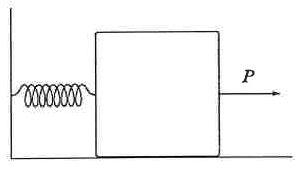
4. A 10-kg block on a horizontal, frictionless surface is attached to a light spring (force constant = 0.80 kN/m). The block is initially at rest at its equilibrium position when a force (magnitude P = 80 N) acting parallel to the surface is applied to the block, as shown. What is the speed of the block when it is 13 cm from its equilibrium position?
(A) 0.85 m/s (B) 0.95 m/s (C) 0.73 m/s (D) 0.64 m/s (E) 0.51 m/s
5. Identical masses m are attached to identical springs of spring constant k suspended from the ceiling. With both masses hanging in their equilibrium positions, mass A is pulled down 10 cm and released while mass B is pushed up 10 cm and released. Which statement is correct? (A) Mass A will travel a smaller distance to its highest point than mass B will travel to its lowest point. (B) Mass A will travel a greater distance to its highest point than mass B will travel to its lowest point. (C) Masses A and B will travel equal distances between their highest and lowest points. (D) More work was done on mass A by the extending force than on mass B by the compressing force. (E) The total work done on mass A by the extending force was equal to the total work done on mass B by the compressing force.
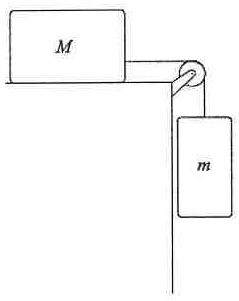
6. A mass m = 4.0 kg is connected, as shown, by a light cord to a mass M = 6.0 kg, which slides on a smooth, horizontal surface. The pulley rotates about a frictionless axle and has a radius R = 0.12 m and a moment of inertia I = 0.090 kg·m². The cord does not slip on the pulley. What is the magnitude of the acceleration of m?
(A) 2.4 m/s² (B) 3.8 m/s² (C) 4.2 m/s² (D) 5.2 m/s² (E) 1.1 m/s²
7. Aluminum Rod #1 has a length L and a diameter d. Aluminum Rod #2 has a length 2L and a diameter 2d. If Rod #1 is under tension T and Rod #2 is under tension 2T, how do the changes in length of the two rods compare? (A) They are the same. (B) Rod #1 has double the change in length that Rod #2 has. (C) Rod #2 has double the change in length that Rod #1 has. (D) Rod #1 has quadruple the change in length that Rod #2 has. (E) Rod #2 has quadruple the change in length that Rod #1 has.
8. A large water storage container is filled to a depth of 3.0 m. The volume above the water is filled with air. In order to pump the water from the container, the air pressure in the container is increased by 3.0 × 10⁵ N/m². What happens to the pressure in the water at a depth of 1.0 m when the air pressure is increased? (A) Nothing, it is still at a depth of 1.0 m and the pressure in the water depends only on the depth. (B) It increases by 1.0 × 10⁵ N/m², since it is at 1/3 the depth of the water. (C) It increases by 2.0 × 10⁵ N/m², since it is at 2/3 the depth from the bottom of the container. (D) It increases by 3.0 × 10⁵ N/m². (E) It increases by 3.0 × 10⁵ N/m² + 9.8 × 10³ N/m² since it is 1.0 m deep in the water.
9. To transmit four times as much energy per unit time along a string, you can (A) double the frequency. (B) double the amplitude. (C) increase the tension by a factor of 16. (D) do any one of the above. (E) do only ( A ) or ( B ) above.
10. A 100-g cube of ice is heated from −120°C to +120°C. In which of the following processes is the greatest amount of energy absorbed by this material? (A) warming ice to the melting point (B) melting the ice to become water (C) warming the resulting water (D) heating the steam (E) vaporizing the water to become steam
11. Two tanks of gas, one of hydrogen, H₂, and one of helium, He, contain equal numbers of moles of gas. The gram-molecular mass of He is twice that of H₂. Both tanks of gas are at the same temperature, 293 K. Which statement(s) below is(are) correct when we ignore vibrational motion? (A) The total internal energy of the hydrogen is the same as that of the helium. (B) The total internal energy of the hydrogen is 1.4 times that of the helium. (C) The total internal energy of the helium is 1.4 times that of the hydrogen. (D) The total internal energy of the hydrogen is 1.67 times that of the helium. (E) The total internal energy of the helium is 1.67 times that of the hydrogen.
12. For the same temperature increase in a system, the change in entropy, ΔS, is largest in a reversible (A) constant-volume process. (B) constant-pressure process. (C) adiabatic process. (D) process in which no heat is transferred. (E) process in which no work is performed.
13. Charge of uniform density (20 nC/m²) is distributed over a cylindrical surface (radius = 1.0 cm), and a second coaxial surface (radius = 3.0 cm) carries a uniform charge density of −12 nC/m². Determine the magnitude of the electric field at a point 2.0 cm from the symmetry axis of the two surfaces. (A) 3.3 kN/C (B) 1.1 kN/C (C) 2.7 kN/C (D) 5.4 kN/C (E) 4.5 kN/C
14. Four electrons move from point A to point B in a uniform electric field as shown below. Rank the electrons in diagrams I through IV by the changes in potential energy from most positive to most negative when traveling from A to B.
(A) I = II = III = IV. (B) II = III > I > IV. (C) III > I = IV > II. (D) II > I = IV > III. (E) I > II = III > IV.
15. Determine the energy stored in C₂ when C₁ = 15 μF, C₂ = 10 μF, C₃ = 20 μF, and V₀ = 18 V.
(A) 0.72 mJ (B) 1.32 mJ (C) 0.50 mJ (D) 0.18 mJ (E) 1.60 mJ
16. In the following figure, if a = 2.0 cm, b = 4.0 cm, and I = 2.0 A, what is the magnitude of the magnetic field at point P?
(A) 49 μT (B) 39 μT (C) 23 μT (D) 69 μT (E) 13 μT
17. Captain Jirk reports to headquarters that he left the planet Senesca 1.88 × 10⁴ seconds earlier. Headquarters sends back the message: "Was that spaceship proper time?" It will be spaceship proper time if it was (A) measured by one clock fixed at one spot on Senesca. (B) measured by one clock fixed at one spot on the spaceship. (C) measured by a clock on Senesca at departure and by a clock on the spaceship when reporting. (D) measured by a clock on the spaceship when departing and by a clock on Senesca when reporting. (E) calculated by dividing the distance from Senesca according to Senesca by the speed of the spaceship.
18. The number of photons per second passing a plane perpendicular to a collimated monochromatic (one frequency) beam of light transporting power P is directly proportional to (A) the wavelength of the light. (B) the frequency of the light. (C) the power of the beam. (D) all of the above. (E) only ( A ) and ( C ) above.
19. Suppose Bohr had chosen the potential energy of the electron in the hydrogen atom to be V = 0 when the electron is in the orbit with n = 1. He could do this by (A) choosing n = 1 for the orbit where the kinetic energy of the electron is zero. (B) adding a constant 13.6 eV to the potential energy for all values of n. (C) adding a constant 27.2 eV to the potential energy for all values of n. (D) subtracting a constant 13.6 eV from the potential energy for all values of n. (E) subtracting a constant 27.2 eV from the potential energy for all values of n.
20. The fact that we can only calculate probabilities for values of physical quantities in quantum measurements means that (A) radiation and matter are not described by mathematical relations between measurements. (B) the probabilities cannot be calculated from mathematical relationships. (C) the results of physical measurements bear no relationship to theory. (D) the average values of a large number of measurements correspond to the calculated probabilities. (E) the average of the values calculated in a large number of different theories corresponds to the results of a measurement.
第二部分:簡答題
1. A 50-gram sample of dry ice (solid CO₂) is placed in a 4-liter container. The system is sealed and allowed to reach room temperature (20°C). By approximately how much does the pressure inside the container increase when the dry ice turns to gas? (Ignore the initial volume of the sample.)
2. A hydrogen atom emits a photon of wavelength 657.7 nm. From what energy state did the electron jump?
3. Two spaceships traveling in opposite directions along parallel lines measure their own and the other spaceship's length while passing one another. The crew on spaceship A says that their ship is 1000 m long and that ship B is 800 m long. The crew on ship B says that their ship is 1000 m long and that ship A is 800 m long. At what speed does each crew say that the other ship is traveling relative to their own ship?
4. The "seeing ability" or resolution of radiation is determined by its wavelength. If an atom is approximately 10⁻¹⁰ m in diameter, how fast must an electron travel to have a wavelength smaller than the size of an atom?
5. The Earth is 1.49 × 10¹¹ meters from the Sun. If the solar radiation at the top of the Earth's atmosphere is 1340 W/m², what is the total power output of the Sun?
6. How much energy is dissipated as heat during a two-minute time interval by a 1.5-kΩ resistor which has a constant 20-V potential difference across its leads?
7. A segment of wire carries a current of 25 A along the x axis from x = −2.0 m to x = 0, and then along the z axis from z = 0 to z = 3.0 m. In this region of space, the magnetic field is equal to 40 mT in the positive z direction. What is the magnitude of the force on this segment of wire?
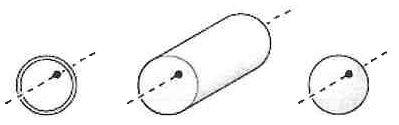
8. A hoop, a solid cylinder, and a solid sphere all have the same mass m and the same radius R. Each is mounted to oscillate about an axis a distance 0.5R from the center. The axis is perpendicular to the circular plane of the hoop and the cylinder and to an equatorial plane of the sphere as shown below. Which is the correct ranking in order of increasing angular frequency ω (from highest to lowest)?
 阿摩線上測驗
登入
 (A) 31 lb (B) 23 lb (C) 47 lb (D) 39 lb (E) 56 lb
 (A) 0.85 m/s (B) 0.95 m/s (C) 0.73 m/s (D) 0.64 m/s (E) 0.51 m/s
 (A) 2.4 m/s² (B) 3.8 m/s² (C) 4.2 m/s² (D) 5.2 m/s² (E) 1.1 m/s²
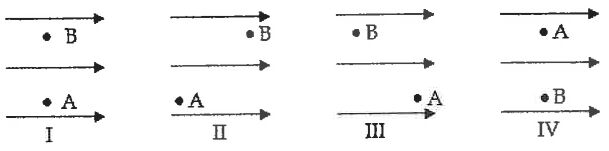 (A) I = II = III = IV. (B) II = III > I > IV. (C) III > I = IV > II. (D) II > I = IV > III. (E) I > II = III > IV.
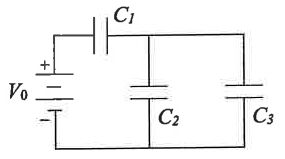 (A) 0.72 mJ (B) 1.32 mJ (C) 0.50 mJ (D) 0.18 mJ (E) 1.60 mJ
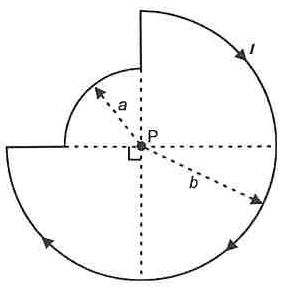 (A) 49 μT (B) 39 μT (C) 23 μT (D) 69 μT (E) 13 μT