所屬科目:研究所、轉學考(插大)◆普通物理學
1. The surface of the inclined plane shown is frictionless. If F = 30 N, what is the magnitude of the force exerted on the 3.0-kg block by the 2.0-kg block?
(A) 18 N (B) 27 N (C) 34 N (D) 51 N (E) 45 N
2. An object attached to the end of a string swings in a vertical circle (R = 1.2 m), as shown. At an instant when θ = 30°, the speed of the object is 5.1 m/s and the tension in the string has a magnitude of 20 N. What is the mass of the object?
(A) 2.8 kg (B) 3.5 kg (C) 4.8 kg (D) 1.2 kg (E) 0.4 kg
3. The coefficient of static friction for the tires of a race car is 0.950 and the coefficient of kinetic friction is 0.800. The car is on a level, circular track of 50.0-m radius on a planet where g = 2.45 m/s² compared to Earth's g = 9.80 m/s². The maximum safe speed on the track on the planet is ____ times as large as the maximum safe speed on Earth. (A) 0.150 (B) 0.500 (C) 1.00 (D) 2.00 (E) 4.00
4. A 10-kg block on a horizontal, frictionless surface is attached to a light spring (force constant = 1.2 kN/m). The block is initially at rest at its equilibrium position when a force (magnitude P) acting parallel to the surface is applied to the block, as shown. When the block is 8.0 cm from the equilibrium position, it has a speed of 0.80 m/s. How much work is done on the block by the force P as the block moves the 8.0 cm?
(A) 8.3 J (B) 6.2 J (C) 7.0 J (D) 9.7 J (E) 3.6 J
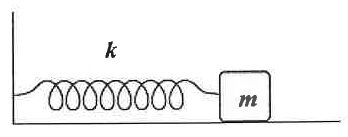
5. The block shown is released from rest when the spring is stretched a distance d. If k = 50 N/m, m = 0.50 kg, d = 10 cm, and the coefficient of kinetic friction between the block and the horizontal surface is equal to 0.25, determine the speed of the block when it first passes through the position for which the spring is unstretched.
(A) 92 cm/s (B) 61 cm/s (C) 50 cm/s (D) 82 cm/s (E) 71 cm/s
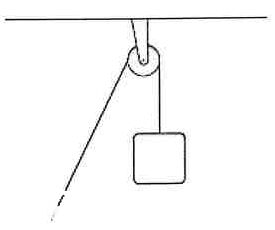
6. A wheel (radius = 0.25 m) is mounted on a frictionless, horizontal axis. The moment of inertia of the wheel about the axis is 0.040 kg·m². A light cord wrapped around the wheel supports a 0.50-kg object as shown in the figure. The object is released from rest. What is the magnitude of the acceleration of the 0.50-kg object?
(A) 3.0 m/s² (B) 2.4 m/s² (C) 4.3 m/s² (D) 5.8 m/s² (E) 1.7 m/s²
7. Angie says that an object is in equilibrium if the net torques about the center of mass is zero. Robbie says an object is in equilibrium if the sum of external forces is zero. Which one, if either, is correct? (A) Both are correct: an object is in equilibrium if either condition holds. (B) Neither is correct: both conditions must hold simultaneously. (C) Neither is correct: the net external force and the net external torque about any axis must be zero. (D) Neither is correct: an object is in equilibrium only if its velocity is zero in all coordinate systems. (E) Both are correct: if the sum of the external forces is zero, the net torque about any axis is automatically zero, and vice versa.
8. A boat is floating in a small pond. The boat then sinks so that it is completely submerged. What happens to the level of the pond? (A) It increases. (B) It decreases. (C) It stays the same. (D) In some cases, it would decrease, in others it would stay the same. (E) In some cases, it would increase, in others it would stay the same.
9. To decrease the intensity of the sound you are hearing from your speaker system by a factor of 36, you can (A) reduce the amplitude by a factor of 12 and increase your distance from the speaker by a factor of 3. (B) reduce the amplitude by a factor of 4 and increase your distance from the speaker by a factor of 3. (C) reduce the amplitude by a factor of 2 and increase your distance from the speaker by a factor of 3. (D) reduce the amplitude by a factor of 3 and increase your distance from the speaker by a factor of 4. (E) reduce the amplitude by a factor of 3 and increase your distance from the speaker by a factor of 12.
10. A team of people who traveled to the North Pole by dogsled lived on butter because they needed to consume 6000 dietician's Calories each day. Because the ice there is lumpy and irregular, they had to help the dogs by pushing and lifting the load. Assume they had a 16-hour working day and that each person could lift a 500-N load. How many times would a person have to lift this weight 1.00 m upwards in a constant gravitational field, where g = 9.80 m/s², to do the work equivalent to 6000 Calories? (A) 50.2 (B) 492 (C) 5130 (D) 50200 (E) 492000
11. Assume 3.0 moles of a diatomic gas has an internal kinetic energy of 10 kJ. Determine the temperature of the gas after it has reached equilibrium. (A) 320 K (B) 160 K (C) 800 K (D) 1550 K (E) 400 K
12. Which answer below is not a statement of the second law of thermodynamics? (A) Real processes proceed in a preferred direction. (B) Energy does not flow spontaneously by heat from a cold to a hot reservoir. (C) The entropy of the universe increases in all natural processes. (D) In theory, heat engines working in a cycle employ reversible processes. (E) You cannot construct a heat engine operating in a cycle that does nothing but take heat from a reservoir and perform an equal amount of work.
13. Charge of uniform density (20 nC/m²) is distributed over a cylindrical surface (radius = 1.0 cm), and a second coaxial surface (radius = 3.0 cm) carries a uniform charge density of −12 nC/m². Determine the magnitude of the electric field at a point 4.0 cm from the symmetry axis of the two surfaces. (A) 0.45 kN/C (B) 1.2 kN/C (C) 1.73 kN/C (D) 2.56 kN/C (E) 3.3 kN/C
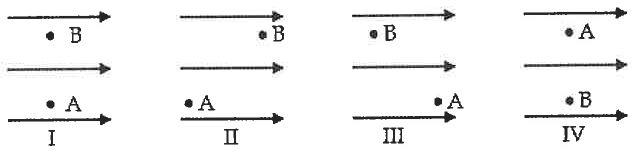
14. Four electrons move from point A to point B in a uniform electric field as shown below. Rank the electrons in diagrams I through IV by the changes in potential from most positive to most negative when traveling from A to B.
(A) I = II = III = IV. (B) II = III > I > IV. (C) III > I = IV > II. (D) II > I = IV > III. (E) I > II = III > IV.
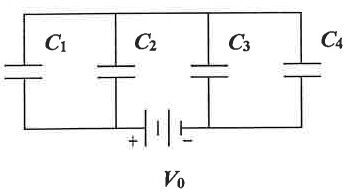
15. What is the total energy stored by C₃ when C₁ = 50 μF, C₂ = 30 μF, C₃ = 36 μF, C₄ = 12 μF, and V₀ = 30 V?
(A) 6.3 mJ (B) 25 mJ (C) 57 mJ (D) 1.6 mJ (E) 14 mJ
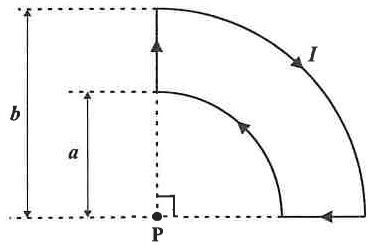
16. In the following figure, if a = 1.0 cm, b = 3.0 cm, and I = 30 A, what is the magnitude of the magnetic field at point P?
(A) 0.62 mT (B) 0.89 mT (C) 0.45 mT (D) 0.31 mT (E) 0.10 mT
17. Captain Ray, on the Galactic Explorer, sets off bright signal lights at the two ends of his spaceship so that they are seen as flashing simultaneously by General Kay, who is watch the ship go by. General Kay concludes that she was next to the midpoint of the ship at the instant when the lights flashed in her reference frame. This can only happen if Captain Ray, at the center of the Galactic Explorer, (A) sees the lights flash simultaneously in his coordinate system. (B) sees the bow (front) light flash before the aft (rear) light. (C) sees the aft (rear) light flash before the bow (front) light. (D) can calculate that the light flashes reach General Kay so that the flash from the bow light reaches her before the flash from the aft light. (E) can calculate that the light flashes reach General Kay so that the flash from the aft light reaches her before the flash from the bow light.
18. Film behind a double slit is exposed to light in the following way: First one slit is opened and light is allowed to go through that slit for time Δt. Then it is closed and the other slit is opened and light is allowed to go through that slit for the same time Δt. When the film is developed the pattern will be (A) one single slit pattern. (B) two superimposed single slit patterns, their centers displaced from each other by the distance between the two slits. (C) one double slit pattern. (D) two double slit patterns, their centers displaced from each other by the distance between the two slits. (E) random darkening of the film. (no pattern at all)
19. Aline says that the magnetic moment of an atom originates in the orbital angular momentum of the electron. Bevis says that it comes from the electron spin. Which one, if either, is correct, and why? (A) Aline, because only atoms, not electrons, can have angular momentum. (B) Bevis, because only atoms, not electrons, can have angular momentum. (C) Neither, because electron spin and orbital angular momentum always cancel exactly. (D) Neither, because the magnetic moment of an atom comes only from the spin of the nucleus. (E) Both, because both the orbital angular momentum and the spins of the electrons contribute to the magnetic moment of an atom.
20. What is the quantum number n of a particle of mass m confined to a one-dimensional box of length L when its momentum is 4h/L? (A) 1 (B) 4 (C) 2 (D) 8 (E) 16
1. During the volcanic eruption of Mt. Pelee in 1902, an incredibly hot "burning cloud" rolled down the mountain and incinerated the town of Saint-Pierre. From the damage done, the temperature in the cloud was estimated at 700°C. If the air temperature was 20°C and a mole of air is 29 grams, estimate the molecular weight of the gas in the "burning cloud" that made it heavier than the surrounding air. (As a follow-on, estimate the most probable composition of the cloud. Some typical volcanic gases are H₂S, SO₂, H₂SO₄, CO₂, NO.)
2. Rubidium (Z = 37) and potassium (Z = 19) are similar to sodium in that they have ____ electron(s) in the outermost shell.
3. When 1.0 gram of hydrogen combines with 8.0 grams of oxygen, 9.0 grams of water is formed. But is this true? During the reaction 2.86 × 10⁵ J of energy is released. How much mass is actually lost in this reaction?
4. An electron is accelerated through a potential difference of 25000 V. What is the de Broglie wavelength of the electron (in m)?
5. A solar cell has a light-gathering area of 10 cm² and produces 0.2 A at 0.8 V (DC) when illuminated with S = 1000 W/m² sunlight. What is the efficiency of the solar cell?
6. A high-voltage transmission line carries 1000 A at 700 kV for a distance of 100 miles. If the resistance per length in the wire is 0.5 Ω/mile, what is the power loss due to resistive losses?
7. A straight wire of length L carries a current I in the positive z direction in a region where the magnetic field is uniform and specified by Bx = 3B, By = −2B, and Bz = B, where B is a constant. What is the magnitude of the magnetic force on the wire?
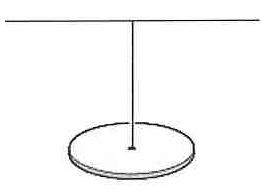
8. A torsional pendulum consists of a solid disk (mass = 2.0 kg, radius = 1.0 m) suspended by a wire attached to a rigid support. The body oscillates about the support wire. If the torsion constant is 16 N·m/rad. What is the angular frequency (in rad/s)?
 阿摩線上測驗
登入
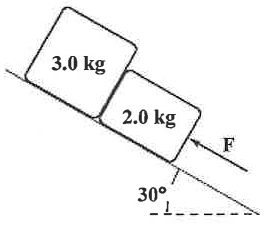 (A) 18 N (B) 27 N (C) 34 N (D) 51 N (E) 45 N
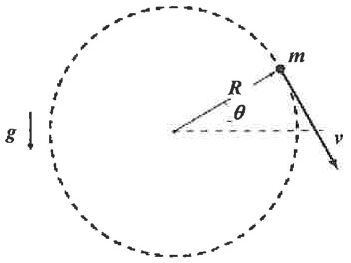 (A) 2.8 kg (B) 3.5 kg (C) 4.8 kg (D) 1.2 kg (E) 0.4 kg
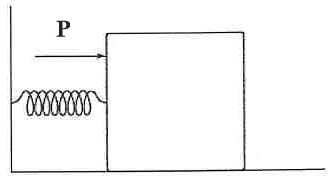 (A) 8.3 J (B) 6.2 J (C) 7.0 J (D) 9.7 J (E) 3.6 J
 (A) 92 cm/s (B) 61 cm/s (C) 50 cm/s (D) 82 cm/s (E) 71 cm/s
 (A) 3.0 m/s² (B) 2.4 m/s² (C) 4.3 m/s² (D) 5.8 m/s² (E) 1.7 m/s²
 (A) I = II = III = IV. (B) II = III > I > IV. (C) III > I = IV > II. (D) II > I = IV > III. (E) I > II = III > IV.
 (A) 6.3 mJ (B) 25 mJ (C) 57 mJ (D) 1.6 mJ (E) 14 mJ
 (A) 0.62 mT (B) 0.89 mT (C) 0.45 mT (D) 0.31 mT (E) 0.10 mT