所屬科目:研究所、轉學考(插大)◆審計學
1. The risk that a company's financial statements will materially depart from generally accepted accounting principles is referred to as:(A) Business Risk.(B) Information Risk.(C) Detection Risk.(D) Control Risk.
2. Which of the following best describes what is meant by generally accepted auditing standards?(A) Acts to be performed by the auditors.(B) Measures of the quality of the auditors' performance.(C) Procedures to be used to gather evidence to support financial statements.(D) Audit objectives generally determined on audit engagements.
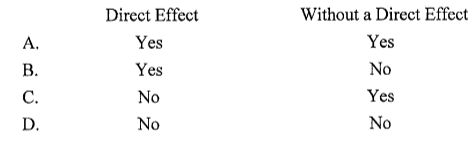
3. An audit provides reasonable assurance of detecting which of the following types of material illegal acts?(A) Option A(B) Option B(C) Option C(D) Option D
4. An attitude that includes a questioning mind, being alert to conditions that may indicate possible misstatements, and a critical assessment of audit evidence is referred to as:(A) Reasonable assurance.(B) Professional skepticism.(C) Audit neutralism.(D) Auditing mindset.
5. Bailey CPA, audited Lincoln Corporation. The shareholders sued both Lincoln and Bailey for securities fraud under the Federal Securities Exchange Act of 1934. The court determined that there was securities fraud and that Lincoln was 80% at fault and Bailey was 20% at fault due to her negligence in the audit. Both Lincoln and Bailey are solvent and the damages were determined to be $2 million. What is the maximum liability of Bailey?(A) $0(B) $400,000(C) $1,000,000(D) $2,000,000
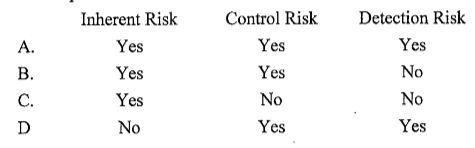
6. The components of the risk of misstatement are:(A) Option A(B) Option B(C) Option C(D) Option D
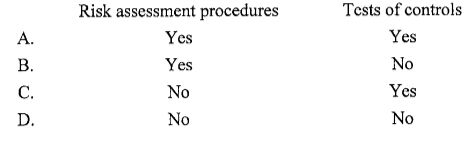
7. Further audit procedures include:(A) Option A(B) Option B(C) Option C(D) Option D
8. Which of the following is not an assertion relating to classes of transactions?(A) Accuracy.(B) Adequacy.(C) Cutoff.(D) Classification.
9. Analytical procedures are required at the risk assessment stage and as:(A) Tests of internal control.(B) Substantive procedures.(C) Procedures near the end of the audit.(D) Computer generated procedures.
10. The management representation letter date should coincide with the:(A) Date of the auditor's report.(B) Balance sheet date.(C) Date of the latest subsequent event referred to in the notes to the financial statements.(D) Date of the engagement agreement.
11. When a company has changed auditors, according to the Professional Standards:(A) The successor auditor has the responsibility to initiate contact with the predecessor auditor to ask about the client before the engagement is accepted; the predecessor has no responsibility to initiate this contact, even when aware of matters bearing on the integrity of management.(B) The predecessor must always respond fully to all inquiries made by the successor auditor.(C) The successor must discuss with the predecessor matters bearing on the engagement prior to accepting the engagement.(D) The successor may choose not to attempt any communication with the predecessor auditor.
12. Which of the following is generally not true about statistical sampling as compared to nonstatistical sampling?(A) Statistical samples are more representative of the population.(B) Statistical sample plans involve additional costs of evaluation.(C) Statistical sampling allows a more objective evaluation of sample results.(D) Statistical sampling may assist the auditors in designing more efficient samples.
13. When conducting fieldwork for a physical inventory, an auditor is least likely to perform which of the following steps using a generalized audit software package?(A) Observing inventory.(B) Selecting sample items of inventory.(C) Analyzing data resulting from inventory.(D) Recalculating balances in inventory reports.
14. A situation in which the design or operation of a control does not allow management or employees, in the normal course of performing their assigned functions, to prevent or detect material misstatements on a timely basis is referred to as a:(A) Control deficiency.(B) Material weakness.(C) Reportable condition.(D) Significant deficiency.
15. The minimum likelihood of loss involved in the consideration of a control deficiency that is less than a significant deficiency is:(A) Remote.(B) More than remote.(C) Probable.(D) Not considered.
16. 當查核人查核範圍受到限制時,其受限情況可能為不重大、重大或非常重大(pervasiveness),在查核範圍受到限制的情況下,會計師不可能出具何種查核意見?(A) 無保留意見(B) 保留意見(C) 否定意見(D) 無法表示意見
17. 會計師對關係人及關係人交易無法獲取足夠及適切之證據時,應出具何種類型之查核報告?(A) 無保留意見,且增加強調事項段(B) 保留或無法表示意見(C) 不出具報告並解除委任合約(D) 保留或否定意見
18. 依我國職業道德規範,在下列那一情況下,查核會計師仍被視為具有獨立性?(A) 受查者為金融機構,查核會計師在該金融機構獨立支票存款帳戶(B) 查核會計師同時具有律師資格,也同時擔任受查者的法律顧問(C) 受查者連續兩年積欠會計師查核公費(D) 查核人員向受查者大量購買其生產的商品,並享特別優惠
19. 一位獨立執業的會計師購買受查客戶的股票,並以信託的方式成立未成年子女的教育基金。已交付信託的股票占會計師個人財富淨值的百分比並不重大,但占未成年子女財富淨值的百分比卻是重大。試問會計師對客戶的獨立性是否受損?(A) 是,因為股票屬於會計師之直接財務利益(B) 是,因為股票對會計師未成年子女之財富淨值係屬重大,屬於會計師之間接財務利益(C) 否,因為會計師與客戶之間並無直接財務利益關係(D) 否,因為會計師與客戶之間並無重大間接財務利益關係
20. 下列何者非我國會計師之行政懲戒處分項目?(A) 除名(B) 申誡(C) 停止執行業務二個月以上二年以下(D) 新臺幣十二萬元以上一百五十萬元以下罰鍰
21. 有關查核證據之敘述,下列何者正確?①查核證據之足夠性係指查核證據品質之衡量 ②查核證據之適切性係指會計紀錄 ③查核證據係指查核人員做成查核結論時所使用之資訊 ④查核證據之適切性係為查核人員做成查核結論時,所使用查核證據之攸關性及可靠性 ⑤查核證據必須足夠及適切,此兩項特質可以相互替代(A) 僅①②⑤(B) 僅③④(C) 僅③⑤(D) 僅②④
22. 查核工作底稿所有權歸下列何者?(A) 委託人(B) 查核會計師(C) 主管機關(D) 除法令或會計師事務所內部契約另有規定者外歸會計師事務所
23. 執行重大性可協助查核人員決定:(A) 控制風險之評估水準(B) 所需查核證據的程度(C) 應執行何種特定的證實性程序(D) 應執行何種特定的分析性程序
24. 應收帳款帳載金額為$4,000,000,查核人員採用機率與大小或比例(PPS)抽樣,抽樣區間為15,000,若抽查結果發現三項錯誤,分別為帳面金額$25,000,查定金額為$15,000;帳面金額$10,000,查定金額為$7,000及帳面金額$5,000,查定金額為$4,000。則應收帳款的估計總錯誤金額為若干?(A) $13,500(B) $14,000(C) $17,500(D) $20,000
25.根據過去的查核經驗,A公司之內部控制不佳,使得應收帳款常有錯誤發生,高估或低估的錯誤型態均有,且錯誤型態係成線性關係。試問查核人員適宜採用那一種統計抽樣方法?(A)平均單位估計法 (B)差額估計法 (C)比率估計法 (D)機率比例大小抽樣
1.何謂風險評估程序。(4 分)
2.風險評估程序應包含哪些程序。(4 分)
3.何謂顯著風險?48 號公報中指出每個審計個案應辨認之顯著風險為何?(6 分)
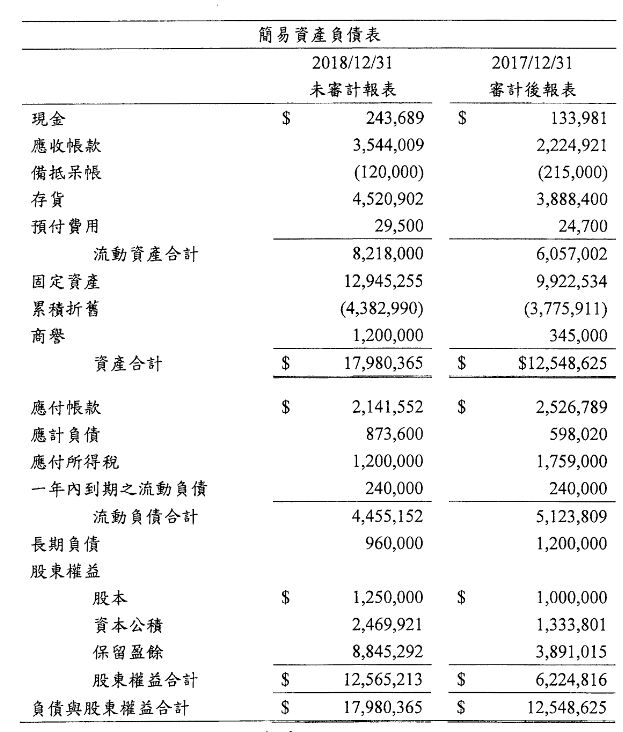
4.假設你為 A 會計師事務所之審計人員,正執行臺北公司之年度財務報表審計工作,相關資訊如下:(1) 臺北公司總部位於臺北,工廠分別設置在台灣與中國各地,並在美國與歐洲各地設有負責經銷之子公司。(2) 臺北公司為 A 會計師事務所首次查核之客戶。(3) 臺北公司之經理人在行業界之評價屬於積極有自信,追求獲利與風險。該經理人過去任職的公司曾有破產之紀錄。臺北公司設有監察人 2 人。(4) 臺北公司所屬產業過去幾年間整體呈現成長趨勢。(5) 臺北公司的內部控制設計完備,但內部稽核部分的紀錄顯示,行政人員因超時工作,過度疲累使資訊系統之處理產生人為錯誤。(6) 臺北公司與該公司經理人簽訂合約,若該年度稅前淨利超過 7800 萬元,則除固定薪資外,經理人尚可取得稅前淨利之 5%紅利。(7) 臺北公司簡明損益表與資產負債表如下:問題:請你寫下初步風險評估時,所有你辨認出之風險。(18 分)
1. 何謂外部函證?(4 分)
2. 為何執行外部函證程序可以協助查核人員取得較為可靠之證據?(6 分)
3. 採用消極式函證作為唯一證實程序的條件為何?(8 分)
 阿摩線上測驗
登入