所屬科目:學士後西醫-化學
19. Which of the following resonance structures is the most stable? (A) (B) (C) (D) (E) All of them are the same.
26. Consider the following octahedral complex structures, each involving ethylene diamine and two different, unidentate ligands X and Y. Which, if any, of the following pairs are optical isomers? (A) 1 and 4 (B) 1 and 2 (C) 3 and 4 (D) 1 and 3 (E) None of the above.
28. Why is this reaction considered to be exothermic? (A) Because energy difference A and energy difference C are about equal. (B) Because energy difference B is greater than energy difference C plus energy difference A. (C) Because energy difference A is greater than energy difference C. (D) Because energy difference B is greater than energy difference A. (E) Because energy difference B is greater than energy difference C.
29. The structure of pentose is shown on the down figure. How many carbon atoms with chirality are there in this molecule? (A) 1 (B) 2 (C) 3 (D) 4 (E) 5
62. Consider the following data concerning the equation:
(A) Rate = k[H2O2][I– ][H+ ] (B) Rate = k[H2O2]2 [I– ]2 [H+ ]2 (C) Rate = k[I– ][H+ ] (D) Rate = k[H2O2][H+ ] (E) Rate = k[H2O2][I– ]
64. Which of the following statements is true about the following electrochemical cell? (A) The cell reaction is spontaneous with a standard cell potential of 0.06 V. (B) The cell reaction is nonspontaneous with a standard cell potential of –5.80 V. (C) The cell reaction is nonspontaneous with a standard cell potential of –0.06 V. (D) The cell reaction is spontaneous with a standard cell potential of 5.80 V. (E) The cell is at equilibrium.
65. Examine the phase diagram for the substance Bogusium (Bo) and select the correct statement. (A) Bo changes from a liquid to a gas as one follows the line from C to D. (B) The triple point for Bo is at a higher temperature than the melting point for Bo. (C) Bo changes from a solid to a liquid as one follows the line from C to D. (D) Point B represents the critical temperature and pressure for Bo. (E) Bo(s) has a lower density than Bo(l).
77. It is desired to determine the concentration of arsenic in a lake sediment sample by means of neutron activation analysis. The nuclide As captures a neutron to form As , which in turn undergoes β decay. The daughter nuclide produces the characteristic γ rays used for the analysis. What is the daughter nuclide? (A) (B) (C) (D) (E)
78. As shown below, compound IV can be prepared from reagents I, II, and III. Which of the following reaction conditions is the most suitable for the preparation of IV? (A) I is slowly added to II, and III is then added to the above mixture. (B) I is slowly added to II, and the resultant mixture is slowly added to III. (C) II is slowly added to I, and III is then added to the above mixture. (D) II is slowly added to I, and the resultant mixture is slowly added to III. (E) I is slowly added to III, and II is then added to the above mixture.
79. The equilibrium constant of a certain reaction was measured at various temperatures to give the plot shown below. What is Δ S o (J/mol∙K ) for the reaction? (R = 8.314 J/mol∙K ) (A) 0.20 (B) 3.0 (C) −50 (D) −8.3 × 10³ (E) 33
86. Which of the lines in the figure below is the best representation of the relationship between the volume of a gas and its pressure, other factors remaining constant? (A) a (B) b (C) c (D) d (E) e
89. A sample of a washing powder that contains a mixture of Na2CO3 and NaHCO3 is titrated with aqueous HCl and the following result is obtained: What is the mole ratio of CO32– to HCO3– in the washing powder? (A) 2 mole CO32– : 1 mole HCO3– (B) 1 mole CO32– : 1 mole HCO3– (C) 1 mole CO32– : 2 mole HCO3– (D) 1 mole CO32– : 3 mole HCO3– (E) 3 mole CO32– : 1 mole HCO3–(一律送分)
 阿摩線上測驗
登入
 (B)
 (C)
 (D)
 (E) None of the above.
 (B)
 (C)
 (D)
 (E) All of them are the same.
 (A) 1 and 4 (B) 1 and 2 (C) 3 and 4 (D) 1 and 3 (E) None of the above.
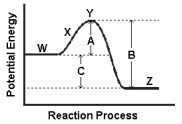 (A) Because energy difference A and energy difference C are about equal. (B) Because energy difference B is greater than energy difference C plus energy difference A. (C) Because energy difference A is greater than energy difference C. (D) Because energy difference B is greater than energy difference A. (E) Because energy difference B is greater than energy difference C.
 (A) 1 (B) 2 (C) 3 (D) 4 (E) 5
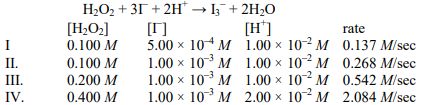
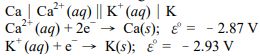 (A) The cell reaction is spontaneous with a standard cell potential of 0.06 V. (B) The cell reaction is nonspontaneous with a standard cell potential of –5.80 V. (C) The cell reaction is nonspontaneous with a standard cell potential of –0.06 V. (D) The cell reaction is spontaneous with a standard cell potential of 5.80 V. (E) The cell is at equilibrium.
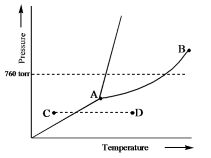 (A) Bo changes from a liquid to a gas as one follows the line from C to D. (B) The triple point for Bo is at a higher temperature than the melting point for Bo. (C) Bo changes from a solid to a liquid as one follows the line from C to D. (D) Point B represents the critical temperature and pressure for Bo. (E) Bo(s) has a lower density than Bo(l).
 captures a neutron to form As
 , which in turn undergoes β decay. The daughter nuclide produces the characteristic γ rays used for the analysis. What is the daughter nuclide? (A)
 (B)
 (C)
 (D)
 (E)

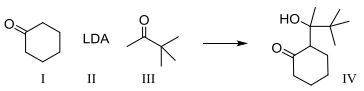 (A) I is slowly added to II, and III is then added to the above mixture. (B) I is slowly added to II, and the resultant mixture is slowly added to III. (C) II is slowly added to I, and III is then added to the above mixture. (D) II is slowly added to I, and the resultant mixture is slowly added to III. (E) I is slowly added to III, and II is then added to the above mixture.
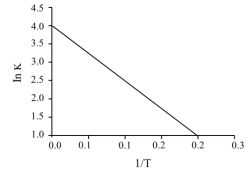 (A) 0.20 (B) 3.0 (C) −50 (D) −8.3 × 10³ (E) 33
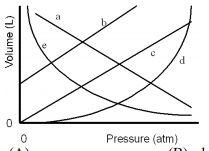 (A) a (B) b (C) c (D) d (E) e
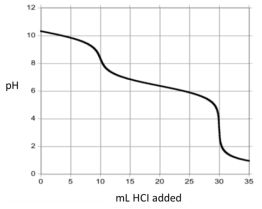 (A) 2 mole CO32– : 1 mole HCO3– (B) 1 mole CO32– : 1 mole HCO3– (C) 1 mole CO32– : 2 mole HCO3– (D) 1 mole CO32– : 3 mole HCO3– (E) 3 mole CO32– : 1 mole HCO3–(一律送分)