所屬科目:研究所、轉學考(插大)◆無機化學
1. Rank in order of increasing energy for the following spectroscopic techniques for inorganic chemistry:A. EPR spectroscopyB. Mössbauer spectroscopyC. Infrared spectroscopyD. UV-Vis (electronic) spectroscopyE. X-ray absorption spectroscopy (XAS)(A)A < B < C < D < E(B)A < C < D < E < B(C)E < D < C < B < A(D)C < A < D < B < E
2. Determine the point group of triflate ion, F3CSO3-.(A)C3h(B)C2v(C)D3d(D)C3v(E)D3h
3. Determine the point group of Os2Cl82- (staggered).(A)D4h(B)D4d(C)C4h(D)C4v(E)D4
4. Which metal hydride, in each of the following pairs of compounds, should be more acidic?(a) HV(CO)6 or (b) HV(CO)3(PPh3)3(c) HRh(CO)(PPh3)2 or (d) HRh(CO)2{P(OPh)3}(A)(a) and (c)(B)(a) and (d)(C)(b) and (c)(D)(b) and (d)
5. For the compound that contains only one Fe environment, which Mössbauer spectrum would you NOT expect?(A)a singlet(B)a doublet(C)a triplet(D)a sextet
6. Which of the following acids is the strongest?(A)Fe(H2O)63+(B)Fe(H2O)62+(C)Co(H2O)62+(D)Ni(H2O)62+(E)Zn(H2O)62+
7. Pick the INCORRECT statement about early transition metals.(A)They are oxophilic.(B)They prefer lower oxidation states.(C)They are more electropositive than late transition metals.(D)Some of them are useful catalysts in olefin polymerization.(E)They are usually classified as hard metals.
8. Determine the electron count for U in U(cot)2 (cot = cyclooctatetraenyl dianion).(A)18(B)22(C)24(D)28(E)32
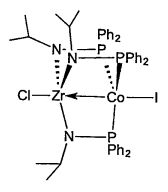
9. Determine the electron count for Zr and Co in the following complex, respectively.(A)10, 16(B)10, 18(C)18, 18(D)10, 10(E)16, 10
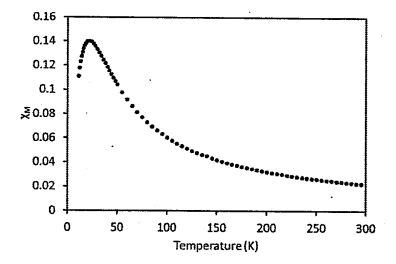
10. What type of compounds or materials might exhibit the following behavior?(A)paramagnetic(B)superparamagnetic(C)ferromagnetic(D)antiferromagnetic
11. What is NOT the typical behavior of a single molecule magnet (SMM)?(A)slow magnetization relaxation(B)magnetic hysteresis(C)long range ordering(D)typically consist of high-spin metal ions
12. What is the LUMO of O2?(A)σu(B)πg(C)σg(D)πu(E)δg
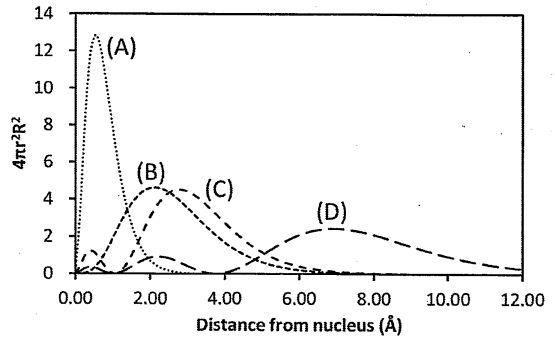
13. Below is the radial probability plot of the H atom, which one is most likely to be the 2p orbital?(A)A(B)B(C)C(D)D
14. A crystal has the following cell parameters, what is the crystal system?a ≠ b ≠ c, α = β = γ = 90°(A)cubic(B)orthorhombic(C)triclinic(D)monoclinic(E)tetragonal
15. Which one of the following complexes has an effective magnetic moment (μeff) close to 5.9?(A)Fe(CN)64-(B)Mn(H2O)62+(C)Cu(H2O)62+(D)Ni(H2O)62+(E)Co(H2O)63+
16. What is NOT a vibration normal mode of ethylene?(A)ag(B)b2g(C)au(D)b3u(E)b3g
17. What is the following symmetry type of the vibration normal mode?(A)e'(B)a1'(C)e"(D)a1"(E)a2'
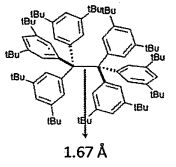
18. The following compound has an unusually long C-C bond length of 1.67 Å in the solid state, what is the main contributing force to the stability of this compound?(A)hydrogen bond(B)dipole-dipole(C)dipole-induced dipole(D)dispersion(E)ionic bond
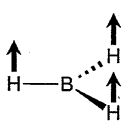
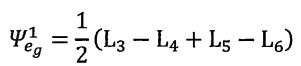
19. One of the Eg SALCs for the octahedral complex isWhat could be the other one?(A)(B)(C)(D)(E)
20. What is the Mo-Mo bond order for Mo2(CH2Ph)6?(A)1(B)2(C)3(D)4(E)5
(a) First, construct the molecular orbital diagram of square pyramidal V(H2O)54+. Assume that H2O is a pure σ donor. Provide an appropriate label for each molecular orbital, sketch each molecular orbital, and fill in the correct number of electrons. (6%)
(b) Use the MO you created in (a), construct the MO diagram of octahedral VO(H2O)52+ with V(H2O)54+ and O2- ion. For simplicity, you can use the 3d orbitals for V. Provide an appropriate label for each molecular orbital, sketch each molecular orbital, and fill in the correct number of electrons. (7%)
(c) Based on your MO, what is the bond order between V and the O2- ligand? (2%)
(a) Write down the symmetry labels for each of the Pd s, p, and d orbitals in the D3h point group. (2%)
(b) Draw each SALC and give it a symmetry label. Assume that PPh3 is a pure σ donor. Provide an appropriate label for each molecular orbital, sketch each molecular orbital, and fill in the correct number of electrons. (4%)
(c) Draw an MO diagram for Pd(PPh3)3. (6%)
(d) What is the bond order for Pd(PPh3)3? (2%)
(e) Is Pd(PPh3)3 paramagnetic or diamagnetic? (1%)
(a) Assign the formal oxidation state of Cu in this species. (2%)
(b) Experiment and computation showed that this species has a 4s0 3d10 electronic configuration. Account for this observation by means of a simplified MO approach. (8%)
24. What is Tolman cone angle? Explain how it can influence the following equilibrium. How may this be important to catalysis? (10%)Ni(PR3)4 ⇌ Ni(PR3)3 + PR3
25. Why is X-ray crystallography not useful for the characterization of transition metal dihydrogen complex? Name at least two other methods that are useful and briefly elaborate. (10%)
 阿摩線上測驗
登入
阿摩線上測驗
登入