所屬科目:研究所、轉學考(插大)◆普通化學
1. The average mass of a boron atom is 10.81 amu. For any single boron atom, what is the chance that one would randomly get an atom with mass 10.81 amu? (A) 0% (B) greater than 50% (C) about 81% (D) 100%.
2. TNT consists of carbon, nitrogen, oxygen, and hydrogen. It is 37.02% carbon by mass, 18.49% nitrogen by mass, and 42.27% oxygen by mass. The molar mass of TNT is between 210 g/mol and 245 g/mol. What is the molecular formula for TNT? (A) C4H7N6O6 (B) C6H4N3O6 (C) C7H5N3O6 (D) C8H12N3O4
3. The root mean square speed of N2 at 300 K is (A) 5.17 (B) 51.7 (C) 571 (D) 5710 m/s.
4. A gas sample is enclosed in a container traveling with a mean free path \( \lambda \); \( \lambda = k_B T / (\sqrt{2}\pi d^2 p) \). For \( T_2 = 2T_1 \), \( \lambda_{T1} : \lambda_{T2} \) is (A) 0.50 (B) 1.0 (C) 1.4 (D) 2
5. The a value in the van der Waals equation \( P_{obs} = nRT/(V-nb) - \underline{a}(n/V)^2 \) corrects for (A) gas volume (B) molecular interaction (C) vapor pressure of water (D) sticky wall.
6. To increase the value of K for the exothermic reaction \( 2H_2(g) + O_2(g) \rightleftharpoons 2H_2O(g) \) we should (A) decrease the temperature. (B) increase the temperature. (C) decrease the total pressure. (D) increase the total pressure.
7. For a particular process q = –10 kJ and w = 25 kJ. Which of the following statements is true? (A) The system does work on the surroundings. (B) Heat flows from the system to the surroundings. (C) ΔE = –35 kJ (D)All of these are true.
8. A reaction, \( 2.00 \text{ moles SO}_2(\text{g}) + 1.00 \text{ mole O}_2(\text{g}) \rightarrow 2.00 \text{ moles SO}_3(\text{g}) \), occur at \( 25^\circ\text{C} \) and a constant pressure of \( 1.00 \text{ atm} \). \( 198 \text{ kJ} \) of energy is released. \( \Delta\text{H} \) for the process is (A) -198 kJ (B) 198 kJ (C) -196 kJ (D) 200 kJ.
9. △E of question 8 is (A) -198 kJ (B) 198 kJ (C) -196 kJ (D) 200 kJ.
10. Which of the following is the strongest oxidizing agent? (A) Zn2+ (B) Zn (C) MnO4- (D) MnO2. \[ \text{MnO}_4^- + 4\text{H}^+ + 3\text{e}^- \rightarrow \text{MnO}_2 + 2\text{H}_2\text{O} \quad \text{E}^\circ = 1.68 \text{ V} \]\[ \text{Zn}^{2+} + 2\text{e}^- \rightarrow \text{Zn} \quad \text{E}^\circ = -0.76 \text{ V} \]
11. The standard potential for the reaction \( \text{Zn} + 2\text{Ag}^+ \rightarrow \text{Zn}^{2+} + 2\text{Ag} \) is 1.56 V. Given that the standard reduction potential for \( \text{Ag}^+ + \text{e}^- \rightarrow \text{Ag} \) is 0.80 V, determine the standard reduction potential for \( \text{Zn}^{2+} + 2\text{e}^- \rightarrow \text{Zn} \). (A) -0.38 V (B) 0.38 V (C) -0.76 V (D) 0.76 V.
12. Which of the following wavelength corresponds to light with the lowest energy? (A) 450 mm (B) 450 nm (C) 450 μm. (D) 450 pm.
13. In 1925, ______developed the form of equation to describe the hydrogen electron as a wave. (A) de Broglie (B) Heisenberg uncertainty (C) Pauli exclusion. (D) Schrödinger.
14. Which of the following sets has elements with the most nearly identical atomic radii? (A) Mg, K, Rb, Ba (B) Be, B, C, N (C) He, Ne, Kr, Ar (D) Mn, Fe, Co, Ni.
15. What is the hybridization of Xe in the molecule \( \text{XeF}_4 \)? (A) \( \text{sp}^3 \) (B) \( \text{sp}^2 \) (C) \( \text{d}^2\text{sp}^3 \) (D) \( \text{dsp}^3 \).
16. Atoms that are sp3 hybridized form ____ pi bond(s). (A) 0 (B) 1 (C) 2 (D) 3.
17. The rate constant k is dependent on (A) the concentration of the product. (B) the order of the reaction. (C) the temperature. (D) the concentration of the reactant.
18. Identify the major attractive force in Ne. (A) ionic bonding (B) dipole-dipole interactions (C) London dispersion forces (D) hydrogen bonding
19. Which substance can be described as cations bonded together by mobile electrons? (A) S8(s) (B) Ag(s) (C) Kr(g) (D) HCl(aq)
20. When a 1.50-g sample of glutamic acid is dissolved in 100.0 g of H2O, the resulting solution freezes at \( -0.190^\circ\text{C} \). Kf for H2O is \( 1.86^\circ\text{C/m} \). The molar mass of glutamic acid is (A) 1.50 g/mol (B) 28.0 g/mol (C) 147 g/mol (D) 189 g/mol.
21. In a given period, this group has the element with the smallest atomic radius. (A) Group 1A (B) Group 2A (C) Group 7A (D) Group 8A.
22. In response to environmental concerns, researchers have been seeking low-cost alternatives to fossil fuels. One such alternative is __________ , which can be liberated from water by using solar energy. (A) carbon (B) hydrogen (C) oxygen (D) ozone
23. The color of a transition metal complex results from (A) nuclear magnetic resonance. (B) transition of an electron between d orbitals. (C) bending vibrations. (D) stretching vibrations.
24. Name the compound shown in the right-hand figure. (A) 2,2-diethylpropane (B) 2-methyl-2-ethylbutane (C) 3,3-dimethylpentane (D) tert-heptane.
25. The product of ethane undergoing dehydrogenation is called (A) ethene (B) ethanal (C) enthanol (D) ethyne.
26. A metal crystallizes with a face-centered cubic lattice. The edge of the unit cell is 434 pm. What is the diameter of the metal atom? (A) 307 pm (B) 434 pm (C) 614 pm (D) 868 pm.
貳、 Write down chemical formula of the following compounds: (12%)1. potassium hydroxide
2. ammonium chloride
3. dinitrogen pentoxide
4. sodium sulfite
5. Iron(III) nitrate
6. sulfuric acid
參、 問答題 (36%)1. Balance the reaction \( \text{MnO}_4^-(\text{aq}) + \text{S}^{2-}(\text{aq}) \rightarrow \text{MnS}(\text{s}) + \text{S}(\text{s}) \), which occurs in basic solution.(6%)
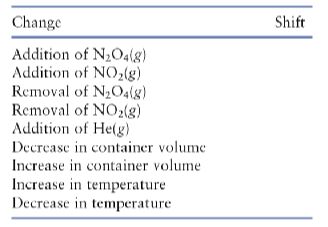
2. Predict shifts in the equilibrium position for the reaction \( \text{N}_2\text{O}_4 + \text{energy} \rightleftharpoons 2\text{NO}_2(\text{g}) \) under conditions listed in the right-hand table. Complete the “Shift” part on the table. (9%)
3. A buffered solution contains 0.50 M acetic acid (HC2H3O2, Ka = 1.8×10⁻⁵M) and 0.50 M sodium acetate. (a) calculate [H+] of the solution. (b) Calculate the new [H+] value when 0.01 mole of solid NaOH is added to 1.0 L of the buffered solution. (6%)
4. Calculate the change in entropy (△Stotal) of the following heating process: 1 mole H2O(l) at 50℃ →H2O(g) at 150℃. The molar heat capacities for H2O(l) and H2O(g) are 75.3 J K-1 mol-1 and 36.4 J K-1mol-1, respectively, and the enthalpy of vaporization for water is 40.7 kJ/mol at 100℃. (5%)
5. For an electron in a 2.00-nm one-dimensional box, calculate the wavelength of light just able to excite the electron from the ground state to the n = 3 level. \( (E_n = n^2h^2/8mL^2) \) (5%)
(a) Derive the integrated rate law for a 1st-order reaction, A→P.
(b) Calculate the half-life of the reaction with its initial reactant concentration of [A]0. (5%)
 阿摩線上測驗
登入
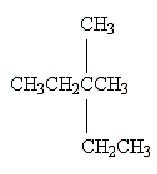 (A) 2,2-diethylpropane (B) 2-methyl-2-ethylbutane (C) 3,3-dimethylpentane (D) tert-heptane.