所屬科目:研究所、轉學考(插大)◆統計學
I. (60%)MULTIPLE CHOICE QUESTION 所有的答案請寫在答案卷,答案寫法如下列所示: All answers must be written on the answer sheet for example: 1. Which of the following statement on a simple OLS regression functionis true ? (A) Coefficient of determinationR 2 is equal to the correlation coefficient of the sample value X and Y . (B) More samples necessarily leads to a lower (C)is always greater than (D)Under the same significant level, if is significantly greater than zero, then is also significantly greater than zero.
6. N samples is randomly selected from a normal distribution population with (A)σ 2 (B) μ2 (C)σ2+μ2(D)
7. Along with 6, if we have two estimatorsX to estimate μ , which of the following statement is true? (A) Both are unbias. (B) Onlyis asymptotically unbias. (C) is more efficient than. (D)Only is a consistent estimator.
8. If random variable X is uniformly distributed between 2 and 4 , then Var (X) = (A) (B)(C) (D)
15. When we use n random samples to obtain the OLS regression function the coefficient of determination 2 R is not equal to (A) (B) (C) (D)
17. According to Chebyshev inequality, the probability that the distance between a random variable and the expected value of the random variable is no greater than three times of standard deviation is no less than (A) (B) (C) (D)
18. The probability density function of random variable X is . Var( X) = ? (A) 1 (B) 3 (C) 6 (D)9
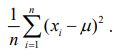
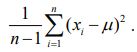
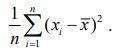
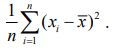
19. A normal distribution is with known mean μ and unknown variance θ . If we have n samples , the maximum likelihood estimator of θ is (A) (B) (C)(D)
20. There are two projects as follows: Project A : If success, the profit is 400,000; if not success : the loss is 40,000. Project B : If success, the profit is 500,000; if not success : the loss is 115,000. If they have the same success probability and expected profit, the success probability is (A) (B) (C) (D)
II (20%) is the impact of X on Y in the population. If we have 40 random samples of (i) Find the OLS equation and R2 . (ii) If we transform the 40 random samples to regress, find the OLS equation
III (20%) Let Y1 ,Y2 ,Y3 ….,Y n be n uncorrelated random variables with the same mean μ and variance σ2 and denote as the sample average.
(i) Find E Y( ) and Var Y( ). (ii) If we define the class of linear estimators of μ as where every ai is constant, if G is an unbiased estimator of μ , what restriction on the ai needed? (iii) Find Var (G ) (iv) Along with (i)-(iii), show that Var G ≥Var ( ) .
 阿摩線上測驗
登入
 is true ? (A) Coefficient of determinationR 2 is equal to the correlation coefficient of the sample value X and Y . (B) More samples necessarily leads to a lower
 (C)
 (D)Under the same significant level, if
 is significantly greater than zero, then
 is also significantly greater than zero.

 (A)σ 2 (B) μ2 (C)σ2+μ2(D)

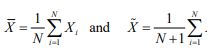 X to estimate μ , which of the following statement is true? (A) Both are unbias. (B) Only
 is asymptotically unbias. (C)
 is more efficient than
 (B)
 (C)
 (D)

 to obtain the OLS regression function
 the coefficient of determination 2 R is not equal to (A)
 (B)
 (C)
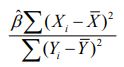 (D)

 (B)
 (C)
 (D)

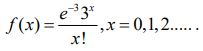 . Var( X) = ? (A) 1 (B) 3 (C) 6 (D)9
 with known mean μ and unknown variance θ . If we have n samples
 , the maximum likelihood estimator of θ is (A)
 (B)
 (C)
 (D)
 (B)
 (C)
 (D)

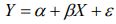 is the impact of X on Y in the population. If we have 40 random samples of

 and R2 .
 , find the OLS equation

 as the sample average.
