所屬科目:研究所、轉學考(插大)◆普通化學
( ) 1. Which of the following formulas is not correct?(A) Ba(OH)2(B) LiS(C) NaI(D) KCl(E) MgSO3
( ) 2. How many protons, neutrons, and electrons does the atom 39K have?(A) 20 protons, 19 neutrons, 20 electrons(B) 19 protons, 19 neutrons, 39 electrons(C) 20 protons, 20 neutrons, 19 electrons(D) 19 protons, 19 neutrons, 19 electrons(E) 19 protons, 20 neutrons, 19 electrons
( ) 3. Which compound has the smallest molar mass?(A) C2H6(B) CH3Cl(C) CO2(D) C2H4O(E) none of these
( ) 4. Consider the following unbalanced equation: C4H10 + O2 → CO2 + H2O For every 1.0 mol of C4H10, ____ mol of O2 is required.(A) 1.0(B) 8.0(C) 13.0(D) 6.5(E) none of these
( ) 5. You have separate aqueous solutions of NaOH and Ca(OH)2 with the sameconcentrations. You wish to neutralize an aqueous solution of HCl. Which basic solution wouldrequire more volume to neutralize the acid?(A) You need to know the volume and concentration of the HCl solution to answer this question.(B) You need to know the concentrations of the basic solutions to answer this question.(C) the NaOH solution(D) You need to know the concentrations of the acid and bases and the volume of the acid toanswer this question.(E) the Ca(OH)2 solution
( ) 6. The following reaction occurs in aqueous acid solution: \[ \text{NO}_3^- + \text{I}^- \rightarrow \text{IO}_3^- + \text{NO}_2 \] What is the oxidation state of iodine in \( \text{IO}_3^- \)?(A) +5(B) 0(C) –3(D) –5(E) +3
( ) 7. Consider the following reaction: \[ \text{AgBr}(s) + 2\text{CN}^-(aq) \rightarrow \text{Ag(CN)}_2^-(aq) + \text{Br}^-(aq) \] The species that are acting as a Lewis acid and Lewis base, respectively, are: (A) \( \text{AgBr} \) and \( \text{Ag(CN)}_2^- \) (B) \( \text{Ag(CN)}_2^- \) and \( \text{Ag}^+ \) (C) \( \text{Ag}^+ \) and \( \text{Br}^- \) (D) \( \text{Ag}^+ \) and \( \text{CN}^- \)
( ) 8. The density of a certain diatomic gas is 1.696 g/L at STP. Identify the gas. (A) Cl2 (B) O2 (C) F2 (D) H2 (E) N2
( ) 9. The value of the equilibrium constant K is dependent on:I. the temperature of the system.II. the nature of the reactants and products.III. the concentration of the reactants.IV. the concentration of the products.(A) I and II only(B) III and IV only(C) II and III only(D) three of these(E) none of these
( ) 10. A single atom of an element weighs \( 5.81 \times 10^{-23} \) g. Identify the isotope. (A) \( ^{35}\text{Cl} \) (B) \( ^{103}\text{Rh} \) (C) \( ^{80}\text{Br} \) (D) \( ^{45}\text{Sc} \) (E) none of these
( ) 11. For a neutral solution, it must be true that (A)pH = 7.00. (B) \( [H^+] = [OH^-] \).(C)\( [H_2O] = 1 \times 10^{-14} \) (D) \( [H^+] = 0 \ M \). (E) At least two of these must be true.
( ) 12. If \( K_a \) for HCN is \( 6.2 \times 10^{-10} \), what is \( K_b \) for \( \text{CN}^- \)? Note: \( \text{CN}^- + \text{H}_2\text{O} \rightleftharpoons \text{HCN} + \text{OH}^- \) (A) \( 6.2 \times 10^{-24} \) (B) \( 6.2 \times 10^4 \) (C) \( 1.6 \times 10^{-5} \) (D) \( 1.6 \times 10^{23} \) (E) none of these
( ) 13. \( [\text{Cu(CN)}_3^{2-}] \)(A) \( 3.33\ M \)(B) \( 1.67\ M \)(C) \( 2.0 \times 10^{-3}\ M \)(D) \( 1.0 \times 10^{-3}\ M \)(E) none of these
( ) 14. \( [\text{Cu(CN)}_2^-] \)(A) \( 1.0 \times 10^{-3} M \)(B) \( 4.0 \times 10^{-12} M \)(C) \( 2.0 \times 10^{-7} M \)(D) \( 2.0 \times 10^{-3} M \)(E) none of these
( ) 15. For which of the following reaction(s) is the enthalpy change for the reaction not equal to \( \Delta H^\circ_f \) of the product?I. \( 2\text{H}(g) \rightarrow \text{H}_2(g) \)II. \( \text{H}_2(g) + \text{O}_2(g) \rightarrow \text{H}_2\text{O}_2(l) \)III. \( \text{H}_2\text{O}(l) + \text{O}(g) \rightarrow \text{H}_2\text{O}_2(l) \)
(A) I and III(B) III only(C) II and III(D) II only(E) I only
( ) 16. For the reaction\( \text{AgI}(s) + (1/2)\text{Br}_2(g) \rightarrow \text{AgBr}(s) + (1/2)\text{I}_2(s) \), \( \Delta H^\circ = -54.0 \text{ kJ} \)\( \Delta H^\circ_f \) for \( \text{AgBr}(s) = -100.4 \text{ kJ/mol} \)\( \Delta H^\circ_f \) for \( \text{Br}_2(g) = +30.9 \text{ kJ/mol} \)The value of \( \Delta H^\circ_f \) for \( \text{AgI}(s) \) is
(A) \( +61.8 \text{ kJ/mol} \)(B) \( -77.3 \text{ kJ/mol} \)(C) \( -61.8 \text{ kJ/mol} \)(D) \( -123.5 \text{ kJ/mol} \)(E) \( +77.3 \text{ kJ/mol} \)
( ) 17. Calculate ΔG.(A) –7.98 kJ(B) 7.98 kJ(C) 0 kJ(D) 59.5 kJ(E) none of these
( ) 18. Calculate ΔS.(A) –20.5 J/K(B) –26.8 J/K(C) 26.8 J/K(D) 20.5 J/K(E) none of these
( ) 19. What is the electron configuration of Co3+?(A) [Ar] 3d6(B) [Ar] 4s24d4(C) [Ar] 3d4(D) [Ar] 4s23d4(E) none of these
( ) 20. What is E° for this cell?(A) 0.36 V(B) 4.40 V(C) 1.79 V(D) 1.82 V(E) 4.75 V
( ) 21. Which of the following statements about this cell is false?(A) To complete the circuit, cations migrate into the left half-cell and anions migrate into the righthalf-cell from the salt bridge.(B) This is a galvanic cell.(C) Electrons flow from the Pt electrode to the Cr electrode.(D) The cell is not at standard conditions.(E) Reduction occurs at the Pt electrode.
( ) 22. Which of the following combinations of quantum numbers do not represent permissiblesolutions of the Schrodinger equation for the electron in the hydrogen atom? (In other words, whichcombination of quantum numbers is not allowed?) (Combinations are listed as follows: n, l, m(l), m(s).)(A) 6 5 –5 1/2(B) All are allowed.(C) 8 2 2 1/2(D) 9 8 –4 1/2(E) 6 –5 –1 1/2
( ) 23. Which of the following shows these molecules in order from most polar to least polar?
(A) \( \text{CF}_2\text{Cl}_2 > \text{CF}_2\text{H}_2 > \text{CCl}_2\text{H}_2 > \text{CH}_4 = \text{CCl}_4 \)(B) \( \text{CH}_4 > \text{CF}_2\text{Cl}_2 > \text{CF}_2\text{H}_2 > \text{CCl}_4 > \text{CCl}_2\text{H}_2 \)(C) \( \text{CF}_2\text{H}_2 > \text{CCl}_2\text{H}_2 > \text{CF}_2\text{Cl}_2 > \text{CH}_4 = \text{CCl}_4 \)(D) \( \text{CF}_2\text{Cl}_2 > \text{CF}_2\text{H}_2 > \text{CCl}_4 > \text{CCl}_2\text{H}_2 > \text{CH}_4 \)(E) \( \text{CH}_4 > \text{CF}_2\text{H}_2 > \text{CF}_2\text{Cl}_2 > \text{CCl}_4 > \text{CCl}_2\text{H}_2 \)
( ) 24. How many of the following molecules and ions are linear?NCl3 CH4 SCN– CS2 NO2–(A) 4(B) 2(C) 3(D) 1(E) 0
( ) 25. Consider the structure of glycine, the simplest amino acid:\[ \begin{array}{c} \text{H} \quad \text{O} \\ | \quad \parallel \\ \text{H}_2\text{N} - \text{C} - \text{C} - \text{OH} \\ | \\ \text{H} \end{array} \]
Indicate the hybridizations at each N and C atom in the molecule (in sequence from left to right).(A) \( sp^3 \) \( sp^3 \) \( sp^2 \)(B) \( sp^2 \) \( sp^2 \) \( sp^2 \)(C) \( sp^3 \) \( sp^3 \) \( sp^3 \)(D) \( sp^2 \) \( sp^3 \) \( sp^2 \)(E) none of these
( ) 26. Order the following from shortest to longest bond: \( \text{C}_2, \text{B}_2, \text{H}_2, \text{N}_2 \)(A) \( \text{H}_2, \text{N}_2, \text{C}_2, \text{B}_2 \)(B) C2, N2, H2, B2(C) N2, C2, B2, H2(D) C2, B2, H2, N2(E) none of these
( ) 27. Consider the second-order reaction aA → products (which has a first half-life of 25 s). If the concentration of A after 15.6s is 0.36M, determine the initial concentration of A.(A) 0.58M(B) 0.26M(C) 0.53M(D) 0.14M(E) 0.16M
( ) 28. The activation energy for the reaction \( \text{H}_2(g) + \text{I}_2(g) \rightarrow 2\text{HI}(g) \) is changed from 184 kJ/mol to 59.0 kJ/mol at 600. K by the introduction of a Pt catalyst. Calculate the value of the ratio rate(catalyzed)/rate(uncatalyzed).(A) 1.00(B) 0.321(C) 1.38(D) 7.62 × 10¹⁰(E) none of these
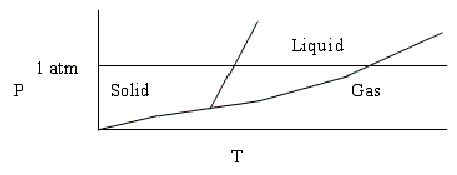
( ) 29. Choose the correct statement about the diagram below.(A) The diagram could represent the phase diagram of CO2.(B) The diagram shows the triple point above 1 atm pressure.(C) The diagram is qualitatively correct for water.(D) The diagram shows that the melting point of the solid increases with increasing pressure.(E) None of these statements is correct.
( ) 30. Metallic copper crystallizes in a face-centered cubic lattice. The volume of the unit cell is \( 4.11 \times 10^8 \text{ pm}^3 \). What is the density of copper metal?(A) \( 5.14 \text{ g/cm}^3 \)(B) \( 373 \text{ g/cm}^3 \)(C) \( 10.3 \text{ g/cm}^3 \)(D) \( 2.57 \text{ g/cm}^3 \)(E) \( 62 \text{ g/cm}^3 \)
( ) 31. Which of the following relationships is not true?(A) PV = constant when temperature and moles of gas are held constant.(B) V/T = constant when pressure and moles of gas are held constant.(C) nT = constant when pressure and volume are held constant.(D) P/n = constant when volume and temperature are held constant.(E) All of these are true.
( ) 32. When 0.800 g of NH4NO3 was added to 150.0 g of water in a styrofoam cup, thetemperature dropped by 0.413°C. The heat capacity of H2O is 4.18 J/g°C. Assume the specific heat ofthe solution equals that of pure H2O and that the calorimeter neither absorbs nor leaks heat. What isthe molar heat of solution of solid NH4NO3?(A) +260. J/mol(B) –2.60 kJ/mol(C) +2.60 kJ/mol(D) +26.0 kJ/mol(E) none of these
( ) 33. The deciding factor that makes HF a weak acid is that(A) HF has a large bond energy.背面尚有試題 第 9 頁,共 12 頁國立高雄大學 110 學年度第 2 學期寒假轉學招生考試試題(轉二年級)系所:科目:普通化學應用化學系(無組別) 是否使用計算機:是考試時間:80 分鐘本科原始成績:100 分(B) F2 has a small bond energy.(C) the entropy for hydration of F– is a large negative valu(E)(D) the enthalpy of hydration of F– is negativ(E)(E) F– has the largest ionization energy of all the halide ions.
( ) 34. Which of the following statements about the complex ion Co(en)2Cl2+ is true?(en = ethylenediamine, NH2CH2CH2NH2)(A) The geometric isomers of the complex ion have identical chemical properties.(B) The complex ion exhibits two geometric isomers (cis and trans) and two optical isomers.(C) Because en is a strong field ligand (large Δ), the complex ion is paramagnetic.(D) The complex ion exhibits cis and trans geometric isomers, but no optical isomers.(E) The complex ion contains Co(I).
( ) 35. Addition of AgNO3 to aqueous solutions of the complex results in a cloudy white precipitate,presumably AgCl. You dissolve 0.1000 g of the complex in H2O and perform a precipitation titrationwith 0.0500 M AgNO3 as the titrant. Using an electrode that is sensitive to [Ag+], you reach theendpoint after 9.00 mL of titrant is added.How many grams of chloride ion were present in the0.1000-g sample?(A) 4.50 × 10⁻⁴ g(B) 1.77 × 10⁻³ g(C) 5.00 × 10⁻³ g(D) 1.60 × 10⁻² g(E) 6.38 × 10⁻² g
( ) 36. Which metal ion has a d4 electron configuration?(A) Ti2+(B) Mn2+(C) Ni2+(D) Fe3+(E) Mn3+背面尚有試題 第 10 頁,共 12 頁國立高雄大學 110 學年度第 2 學期寒假轉學招生考試試題(轉二年級)系所:科目:普通化學應用化學系(無組別) 是否使用計算機:是考試時間:80 分鐘本科原始成績:100 分
( ) 37. Radioactive elements decay via first-order kinetics. Consider a certain type of nucleus thathas a rate constant of 1.9× 10⁻² h–1. A sample contains 6.6× 10⁸ radioactive nuclides. Calculate thetime required to reduce that number to 2.8× 10⁸.(A) 4.5 h(B) 2.0 × 10¹⁰ h(C) 4.5 × 101 h(D) 2.0 × 101 h(E) 8.1 × 10⁻¹ h
( ) 38. Calculate the pH of a solution that contains 3.25 M HCN (Ka = 6.2 × 10⁻¹⁰), 1.00 M NaOHand 1.50 M NaCN.(A) 8.28(B) 7.46(C) 9.25(D) 8.86(E) none of these
( ) 39. Which of the following reactions does not involve oxidation-reduction?(A) LiOH + HI → H2O + LiI(B) Mg + 2HI → MgI2 + H2(C) Ca + 2H2O → Ca(OH)2 + H2(D) MnO2 + 4HI → I2 + 2H2O + MnI2(E) CH4 +2O2 → 2H2O + CO2
( ) 40. Tabulated below are initial rate data for the reaction2Fe(CN)63– + 2I– → 2Fe(CN)64– + I2Run [Fe(CN)63–]0 [I–]0 [Fe(CN)64–]0 [I2]0 Initial Rate(M) (M) (M) (M) (M/s)1 0.01 0.01 0.01 0.01 1 x 10–52 0.01 0.02 0.01 0.01 2 x 10–53 0.02 0.02 0.01 0.01 8 x 10–54 0.02 0.02 0.02 0.01 8 x 10⁻⁵背面尚有試題 第 11 頁,共 12 頁國立高雄大學 110 學年度第 2 學期寒假轉學招生考試試題(轉二年級)系所:科目:普通化學應用化學系(無組別) 是否使用計算機:是考試時間:80 分鐘本科原始成績:100 分5 0.02 0.02 0.02 0.02 8 x 10⁻⁵What is the experimental rate law? I2 (A) = k[Fe(CN)63–]2[I–]2[Fe(CN)64–]2[I2]t I2 (B) = k[Fe(CN)63–]2[I–][Fe(CN)64–][I2]t I2 (C) = k[Fe(CN)63–]2[I–]t I2 (D) = k[Fe(CN)63–][I–]2t背面尚有試題 第 12 頁,共 12 頁
 阿摩線上測驗
登入