所屬科目:研究所、轉學考(插大)-近代物理學
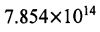
1. For a metal with specified work function Φ0= 3.1 eV subject to exposure of light with various wavelengths and intensity of 8.01 W/m2 directed at the metal sphere with a radius of 5 cm (A) The maximum wavelength required to stimulate the photoelectron emission is = 350 nm, which is the kind of ultra-violate (UV) (B) Under the exposure of light withλ = 248 nm, the maximum energy of the photoelectrons emitted from the metal is 1.5 eV (C) Under the exposure of light with λ = 155 nm, the maximum energy of the photoelectrons emitted from the metal is 4.5 eV (D) Under the condition that the exposure of light λ = 248 nm and 0.25% of the incident photons create photoelectrons, the number of emitted photoelectrons is (E) The increase of exposure light intensity can increase the photoelectrons numbers and energy
2. Which of the following statements is wrong, in regard to the physics of a 1D oscillator in the quadratic potential energy ? Let n denote the state quantum number of oscillation, with n = 0 for the ground state and n = 1, 2, for excited states. (A) The classical ground state energy is given by E0 = 0. (B) Quantum energy levels {En's} are equally spaced. (C) Oscillation frequencies are identical for classical and quantum oscillators. (D) For large n, the quantum description approaches the classical one. (E) The ground state wave function (Note: xtis the classical turning point where the kinetic energy vanishes.)
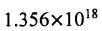
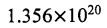
3. Assuming that the conduction electrons in a cube of a metal on edge 1 cm behave as a free quantized gas, what is the number of states which are available in the energy interval 4.00-4.01 eV, per unit volume? (A)(B) (C) (D) (E)
4. What is the depletion-layer width for a p-n junction with zero bias in germanium, given that the impurity concentrations are, respectively, at T = 300 K, relative permittivity εr = 16 and contact potential difference Vo = 0.8 V? (A) 0.0725 μm (B) 0.145 μm (C) 0.29 μm (D) 0.58 μm (E) 1.16 μm
5. For a muon with mμ = 200 me captured by a proton to form a muonic atom, please calculate the orbital radius, wavelength, speed, and energies at ground state n= 1: r1, λ1, v1, E1, and photon wavelength λa for transition from E2 to E1 (c-line) (A) (B) (C) v1= 2.1872x10⁶m/s (D) E1=-2505 eV (E)
6. Consider a particle moving in a 2D square quantum' well, with well width = L and well depth = ∞. Take potential well bottom = 0. Which of the following statements is correct, in regard to state? (A) The ground state energy is four times as large as that in a 1D quantum well of identical width and depth. (B) The ground state energy is 1/4 of the first excited state energy. (C) The ground state wave function is given by the sum F0(x) + F0(y), ((x,y) = particle position), where F0 is the ground state wave function in a 1D quantum well of identical width and depth. (D) The ground state wave function vanishes at the well center. (E) The ground state wave function is even with respect to the inversion operation (x,y) → (-x,-y).
7. Electrons with energy of 2 eV are separately incident on 10 eV barriers with 0.5 nm and I nm wide. What are their respective transmission probabilities? (A) (B) (C)(D) (E)
8. In terms of a particle trapped in a box with the length of L, which of following statements is wrong? (A) The normalized wave functions of the particle are (B) At ground state, the probability of the particle which is found between 0.45 L and 0.55 L is about 10%. (C) At first excited state, the probability of the particle which is found between 0.45 L and 0.55 L is about 0.65%. (D) At first excited state, the probability of the particle which is found at x = 0.5 L is zero. (E) At a particular place in the box, the probability of the particle may be different for different quantum numbers.
9. Which of the following statements are correct concerning the quantum energy eigenstate of a free particle? Let E = energy, p = momentum, and k = wave vector of the state.【複選題】(A) E's of all eigenstates form a continuous spectrum. (B) gives the speed of a moving wave packet formed by mixing the eigenstates with (E, p) around (Ec, Pc). (C) A particle with k will behave approximately classically, when hitting a wall with an opening of the size L>> 1/|k|. (D) A mixed state formed of two eigenstates such as exp, where ki and k2 differ but|k1|=| k2|, is not an eigenstate of momentum but is that of energy. (E) If one measures the momentum of mixed state exp(ik●r) + exp(-ik●r) for many times by performing the measurement on a very large number of identical copies of the state, the distribution of measured values will have a width of the order of |k|.
11. Consider the quantum system of two identical, spin-1/2 particles moving in a 1D infinite quantum well, in the presence of a uniform magnetic field B. Let x1 and x2 denote the two particle positions, szl and s22 the two particle spins in the B direction, Ez = Zeeman energy, and dE = energy spacing between the ground and first excited states of one particle in the well at B = 0. Which of the following statements are correct?【複選題】 (A) When B is turned off, the ground state of the two-particle system consists of two particles of opposite spins. (B) When B is turned on, the ground state of the two-particle system consists of two particles of parallel spins, if Ez >> dE. (C) At B = 0, the wave function of the two-particle system is of the determinant form (D) The Pauli exclusion principle implies that the wave function of the two-particle system must al ways vanish if (E) All of the above are true.
12. A muon has a half lifetime and a mass of 200 me. This muon is moving with a speed of u = 0.6 c. Please calculate mean lifetime τ0, the traveling distance d measured at rest, during mean lifetime To the relativistic momentum P, the de-Broglie wavelength λd, the total energy E and kinetic energy (KE) in the unit of eV, the wavelengths of a photon with the same kinetic energy or the same momentum P, λp【複選題】 (A) The mean lifetime and traveling distance measured at rest is (B) The relativistic momentum is P = 76.66 MeV/c (C) The de-Broglie wavelength is (D) The total energy and kinetic energies are E = 165.77 MeV, KE = 35.55 MeV (E) The wavelengths of photon with the same P or KE:
13. An electron and a positron move side by side, at the same velocity of 0.8c, in the same direction on the x-axis. Finally, these two particles merge together thus annihilate each other, and two photons are generate【複選題】 (A) These two photons move in the same direction (B) These two photons move in opposite direction with momentum p1 = 2.55 MeV/c, p2 = 0.51 MeV/c (C) These two photons move off with the energy E1 = 1.533 MeV, E2 = 170.36 KeV (D) These two photons move in the same direction, with the energy E1 = 1.55 MeV, E2 = 0.51 MeV (E) These two photons move off, with the wavelength m
14. Which of the following statements are correct?【複選題】 (A) If the mean track length of 100 MeV tt mesons is 4.88 m up to the point of decay, their mean lifetime is s. (B) A neutrino of energy 2 GeV collides with an electron. The maximum momentum transfer to the electron is 2.0437 GeV/c. (C) A positron-electron pair production can occur in the interaction of a gamma ray with electron, via (D) A linear accelerator produces a beam of excited carbon atoms of kinetic energy 120 MeV. Light emitted on de-excitation is viewed at right angles to the beam and has a wavelength λ'. If λ is the wavelength emitted by a stationary atom, the value of (λ' -λ) /λ = 0.0099. (Take the rest energies of both protons and neutrons to be 109 eV). (E) All statements are correct.
16. Which of the following statements are correct?【複選題】 (A) Possible values of the principle quantum number n are 1, 2, 3, ...,determining the electron energy (B) Possible values of the orbital quantum number / are 0, 1, 2,..... , n, determining the angular- momentum direction (C) The electron spin direction can be described by spin magnetic quantum number ms, which is independent with other quantum numbers. (D) No two electrons in an atom can exist in the same quantum state. They must have a different set of quantum numbers. (E) Electrons are fermions and can be described by the antisymmetric wave function,
 阿摩線上測驗
登入
 = 350 nm, which
is the kind of ultra-violate (UV)
(B) Under the exposure of light withλ = 248 nm, the maximum energy of the photoelectrons emitted
from the metal is 1.5 eV
(C) Under the exposure of light with λ = 155 nm, the maximum energy of the photoelectrons emitted
from the metal is 4.5 eV
(D) Under the condition that the exposure of light λ = 248 nm and 0.25% of the incident photons create
photoelectrons, the number of emitted photoelectrons is
 (E) The increase of exposure light intensity can increase the photoelectrons numbers and energy
 ? Let n denote the state quantum number of
oscillation, with n = 0 for the ground state and n = 1, 2, for excited states.
(A) The classical ground state energy is given by E0 = 0.
(B) Quantum energy levels {En's} are equally spaced.
(C) Oscillation frequencies are identical for classical and quantum oscillators.
(D) For large n, the quantum description approaches the classical one.
(E) The ground state wave function
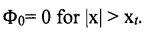 (Note: xtis the classical turning point where the
kinetic energy
 vanishes.)
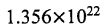
 (B)
 (C)
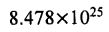
 (D)
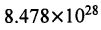
 (E)
 , respectively, at T = 300 K, relative
permittivity εr = 16 and contact potential difference Vo = 0.8 V?
(A) 0.0725 μm
(B) 0.145 μm
(C) 0.29 μm
(D) 0.58 μm
(E) 1.16 μm
 (B)
 (C) v1= 2.1872x10⁶m/s
(D) E1=-2505 eV
(E)

 ?
(A)
 (B)
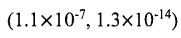 (C)
 (D)
 (E)

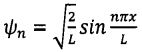 (B) At ground state, the probability of the particle which is found between 0.45 L and 0.55 L is about
10%.
(C) At first excited state, the probability of the particle which is found between 0.45 L and 0.55 L is about
0.65%.
(D) At first excited state, the probability of the particle which is found at x = 0.5 L is zero.
(E) At a particular place in the box, the probability of the particle may be different for different quantum
numbers.
 gives the speed of a moving wave packet formed by mixing the eigenstates with (E, p)
around (Ec, Pc). (C) A particle with k will behave approximately classically, when hitting a wall with an opening of the
size L>> 1/|k|.
(D) A mixed state formed of two eigenstates such as exp
 , where
ki and k2 differ but|k1|=| k2|, is not an eigenstate of momentum but is that of energy.
(E) If one measures the momentum of mixed state exp(ik●r) + exp(-ik●r) for many times by performing
the measurement on a very large number of identical copies of the state, the distribution of measured
values will have a width of the order of |k|.

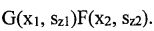 (D) The Pauli exclusion principle implies that the wave function of the two-particle system must al ways
vanish if
 (E) All of the above are true.
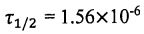 and a mass of 200 me. This muon is moving with a speed
of u = 0.6 c. Please calculate mean lifetime τ0, the traveling distance d measured at rest, during mean
lifetime To the relativistic momentum P, the de-Broglie wavelength λd, the total energy E and kinetic
energy (KE) in the unit of eV, the wavelengths of a photon with the same kinetic energy
 or the same
momentum P, λp【複選題】 (A) The mean lifetime and traveling distance measured at rest is
 (B) The relativistic momentum is P = 76.66 MeV/c
(C) The de-Broglie wavelength is
 (D) The total energy and kinetic energies are E = 165.77 MeV, KE = 35.55 MeV
(E) The wavelengths of photon with the same P or KE:

 m
 s.
(B) A neutrino of energy 2 GeV collides with an electron. The maximum momentum transfer to the
electron is 2.0437 GeV/c.
(C) A positron-electron pair production can occur in the interaction of a gamma ray with electron, via
 (D) A linear accelerator produces a beam of excited carbon atoms of kinetic energy 120 MeV. Light
emitted on de-excitation is viewed at right angles to the beam and has a wavelength λ'. If λ is the
wavelength emitted by a stationary atom, the value of (λ' -λ) /λ = 0.0099. (Take the rest energies of
both protons and neutrons to be 109 eV).
(E) All statements are correct.

