所屬科目:研究所、轉學考(插大)◆線性代數
1. (14 points) Consider the following function:$$ f(x) = \begin{cases} 3x - 1, & x < 1; \\ 2x, & x \geq 1. \end{cases} $$Use the $ \epsilon $-$\delta $ definition of the limit to show that $ \lim_{x \to 1} f(x) = 2 $. | | | | | |
(a) (3 points) Find the partial derivatives at $(0, 0)$ and the gradient vector $ \nabla f(0, 0) $.
(b) (6 points) Use the definition of the directional derivative to find $ D_u(0, 0) $ for all unit vectors $ \mathbf{u} = (a, b) $.
(c) (6 points) Is $ f $ continuous at $(0, 0)$? How about differentiability? | | | | | |
(a) (6 points) Let $ f(x) $ be a continuous function. Show that if $ f(x) $ has two local maxima, it also must have a local minima.
(b) (8 points) Show that part (a) becomes wrong for a function of two variables by finding all local maxima and minima of the function:$$ f(x, y) = - (x2 - 1)2 - (x2 y - x - 1)2.
(a) (7 points) Evaluate$$ \int \frac{x}{(x + 1)(x + 2)} \, dx. $$
(b) (7 points) Evaluate$$ \int_0^1 \frac{dx}{(2 - x)\sqrt{1 - x}}. $$
(a) (7 points) Use a suitable change of variable to compute$$\iint_R (x + y)^2 e^{x^2 - y^2} \mathrm{d}A,$$where $R$ is the square with vertices $(1,0), (0,1), (-1,0)$ and $(0, -1)$
(b) (7 points) Evaluate$$\iiint_{x^2 + y^2 + z^2 \leq 1} e^{(x^2 + y^2 + z^2)^{3/2}} \mathrm{d}V.$$
(a) (3 points) Find radius and interval of convergence.
(b) (6 points) Show that for $|x| < 1$:$$\sum_{n=0}^{\infty} \frac{x^n}{(n+1)(n+2)} = \frac{1 - x}{x^2} \ln(1 - x) + \frac{1}{x}$$
(c) (6 points) The function on the right-hand side of (1) has a removable discontinuity at $x = 1$. Remove it and then show that (1) also holds for $x = 1$.
(a) (6 points) Consider$$f(x) = \int_{\tan x}^{x/4} \sin(t^2) \mathrm{d}t.$$Compute $f'(\pi)$
(b) (8 points) Suppose that $f(0) = 0$ and$$f'(\ln x) = \begin{cases} 1, & \text{if } 0 < x \leq 1; \\ x, & \text{if } 1 < x < \infty. \end{cases}$$Find $f(x)$ | | | | | |
1. (15%) Prove that there exists a linear transformation T:R²→R³ such that T(1,1)=(1,0,2) and T(2,3)=(1,-1,4). What is T(8,11)?
2. (15%) Find linear transformations U,T:F²→F² such that UT=T₀ (the zero transformation) but TU≠T₀.
3. (15%) Let A,B∈Mₙₓₙ(F) be such that AB=−BA. Prove that if n is odd and F is not a field of characteristic two, then A or B is not invertible.
4. (20%) Prove that every invertible matrix is a product of elementary matrices.
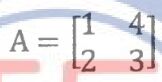
5. (20%) For
Find an expression for Aⁿ, where n is an arbitrary positive integer.
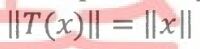
6. (15%) Let T be a linear operator on an inner product space V, and suppose that
for all x. Prove that T is one-to-one.
 阿摩線上測驗
登入
阿摩線上測驗
登入