所屬科目:研究所、轉學考(插大)◆有機化學
1. Which of the following nucleophile shows the greatest nucleophilicity in a protic solvent? (3%) (A) \( \text{CH}_3\text{CO}_2^- \) (B) \( \text{CH}_3\text{O}^- \) (C) \( \text{CH}_3\text{S}^- \) (D) \( \text{CH}_3\text{OH} \) (E) \( \text{C}_6\text{H}_5\text{NH}_2 \)
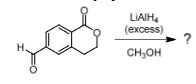
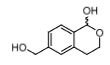
2. What is the major product from the following reaction? (3%)(A) (B) (C)(D) (E)
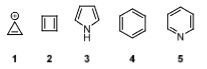
3. Identify all the aromatic compounds. (3%)(A) only 4 (B) 4 and 5 (C) 2, 4, and 5 (D) 1, 3, 4, and 5 (E) 1, 2, 3, 4, and 5
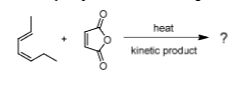
4. Identify the product of the following Diels-Alder reaction. (3%)(A) (B) (C)(D) (E)
5. Which of the following alkene gives the greatest heat upon hydrogenation? (3%)(A)1,3-pentadine (B) 1-pentene (C) trans-2-pentene (D) cis-2-pentene (E) 2-methyl-2-butene
6. Which reaction conditions can complete the following transformation? (3%)(A) \( \text{H}_2 \), Pt (B) \( \text{H}_2 \), Lindlar's catalysts (C) \( \text{NaBH}_4 \) (D) 9-BBN, \( \text{CH}_3\text{CO}_2\text{H} \) (E) Li, \( \text{NH}_3 \), \( -78 \, ^\circ\text{C} \)
7. List the following compounds in the order from the highest boiling point to the lowest boiling point. (3%)(A) 3 > 2 > 1 > 4 (B) 2 > 3 > 1 > 4 (C) 1 > 2 > 3 > 4 (D) 3 > 1 > 4 > 2 (E) 1 > 3 > 2 > 4
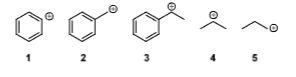
8. Arrange the stability of the following carbocation in order of decreasing stability. (4%)
 阿摩線上測驗
登入
阿摩線上測驗
登入
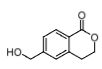 (B)
(B) 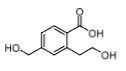 (C)
(C)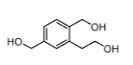
 (E)
(E)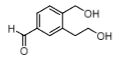
 (B)
(B) (C)
(C)
 (E)
(E)