所屬科目:研究所、轉學考(插大)◆普通化學
1. Which of the following is the correct order of boiling points for NaNO3, CH3OH, C3H8, and He? (A) He > C3H8 > CH3OH > NaNO3 (B) NaNO3 > CH3OH > He > C3H8 (C) NaNO3 > CH3OH > C3H8 > He (D) NaNO3 > C3H8 > CH3OH > He (E) CH3OH > NaNO3 > C3H8 > He
2. Which of the following has the largest radius? (A) Ar (B) K + (C) S 2– (D) Cl– (E) Ca2+
3. Which of the following is nonpolar? (A) CS2 (B) NCl3 (C) SF4 (D) IF3 (E) Cl2O
4. Which of the compounds below is an example of a network solid? (A) S8(s) (B) NaCl(s) (C) MgO(s) (D) SiO2(s) (E) C25H52(s)
5. Based on electronegativities, which of the following would to be the most ionic? (A) CO2 (B) N2 (C) CH4 (D) CF4 (E) CaF2
6. Consider three 1.0 L flasks at STP. Flask H2 contains gas, flask B contains Ar gas, and flask C contains N2 gas. In which flask do the gas particles have the lowest average kinetic energy? (A) flask B (B) The gas particles in all of the flasks have the same average kinetic energy. (C) The gas particles in two of the flasks have the same average kinetic energy. (D) flask C (E) flask A
7. A cylinder is fitted with a movable piston. The pressure inside the cylinder is Pi and the volume is Vi. What is the new pressure in the system when the piston decreases the volume of the cylinder by half? (A) 2ViPi (B) 2Pi (C) (1/4)Pi (D) (1/2)Pi (E) Pi2
8. Which of the following ionic compounds has the largest lattice energy; that is, which has the lattice energy most favorable to a stable lattice? (A) LiF (B) LiI (C) CsF (D) MgO (E) CsI
9. Consider the reaction between 45.0 mL of 0.200 M sodium hydroxide and 75.0 mL of 0.100 M HCl. Which of the following statements is correct? (A) The NaOH is the limiting reactant. (B) After the reaction, the concentration of Na+ is greater than the concentration of OH– . (C) After the reaction, the concentration of Na+ is equal to the concentration of Cl– . (D) After the reaction, the concentration of Na+ is still 0.200 M because Na+ is a spectator ion. (E) None of these are correct.
10. Which pair of ions would not be expected to form a precipitate when dilute solutions of each are mixed? (A) Ni2+ , SO4 2– (B) Ag+ , Cl– (C) Co2+ , PO4 3– (D) Cu2+ , OH– (E) Ni2+ , S 2–
11. Which of the following statements is(are) true? (A) In exothermic reactions, the reactants are lower in potential energy than the products. (B) The heat of reaction and change in enthalpy can always be used interchangeably. (C) Enthalpy is a state function. (D) A chemist takes the point of view of the surroundings when determining the sign for work or heat. (E) At least two of these statements are true.
12. Calculate the work (wAB) when 1.00 mol of a monatomic ideal gas undergoes a process from state A (3.00 atm, 20.0 L) to B (1.00 atm, 20.0 L). (A) 0 (B) 30 L•atm (C) –30 L•atm (D) 90 L•atm (E) –90 L•atm
13. In the provided phase diagram of compound Y, what is the possible melting point for Y? (A) 0 °C (B) 62 °C (C) 15 °C (D) 40 °C (E) 19 °C
(a) FeSO4 ________ ;
(b) Ca(OH)2 ________ ;
(c) KNO2 ________ ;
(d) NiCO3 ________ ;
(e) NaC2H3O2 ________ ;
(f) aluminum oxide ________ ;
(g) ammonium ion ________ ;
(h) perchloric acid ________ ;
(i) copper(II) bromide ________ ;
(j) sodium phosphate _____
15. 1.00 mL of a 3.50 × 10⁻⁴ M solution of sucrose is diluted with 9.00 mL of H2O, forming solution A. 2.00 mL of solution A is diluted with 8.00 mL of H2O, forming solution B. How many grams of glucose are in 5.00 mL of solution B? (molar mass for glucose = 342.3 g/mol) (5 points)
(a) CO2
(b) I3 –
(c) CH4
(d) SF6
17. Balance the following unbalanced equation (4 points) C4H10 + O2 → CO2 + H2O
18. Balance the following redox reaction in acidic aqueous solution. (4 points) ClO3 – + Fe2+ → Cl– + Fe3+
σ2p* _______
π2p* _______ _______
π2p _______ _______
σ2s* _______
σ2s _______
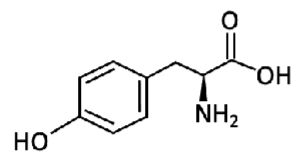
20. How many sigma and pi bonds are present in the tyrosine molecule? (2 points)
21. Utilizing the provided information, calculate ΔH°f for PbO(s). (3 points) PbO(s) + CO(g) → Pb(s) + CO2(g), ΔH° = –131.4 kJ ΔH°f for CO2(g) = –393.5 kJ/mol ΔH°f for CO(g) = –110.5 kJ/mol
 阿摩線上測驗
登入
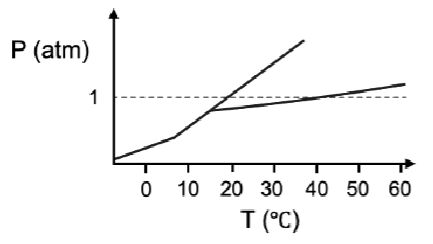 (A) 0 °C (B) 62 °C (C) 15 °C (D) 40 °C (E) 19 °C