所屬科目:研究所、轉學考(插大)◆普通化學
1. ( ) Which among the following represent a set of isotopes? Atomic nuclei containingI. 20 protons and 20 neutrons.II. 21 protons and 19 neutrons.III. 22 neutrons and 18 protons.IV. 20 protons and 22 neutrons.V. 21 protons and 20 neutrons.(A) I, V (B) III, IV (C) I, II, III(D) I, IV and II, V (E) No isotopes are indicated.
2. ( ) How many molecules of ammonia are present in 6.9 g of ammonia? (atomic mass: N= 14.01, H= 1.01) (A) \( 6.7 \times 10^{-25} \) (B) \( 4.1 \times 10^{1} \) (C) \( 8.3 \times 10^{23} \) (D) \( 4.2 \times 10^{24} \) (E) \( 2.4 \times 10^{23} \)
3. ( ) In the reaction 2A + 3B → C4.0 mol A react with 4.0 mol B. Which reactant is limiting?(A) A is limiting because there are 2 mol of it but 4.0 mol are needed.(B) B is limiting because there are 4.0 mol of it but 6.0 mol are needed.(C) A is limiting because 2 is smaller than 3 (the coefficients in the balancedequation).(D) Neither is limiting because equal amounts (4.0 mol) of each reactant are used.(E) B is limiting because 3 is larger than 2 (the coefficients in the balanced equation).
4. ( ) Which pair of ions would not be expected to form a precipitate when dilute solutions of each are mixed? (A) \( \text{Ni}^{2+} \), \( \text{SO}_4^{2-} \) (B) \( \text{Ni}^{2+} \), \( \text{S}^{2-} \) (C) \( \text{Cu}^{2+} \), \( \text{OH}^- \) (D) \( \text{Co}^{2+} \), \( \text{PO}_4^{3-} \) (E) \( \text{Ag}^+ \), \( \text{Cl}^- \)
5. ( ) Calculate the concentration of NaOH if 19.0 mL reacts exactly with 24.6 mL of 0.397 M HCl.(A) 0.257 M (B) 0.307 M (C) 0.514 M(D) 1.028 M (E) 0.397 M
6. ( ) In the reaction \( \text{Zn} + \text{H}_2\text{SO}_4 \rightarrow \text{ZnSO}_4 + \text{H}_2 \), which element, if any, is oxidized? (A) zinc (B) hydrogen (C) oxygen (D) sulfur (E) none of these
7. ( ) Which of the following statements is(are) true?Oxidation and reductionI. cannot occur independently of each other.II. accompany all chemical changes.III. describe the loss and gain of electron(s), respectively.IV. result in a change in the oxidation states of the species involved.(A) I only (B) II only (C) III only(D) IV only (E) I, III, and IV
8. ( ) Which of the following statements is(are) true?(A) In exothermic reactions, the reactants are lower in potential energy than theproducts.(B) The heat of reaction and change in enthalpy can always be used interchangeably.(C) Enthalpy is a state function.(D) A chemist takes the point of view of the surroundings when determining the sign forwork or heat.(E) At least two of these statements are true.
9. ( ) Which of the following combinations of quantum numbers is not allowed?(A) n= 4, l= 0, m(l)= 0, m(s)= –1/2(B) n= 5, l= 3, m(l)= 1, m(s)= –1/2(C) n= 4, l= 1, m(l)= 1, m(s)= 1/2(D) n= 3, l= 1, m(l)= 0, m(s)= 1/2(E) n= 3, l= 3, m(l)= 0, m(s)= -1/2
10. ( ) What is the electron configuration for the chromium atom? (A) [Kr] 4s13d5 (B) [Ar] 4s23d4 (C) [Kr] 4s23d4 (D) [Ar] 4s13d5 (E) none of these
11. ( ) Which of the following statements is incorrect?(A) A molecule with very polar bonds can be nonpolar.(B) Ionic bonding results from the transfer of electrons from one atom to another.(C) Dipole moments result from the unequal distribution of electrons in a molecule.(D) Linear molecules cannot have a net dipole moment.(E) The electrons in a polar bond are found nearer to the more electronegativeelement.
12. ( ) Which of the following groups contains no ionic compounds? (A) KH, SrF2, NaNH2 (B) KOH, CBr4, SF4 (C) HCN, NO2, Sr(NO3)2 (D) CH2O, H2O, NBr3 (E) PCl5, LiBr, Zn(OH)2
13. ( ) Which of the following molecules has a dipole moment? (A) SF4 (B) CF4 (C) XeF4 (D) All of these have a dipole moment. (E) None of these has a dipole moment.
14. ( ) Specify the hybridization of the nitrogen atom in each of the following, in order. \( \text{NO}_3^- \quad \text{N}_2 \quad \text{NO}_2^- \) (A) \( \text{sp}^2, \text{sp}, \text{sp}^2 \) (B) \( \text{sp}^3, \text{sp}, \text{sp} \) (C) \( \text{sp}^2, \text{sp}, \text{sp}^3 \) (D) \( \text{sp}^3, \text{sp}^2, \text{sp}^3 \)(E) none of these
15. ( ) Which of the following is the correct order of boiling points for NaNO3, CH3OH, C3H8, and He? (A) He < C3H8 < NaNO3 < CH3OH (B) He < C3H8 < CH3OH < NaNO3 (C) He < CH3OH < C3H8 < NaNO3 (D) NaNO3 < CH3OH < C3H8 < He (E) C3H8 < He < CH3OH < NaNO3
16. ( ) Rank the following compounds according to increasing solubility in water. I. CH3CH2CH2CH3 II. CH3CH2OCH2CH3 III. CH3CH2OH IV. CH3OH (A) I < II < IV < III (B) I < III < IV < II (C) I < II < III < IV (D) III < IV < II < I (E) None is correct.
17. ( ) Consider a solution of \( 2.0\ M\ \text{HCN} \) and \( 1.0\ M\ \text{NaCN} \) (\( K_{\text{a}} \) for \( \text{HCN} = 6.2 \times 10^{-10} \)). Which of the following statements is true? (A) The solution is not a buffer because \( [\text{HCN}] \) is not equal to \( [\text{CN}^-] \). (B) \( [\text{OH}^-] > [\text{H}^+] \) (C) The \( \text{pH} \) will be below \( 7.00 \) because the concentration of the acid is greater than that of the base. (D) The buffer will be more resistant to \( \text{pH} \) changes from addition of strong acid than to \( \text{pH} \) changes from addition of strong base. (E) All of these statements are false.
18. ( ) The following two half-reactions take place in a galvanic cell. At standard conditions, whatspecies are produced at each electrode?\[ \text{Sn}^{2+} + 2\text{e}^- \rightarrow \text{Sn} \quad\quad E^\circ = -0.14 \text{ V} \]\[ \text{Cu}^{2+} + 2\text{e}^- \rightarrow \text{Cu} \quad \quad E^\circ = 0.34 \text{ V} \](A) Sn is produced at the cathode, and Cu2+ is produced at the anode. (B) Cu is produced at the anode, and Sn2+ is produced at the cathode. (C) Cu is produced at the cathode, and Sn2+ is produced at the anode. (D) Sn is produced at the anode, and Cu is produced at the cathode. (E) Sn is produced at the anode, and Cu2+ is produced at the cathode.
19. ( ) The standard potential for the reaction \( \text{Zn} + 2\text{Ag}^+ \rightarrow \text{Zn}^{2+} + 2\text{Ag} \) is 1.56 V. Given that the standard reduction potential for \( \text{Ag}^+ + \text{e}^- \rightarrow \text{Ag} \) is 0.80 V, determine the standard reduction potential for \( \text{Zn}^{2+} + 2\text{e}^- \rightarrow \text{Zn} \). (A) 0.04 V (B) -0.38 V (C) -0.76 V (D) 0.76 V (E) none of these
20. ( ) In which case must a reaction be spontaneous at all temperatures?(A) ΔS = 0, ΔH is positive(B) ΔH is negative, ΔS is positive(C) ΔH = 0, ΔS is negative(D) ΔH is positive, ΔS is positive(E) none of these
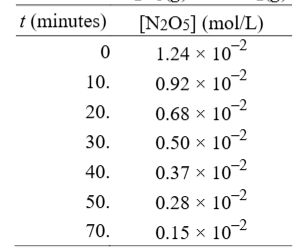
21. ( ) For the reaction \( 2\text{N}_2\text{O}_5(g) \rightarrow 4\text{NO}_2(g) + \text{O}_2(g) \), the following data were collected.t (minutes) [N2O5] (mol/L)The half-life of this reaction is approximately _______.(A) 18 min (B) 36 min (C) 15 min(D) 23 min (E) 45 min
22. Name the following compounds in English. (10 points)(A) Fe2PO4 (B) BaBr2 (C) Li2O (D) HF (E) K2SO4
23. The ion \( _{25}^{54}\text{Mn}^{2+} \) has (a) ________ protons, (b) ________ neutrons, and (c) ________ electrons. (6 points)
24. Balance the following chemical equation: C6H14 + O2 → CO2 + H2O. (4 points)
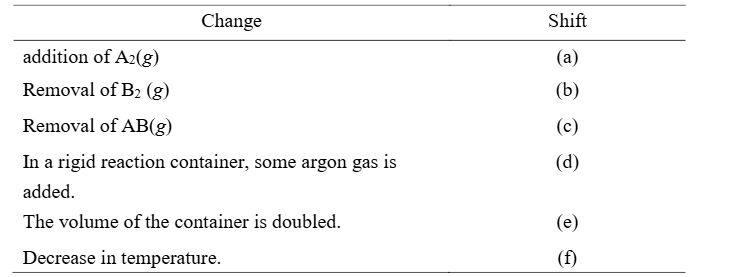
25. In which direction will the position of the equilibrium\[ 2\text{AB}(g) \rightleftharpoons \text{A}_2(g) + \text{B}_2(g) \text{ , exothermic reaction} \]be shifted for each of the following changes? Fill the blanks (a-f) in the following table. (6 points)
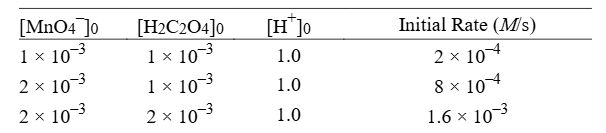
26. The following initial rate data were found for the reaction (8 points)\[ 2\text{MnO}_4^- + 5\text{H}_2\text{C}_2\text{O}_4 + 6\text{H}^+ \rightarrow 2\text{Mn}^{2+} + 10\text{CO}_2 + 8\text{H}_2\text{O} \](a) What is the rate law?(b) Calculate the rate constant.
27. Element A exists in two crystalline forms, rhombic and monoclinic. Using the following data,calculate the temperature at which monoclinic A and rhombic A are in equilibrium. (3 points)
 阿摩線上測驗
登入