所屬科目:學士後西醫-普通生物及生化概論
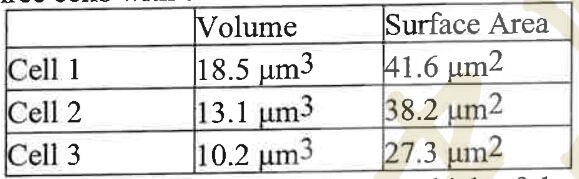
2. Three cells with distinct volumes and surface arcas are listed in the following table:Based on data from the table above, which of the following statements "best" explains which cell will 10.2um3 Cell 3 27.3 um2 eliminate wastes most inefficiently? (A) Cell 1 because it has the lowest ratio of surface area to volume, which will enable it to eliminate its wastes most inefficiently. (B) Cell 2 because it has the highest ratio of surface area to volume, which will enable it to climinate its wastes most inefficiently. (C) Cell 3 because it has the smallest volume, which will cnable it to eliminate its wastes most inefficiently. (D) Cell 3 because it has the smallest surface area, which will enable it to eliminate its wastes most inefficiently.
51. Which of the following statements about diseases associated with mitochondrial gene mutations and affected electron transport chain complexes are incorrect? (A) Leigh Syndrome causes difficulty swallowing and decreased motor abilities→only complex I (B) Hypertrophic cardiomyopathy results in cardiac enlargement and degeneration→ only complex III and IV (C) Pearson Syndrome leads to sideroblastic anemia → only complex I and IV (D) Kearns-Sayre syndrome causes ophthalmoplegia and ragged red fibers →only complex I and IV and IV
56. Which of the following statements are incorrect in describing a biochemical process or phenomenon related to ketone bodies? (A) Legal reaction allows the testing of acetoacetate and nitroferricyanide's purple complex under acidic conditions. (B) In acute diabetic ketoacidosis, the ratio of β-hydroxybutyrate: acetoacetate=10:1 in plasma. (C)During starvation, a low ratio of NADHNAD+ inhibits the ICA cycle and increases ketone body production. (D) in the brain, one acetoacetate molecule yields two acety1 CoA molecules, resulting in 24 ATP production at the end of the TCA cycle.
60. Which pairs of the disease correlated the hormone metabolism are correct? (A) Conn syndrome - progesterone →→aldosterone (B) Cussing syndrome - 17-a-hydroxyprogesterone →→cortisol (C) Benign prostatic hyperplasia - testosterone →→ dihydrotestosterone (D) Virilism - pregnenolone →→ 11-deoxycorticosterone
 阿摩線上測驗
登入