所屬科目:研究所、轉學考(插大)-經濟學
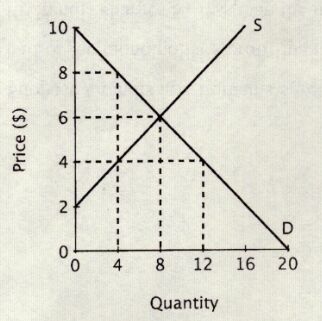
If a price ceiling were imposed at $4, what would be the consumer surplus? (10%)
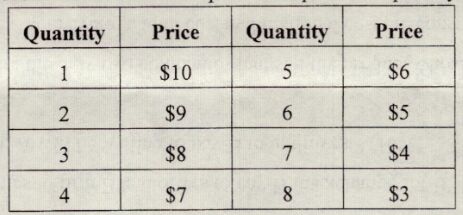
2. Suppose the accompanying table describes the relationship between price and quantity demanded for a monopolist. If the marginal cost of producing each unit of output is $5, then how much per unit would this monopolist charge to maximize his/her profit? (10%)
3. Island Bikes, a profit-maximizing firm, is the only bike rental company in a small resort town. The marginal cost for Island Bikes of renting out a bike is $3, and Island Bikes has no fixed costs. Each day Island Bikes has six potential customers, whose reservations prices are listed as below. Suppose Island Bikes knows that customers whose reservation prices are at least $10 always rent bikes before noon, while those whose reservation prices are below $10 never do so. If Island Bikes charges a different price in the morning and in the afternoon, then what will be the total economic surplus? (10%)
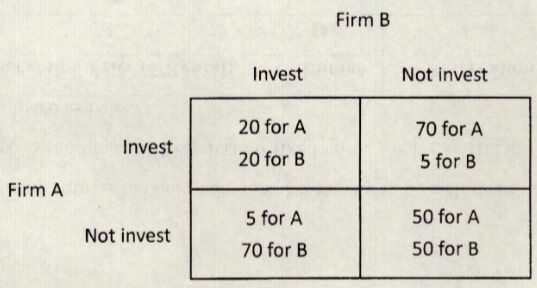
4. The payoff matrix below shows the payoffs (in millions of dollars) for two firms, A and B, for two different strategies, investing in new capital or not investing in new capital. An industry spy from firm A comes to firm B and offers to pay B in exchange for B's certain and enforceable promise to not invest. What is the most that firm A will be willing to pay B to not invest? (10%)
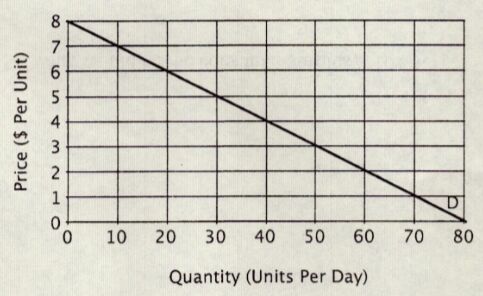
5. Suppose Grandis and Immanis are the only two companies that sell the product whose market demand curve is shown in the figure below. For both companies, both average total cost and marginal cost are constant and equal to $2 (ATC = MC = $2). Suppose Grandis and Immanis agree to collude by both charging the price a monopolist would charge and each producing half of the monopolist's profit-maximizing level of output. However, Grandis decides to cheat on the collusive agreement. If Grandis charges $1 less than the monopoly price while Immanis continues to charge the monopoly price, then how many profits will Grandis will earn per day? (10%)
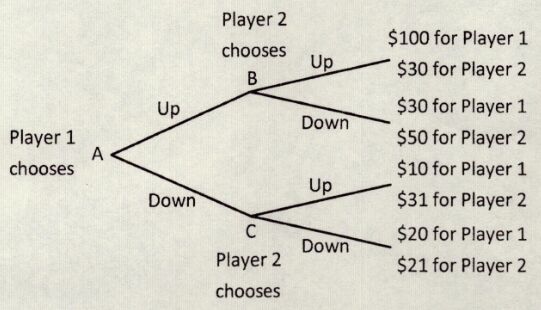
6. Player 1 and Player 2 are playing a game in which Player 1 has the first move at A in the decision tree shown below. Once Player 1 has chosen either Up or Down, Player 2, who can see what Player 1 has chosen, must choose Up or Down at B or C. Both players know the payoffs at the end of each branch. Suppose Player 1 and Player 2 enter into a binding agreement in which Player 1 agrees to pay Player 2 a fixed amount of money to get Player 2 to play Up when it is Player 2's turn. How much will Player 1 have to pay Player 2 to get Player 2 to play Up? (10%)
7. Two companies, Dirty Inc. and Filthy Inc., have access to 5 different production processes, each of which has a different cost and produces a different amount of pollution. The daily costs of the processes and the number of tons of smoke emitted are shown in the table below. Suppose pollution is initially unregulated. If the City Council imposes a tax of $91 per day on each ton of smoke emitted, then what will be the total cost to society of the resulting reduction in pollution? (10%)
8. Suppose there are three power-generating plants, each of which has access to 5 different production processes. The table below summarizes the cost of each production process and the corresponding number of tons of smoke emitted each. Suppose the government decides to impose a tax on each ton of smoke emitted. What would be the lowest tax, in whole dollars, that would reduce emissions to 6 tons per day? (10%)
9. Larry has to select one graduate school out of the three that he got accepted to. Larry was not offered for any financial aid from Elite U, which charges $50,000 annually. Larry places a $60,000 annual value on attending Elite U. Larry was awarded an annual $10,000 scholarship by State College, which charges $30,000 per year. Larry considers State College to be worth $40,000 a year. NoName U costs $20,000 per year, and offered Larry a full $20,000 annual scholarship. Larry values attending NoName at $15,000 per year. What is Larry's opportunity cost of attending State College? (10%)
10. A firm pays Pam $40 per hour to assemble personal computers. Each day, Pam can assemble 4 computers if she works 1 hour, 7 computers if she works 2 hours, 9 computers if she works 3 hours, and 10 computers if she works 4 hours. Pam cannot work more than 4 hours a day. Each computer consists of a motherboard, a hard drive, a case, a monitor, a keyboard, and a mouse. The total cost of these parts is $600 per computer. If the firm sells each computer for $625, then how many hours a day should the firm employ Pam to maximize the firm's net benefit from her employment? (10%)
 阿摩線上測驗
登入

 Suppose pollution is initially unregulated. If the City Council imposes a tax of $91 per day on each ton of smoke emitted, then what will be the total cost to society of the resulting reduction in pollution? (10%)
