所屬科目:研究所、轉學考(插大)-經濟學
1. A student quits a job paying $5,000 a month to prepare for a Master's entrance exam. In economics, this $5,000 is referred to as: (A) Opportunity Cost (B) Sunk Cost (C) Marginal Utility (D) Variable Cost
2. The government imposes a "Carbon Tax" or environmental levy on factories that discharge wastewater into rivers: (A) To solve adverse selection caused by asymmetric information. (B) To increase the marginal returns of the firm. (C) To internalize externalities. (D) To implement a price ceiling to protect consumers.
3. A software company incurs high fixed costs to develop a product, but as the number of users increases, the average total cost per user drops significantly: (A) The industry exhibits economies of scale. (B) The industry faces diminishing marginal product. (C) It proves the company has an Absolute Advantage. (D) It is evidence of unfair competition.
4. A restaurant keeps hiring more chefs while the kitchen size and equipment remain fixed. Eventually, the additional output produced by each new chef begins to fall. This illustrates: (A) Economy of scale. (B) The law of diminishing marginal returns. (C) Negative externalities in the workplace. (D) Increasing average fixed costs.
5. A firm in a competitive labor market finds that the marginal product of labor of the last worker hired is 5 units, and the product price is $20. If the current market wage is $120, the firm should: (A) Hire more workers to increase total revenue. (B) Fire workers because the marginal revenue product is less than the wage. (C) Maintain the current workforce because profit is being made. (D) Increase the price of the product.
6. Consider a Duopoly where two firms (A and B) choose between "High Price" and "Low Price." If both choose High, they earn $100 each. If both choose Low, they earn $40 each. If one chooses Low while the other stays High, the Low-price firm earns $120 and the High-price firm earns $10. What is the Nash Equilibrium of this simultaneous game? (A) Both firms choose High Price. (B) Both firms choose Low Price. (C) Firm A chooses High; Firm B chooses Low. (D) There is no pure-strategy Nash Equilibrium.
7. The cross-price elasticity of demand between Product A and Product B is -1.5. If the price of Product B increases by 10%, what will happen to the demand for Product A and the nature of their relationship? (A) Demand for A increases by \( 15\% \); they are substitutes. (B) Demand for A decreases by \( 15\% \); they are complements. (C) Demand for A decreases by \( 1.5\% \); they are complements. (D) Demand for A increases by \( 15\% \); they are normal goods.
8. According to the Coase Theorem, private parties can solve the problem of externalities without government intervention if: (A) Transaction costs are low and property rights are clearly defined. (B) The government imposes a Pigovian tax equal to the marginal external cost. (C) The polluter is legally required to pay for all damages regardless of cost. (D) The number of affected parties is large enough to ensure a fair outcome.
9. If the provision of national defense were left entirely to the private market, it would be under-provided primarily because: (A) The marginal cost of providing defense to an additional citizen is extremely high, making it unprofitable for private firms. (B) The marginal social benefit of defense is the horizontal sum of all individual demand curves, which private firms cannot calculate. (C) The government possesses an absolute advantage in military technology, creating an insurmountable barrier to entry for private firms. (D) Individual willingness to pay cannot be captured by a market price, as consumers have no incentive to reveal their true valuation of the good.
10. Consider the market for "Inferior Good X." Assume the following three events happen simultaneously: ✓ Consumer average income levels significantly increase. ✓ A new production technology is adopted that reduces the marginal cost of producing Good X. ✓ The price of a complementary good for X decreases. Which of the following is true regarding the new equilibrium? (A) The equilibrium price will definitely decrease, but the effect on quantity is ambiguous. (B) The equilibrium quantity will definitely increase, but the effect on price is ambiguous. (C) The equilibrium price will definitely increase, but the effect on quantity is ambiguous. (D) Both the equilibrium price and quantity are ambiguous without knowing the magnitude of the shifts.
1. Unlike a perfectly competitive firm, for a monopolistically competitive firm (A) marginal revenue = marginal cost at the profit maximizing output. (B) price ≠ marginal revenue for all output levels. (C) price ≠ average revenue for all output levels. (D) price ≠ marginal cost for all output levels.
2. Assume that the medical screening industry is perfectly competitive. Consider a typical firm that is making short-run losses. Suppose the medical screening industry runs an effective advertising campaign which convinces many people that yearly CT scans are critical for good health. How will this affect a typical firm that remains in the industry? (A) The firm's supply curve shifts right and its marginal revenue curve shifts upwards as the market price rises and ultimately the firm starts making profits. (B) The firm's marginal revenue curve and average cost curve shift upwards in response to the increase in market price and advertising expenditure. The firm increases output until it starts breaking even. (C) The marginal revenue curve shifts upwards, the firm's output increases along its marginal cost curve, it expands production and eventually starts making profits. (D) The marginal revenue curve shifts upwards, the firm's output increases along its marginal cost curve, it expands production until it breaks even.
3. Suppose a monopolistically competitive firm sells 25 units at a price of $10. Calculate its marginal revenue per unit of output if it sells 5 more units of output when it reduced its price to $9. (A) $20 (B) $2.50 (C) $4 (D) $270
4. A Herfindahl-Hirschman Index is calculated by (A) Summing the amount of sales by the four largest firms and dividing by total industry sales. (B) Summing the advertising expenditures of the firms that want to merge by total industry advertising expenditures. (C) Dividing the number of firms wanting to merge by the total number in the industry. (D) Summing the squares of the market shares of each firm in the industry.
5. Suppose two firms in a duopoly implicitly collude and charge a high price. How might each firm benefit from advertising that it will match the lowest price offered by its competitor? (A) The advertisement ensures that the other firm does not cheat. If a firm cheats on the agreement and charges the lower price, the rival firm will retaliate by doing the same. (B) The offer to match prices is a way of signaling to antitrust authorities that the firms are not engaged in illegal collusion. (C) The offer to match prices is a way of deterring entry by other large firms, thereby keeping the market share of the existing firms intact. (D) The advertisement is meant to suggest to consumers that the offered price is the lowest price available.
6. Each member of OPEC can increase its income by selling more oil than its output quota because (A) By selling more at OPEC's cartel price, a member will automatically earn more income. (B) The demand for oil is inelastic, total revenue increases. (C) The demand for oil is perfectly elastic. (D) Each member's demand is more elastic than the total demand for oil.
7. A Big Mac costs $2.40 in the U.S. and 4.60 reals in Brazil. If the exchange rate is 2 reals per dollar, purchasing power parity predicts that (A) The dollar will appreciate as the demand for dollars rises in the long run. (B) The dollar will appreciate as the supply of dollars falls in the long run. (C) The dollar will depreciate as the demand for dollars falls in the long run. (D) The dollar will depreciate as the supply of dollars rises in the long run.
8. Home Depot sells new and used doors to contractors who build new homes. Home Depot also sells new and used doors to homeowners. Which of the following would be counted in GDP? (A) The sale of a used door to a homeowner. (B) The sale of a new door to homeowner. (C) The sale of a used door to contractor for installation into a new home. (D) The sale of a new door to contractor for installation into a new home.
9. Minimum wage laws cause unemployment because the legal minimum wage is set (A) Below the market wage, causing labor demand to be greater than labor supply. (B) Below the market wage, causing labor demand to be less than labor supply. (C) Above the market wage, causing labor demand to be greater than labor supply. (D) Above the market wage, causing labor demand to be less than labor supply. (E) Too low.
10. Suppose the Fed decreases the money supply. In response households and firms will ______ short term assets and this will drive ______ interest rates. (A) buy; up (B) buy; down (C) sell; up (D) sell; down
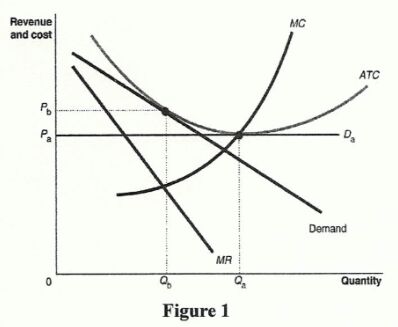
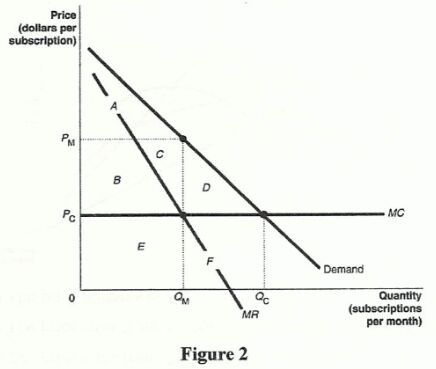
1. Figure 1 demonstrates that (A) In the short run, the monopolistic competitor produces an output \( Q_{b} \) but in the long run after it adjusts its capacity, it will produce the allocatively efficient output, \( Q_{a} \). (B) It is not possible for a monopolistic competitor to produce the productively efficient output level, \( Q_{a} \), because of product differentiation. (C) It is possible for a monopolistic competitor to produce the productively efficient output level, \( Q_{a} \), if it is willing to lower its price from \( P_{b} \) to \( P_{a} \). (D) In the long run, the monopolistic competitor produces the minimum-cost output level, \( Q_{a} \), but in the short run its output of \( Q_{b} \) is not cost minimizing. Figure 2 In 2025, New Taipei City's Franchise and Concession Review Committee granted permission to firm A to enter the market for cable TV, ending the monopolies of firms B and C. Figure 2 shows the cable television market in New Taipei City.
2. Refer to Figure 2. What is the size of the deadweight loss prior to firm A entering the market and what happens to this deadweight loss after firm A does enter the market? (A) The deadweight loss of area \( D \) is converted to consumer surplus. (B) The deadweight loss of area \( C + D \) is converted to consumer surplus. (C) The deadweight loss of area \( D \) is converted to producer surplus. (D) The total deadweight loss is the area \( D + F \); \( D \) is converted to consumer surplus and \( F \) to producer surplus.
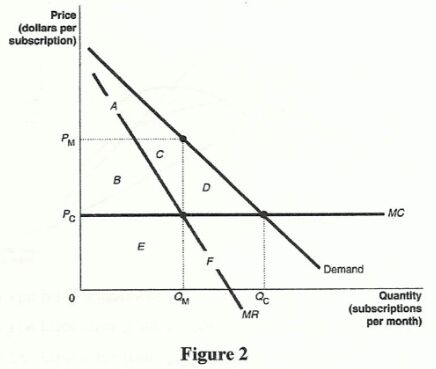
3. Refer to Figure 2. Suppose the local government imposes a $2.50 per month tax on cable companies. What happens to the price charged by the cable company following the imposition of this tax? (A) The price rises from \( P_{\mathrm{M}} \) to \( (P_{\mathrm{M}} + \$2.50) \). (B) The price rises from \( P_{\mathrm{M}} \) but it increases by an amount less than $2.50. (C) The price rises from \( P_{\mathrm{M}} \) but it increases by an amount greater than $2.50 to reflect the monopoly's markup. (D) The price remains at \( P_{\mathrm{M}} \)
4. Refer to Figure 3. What is the monopolist's profit at the profit-maximizing output level? (A) $1,600 (B) $1,000 (C) $850 (D) $600
5. Refer to Figure 3. If this industry was organized as a perfectly competitive industry, what would be the profit-maximizing quantity? (A) 50 (B) 70 (C) 80 (D) 90
1. A consumer is currently maximizing utility by consuming both Water and Diamonds. If the Marginal Utility of the last gallon of Water is 100 and its price is $1, and the price of a Diamond is $1,000, the Marginal Utility of the last Diamond purchased is ____(1)____.
2. A firm in a perfectly competitive market faces a constant market price of $60. If the firm's Total Cost function is TC = 100 + 10Q + Q². To maximize profit, the firm should produce exactly ____(2)____ units.
3. An investor, Joan, has a utility function U = W⁰·⁵, where W represents her total wealth. She is considering a risky investment where there is a 20% probability that her wealth will be $400 and an 80% probability that her wealth will be $100. To avoid the uncertainty of the investment and receive her expected wealth with certainty, the maximum risk premium Joan would be willing to pay is ____(3)____.
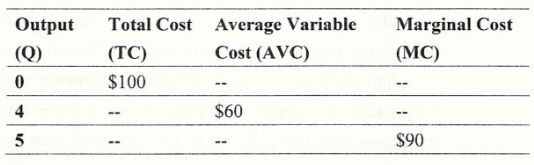
4. A firm operates with a Fixed Cost of $100. Use the cost data provided below to determine the Average Total Cost (ATC) at an output of 5 units. The Average Total Cost (ATC) for producing 5 units is: ____(4)____
5. Define asymmetric information and identify what specific information creators have that investors lack in the memecoin market. Answer in less than 5 sentences. ____(5)____
6. Explain why honest crypto project creators might leave the market even if they want to sell, and how this leads to a "death spiral" in less than 5 sentences. ____(6)____
 阿摩線上測驗
登入
 (A) In the short run, the monopolistic competitor produces an output
 (A) The deadweight loss of area
 (A) The price rises from
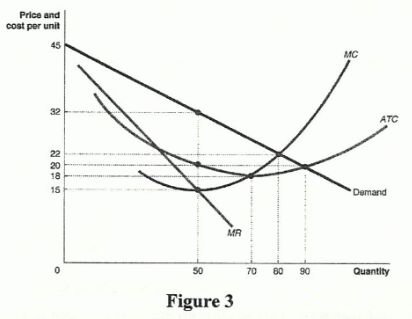 (A) $1,600 (B) $1,000 (C) $850 (D) $600
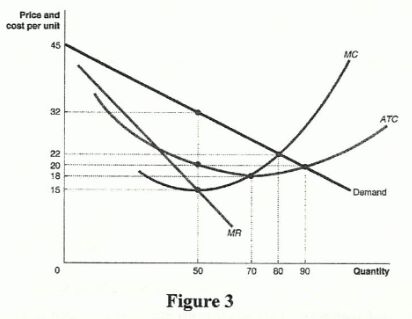 (A) 50 (B) 70 (C) 80 (D) 90