所屬科目:研究所、轉學考(插大)◆生物化學
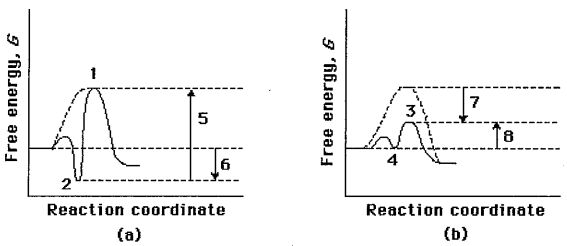
1. Compare the two reaction coordinate diagrams below and select the answer that correctly describes their relationship. In eachcase, the single intermediate is the ES complex.Free energy,
(A) Diagram (a) describes a strict "lock and key" model, whereas diagram (b) describes a transition-state complementarity model. (B) The activation energy for the catalyzed reaction is #5 in diagram (a) and is #7 in diagram (b). (C) The activation energy for the uncatalyzed reaction is given by #5 + #6 in diagram (a) and by #7 + #4 in diagram (b). (D) The contribution of binding energy is given by #5 in diagram (a) and by #7 in diagram (b). (E) The ES complex is given by #2 in diagram (a) and #3 in diagram (b).
2. Which one of the following amino acids is critical for glutathione to function as a redox buffer in cells? (A) Glutamate (B) Methionine (C) Glutamine (D) Cysteine (E) Serine
3. What is the primary cellular location for fatty acid biosynthesis in animal cells? (A) Golgi apparatus (B) Nucleus (C) Mitochondria (D) Cytoplasm (E) Lysosome
4. What are the two major proteins of muscle? (A) Myosin and Troponin C (B) Titin and Tropomyosin (C) Actin and Troponin T (D) Actin and Troponin A (E) Myosin and Actin
5. MRE11 enzyme requires Mn2+ for catalysis. When the enzyme lacks Mn2+, it would be referred to as the: (A) Substrate (B) Apoenzyme (C) Coenzyme (D) Holoenzyme (E) Prosthetic group
6. P/O ratio in electron transport and oxidative phosphorylation is defined as: (A) Molecules of phosphate released from ATP per oxygen utilized by muscle tissue. (B) Molecules of ATP formed per two electrons flowing through the electron transport chain. (C) Pi uptake per oxygen atom by mitochondria. (D) Ratio of atoms of phosphorus to oxygen in phosphate (Pi). (E) None of the above.
7. High levels of which molecule in the liver mitochondria promote ketogenesis rather than the citric acid cycle? (A) High glucose (B) High acetyl-CoA (C) High pyruvate (D) High malonyl-CoA (E) Low NADH and high citrate
8. A scientist solved a protein structure and submitted it to the Ramachandran plot (as given). Which description of structural information is correct?
(A) This protein structure is constituted of ẞ-sheets. (B) This protein structure is constituted of right-handed a-helices. (C) This protein structure is constituted of right-handed a-helices and B-sheets. (D) This protein structure is constituted of left-handed a-helices and ẞ-sheets. (E) This protein structure is constituted of an E-F hand fold.
9. Uncoupling of mitochondrial oxidative phosphorylation: (A) Allows continued mitochondrial ATP formation, but halts O2 consumption. (B) Halts all mitochondrial metabolism. (C) Halts mitochondrial ATP formation, but allows continued O2 consumption. (D) Slows down the citric acid cycle. (E) Slows the conversion of glucose to pyruvate by glycolysis.
10. Which amino acids (in one-letter code) exhibit a specific UV absorption at 280 nm? (A) WYF (B) WTR (C) LKQ (D) KHF (E) AMC
11. In the enzyme catalyzed reaction sequence below, can the E-PO4 intermediate be predicted and why?
(A) Yes, the mechanism is a double-displacement reaction. (B) Yes, the reaction fits the ping-pong model. (C) No, the reaction is random single-displacement. (D) No, the reaction is double-displacement. (E) No, the reaction is order single-displacement.
12 In the pyruvate carboxylase catalyzed reaction, bicarbonate is "activated" by attachment to the of ATP to form ______. (A) B-phosphate; carbonyl ADP (B) a-phosphate; carbonyl AMP (C) a-phosphate; carbonyl phosphate (D) y-phosphate; carbonyl phosphate (E) y-phosphate; carbonyl AMP
13. Which enzyme catalyzes the committed step of fatty acid biosynthesis? (A) Fatty acid synthase (B) HMG-CoA reductase (C) Pyruvate carboxylase (D) Thiolase (E) Acetyl-CoA carboxylase
14. Nitrate reductase reduces NO3 to NO2 with a trace element cofactor. What is this trace element? (A) Co (B) Mo (C) Mn (D) Fe (E) Sn
15. What role does adenylate cyclase play in signal transduction? (A) Activates phospholipase C (B) Converts ATP to cAMP (C) Produces IPs and DAG from phosphatidylinositol 4,5-bisphosphate (PIP2) (D) Activates protein kinase A directly (E) Converts GTP to GDP
16. A plasmid that encodes resistance to ampicillin and tetracycline is digested with the restriction enzyme EcoRI, which cuts the plasmid at a single site in the tetracycline-resistance gene. The plasmid DNA is then annealed with an EcoRI digest of human DNA, ligated, and used to transform E. coli cells. What antibiotic would you put in an agar plate to ensure that the cells of a bacterial colony contain the plasmid? (A) Ampicillin. (B) Tetracycline. (C) Ampicillin and tetracycline (D) Any antibiotic will do. (E) The agar plate should not contain any antibiotic.
17. During the oxidation of odd-chain fatty acids, the final three carbons are released.Which molecule is a required cofactor for the enzyme to produce succinyl-CoA in the final step? (A) Cobalamin (B) Riboflavin (C) Pyridoxine (D) Thiamine (E) Ascorbic acid
18. Protein X adopts a globin fold. What characteristic curve would you expect to observe in its circular dichroism (CD) spectrum?
(A) A (B) B (C) C (D) None of the above. (E) Can NOT determine.
19. The oxidation of a particular hydroxy substrate to a keto product by mitochondria has a P/O ratio of less than 2. The initial oxidation step is very likely directly coupled to the: (A) reduction of a pyridine nucleotide. (B) oxidation of a flavoprotein. (C) reduction of cytochrome aз. (D) oxidation of a pyridine nucleotide. (E) reduction of a flavoprotein.
20. Which process puts NO2 and NH3 back to N2 via a group of bacteria? (A) Nitrogen fixation (B) Denitrification (C) Assimilation (D) Anammox (E) Pegylation
21. The ion channel that opens in response to acetylcholine is an example of a ______ signal transduction system. (A) G protein (B) Ligand-gated (C) Receptor-enzyme (D) Serpentine receptor (E) Voltage-gated
22. When a cell with the pentose phosphate pathway has a need for more pentose phosphates, but not for additional NADPH: (A) Glucose-6-phosphate dehydrogenase is activated. (B) The oxidative and non-oxidative enzymes of the pentose phosphate pathway are active. (C) The non-oxidative enzymes produce pentose phosphates from fructose-6-phosphate and glyceraldehyde-3-phosphate. (D) All enzymes of glycolysis and the pentose phosphate pathway are active. (E) None of the above is true.
23. Sudden infant death syndrome has been linked in some cases to a deficiency in medium-chain acyl-CoA dehydrogenase. Which metabolic profile would you expect in a patient with this deficiency during a period of fasting? (A) Hyperglycemia and high levels of ketone bodies. (B) Hypoglycemia and high levels of ketone bodies. (C) Hypoglycemia and low levels of ketone bodies. (D) High levels of Malonyl-CoA and increased fatty acid synthesis. (E) Accumulation of Propionyl-CoA and metabolic alkalosis.
24. What biomolecule makes up Valine's side chain? (A) Pyruvate (B) Acetyl-CoA (C) Biotin (D) Glutamate (E) Glycine
25. The PCR reaction components do NOT include: (A) All four deoxynucleoside triphosphates. (B) DNA template containing the sequence to be amplified. (C) Heat-stable DNA polymerase. (D) DNA ligase. (E) Oligonucleotide primer(s).
26. Glucose labeled with in C-3 and C-4 is completely converted to acetyl-CoA via glycolysis and the pyruvate dehydrogenase complex. What percentage of the acetyl-CoA molecules formed will be labeled with , and in which position of the acetyl moiety will the label be found? (A) 100% ofthe acetyl-CoA will be labeled at C-1 (carboxyl). (B) 100% of the acetyl-CoA will be labeled at C-2. (C) 50% of the acetyl-CoA will be labeled, all at C-2 (methyl). (D) No label will be found in the acetyl-CoA molecules. (E) Not enough information is given to answer this question.
27. Phosphatidic acid occupies a central position in glycerolipid metabolism. Which reaction of phosphatidic acid commits the molecule toward membrane phospholipid synthesis rather than triacylglycerol storage? (A) Dephosphorylation to diacylglycerol by phosphatidic acid phosphatase (B) Activation to CDP-diacylglycerol by CTP-dependent cytidylyltransferase (C) Acylation by acyl-CoA from 1,2-diacylglycerol (D) Hydrolysis by phospholipase C to generate second messengers (E) Translocation to lipid droplets for sequestration into neutral lipid pools
28. Which statement is NOT correct? (A) Free ammonia is non-toxic to animals. (B) Free ammonia is one of the nitrogen metabolites in animals. (C) Free ammonia competes with K+ for transport into astrocyte cells. (D) Free ammonia alters neuronal response to the neurotransmitter GABA. (E) Free ammonia results in elevated extracellular [K*] in the brain.
29. During seed germination, the glyoxylate pathway is important to plants because it enables them to:
1. Accomplish the net synthesis of four-carbon dicarboxylic acids from acetyl-CoA
2. Carry out the synthesis of glucose from acetyl-CoA.
3. Obtain glyoxylate from fatty acids.
4. Obtain acetyl-CoA from fatty acids.
5. Conversion of lipid to carbohydrate. (A) 1, 2, and 5 are correct. (B) 2 and 4 are correct. (C) Only 2 is correct. (D) 3 and 4 are correct. (E) 1 and 3 are correct.
30. Which amino acid catabolism would lead to anthranilic acid as an intermediate? (A) Phenylalanine (B) Histidine (C) Tryptophan (D) Threonine (E) Leucine
31. The technique known as yeast two hybrid analysis for detecting interacting gene products depends on: (A) Stimulation of transcription by interaction oftwo Gal4p domains via fused protein sequences. (B) Direct binding of a Gal4p activation domain to a DNA sequence in the promoter region. (C) Havinga promoter that responds directly to one of the two proteins whose interactions are being measured. (D) Hybridization of DNA segments corresponding to the two genes being examined. (E) Activation of DNA polymerase by the nearby binding of hybridizing protein complexes.
32. Which of the following statements about the chemiosmotic theory is CORREСТ ? (A) Electron transfer in mitochondria is accompanied by an asymmetric release of protons on one side of the inner mitochondrial membrane. (B) It predicts that oxidative phosphorylation can occur even in the absence of an intact inner mitochondrial membrane. (C) The effect of uncoupling reagents is a consequence of their ability to carry electrons through membranes. (D) The membrane ATP synthase has no significant role in the chemiosmotic theory. (E) All of the above are correct.
33. A marathon runner is engaged in a 42-km race. At this stage, there is a massive flux of fatty acids entering the ẞ-oxidation status. Which of the following statements regarding this regulatory transition is NOT correct? (A) Elevated levels of glucagon activate protein kinases that phosphorylate and inactivate acetyl-CoA carboxylase. (B) An increase in the cellular AMP/ATP ratio activates AMP-activated protein kinase, which further suppresses the formation of malonyl-CoA. (C) The allosteric inhibition of carnitine acyltransferase I is further relieved. (D) The change of malonyl-CoA levels allows for the translocation of acetyl-CoA to compromise the situation. (E) Enhanced fatty acyl-CoA flux increases reliance on the carnitine shuttle for translocation.
34. Which amino acid(s) biosynthesis uses erythrose 4-phosphate and phosphoenolpyruvate as starting materials? (A) Glutamate, Asparagine, Histidine (B) Histidine, Phenylalanine, Lysine (C) Arginine, Serine, Threonine (D) Phenylalanine, Tryptophan, Tyrosine (E) Methionine, Cysteine, Isoleucine
35. In DNA sequencing by the Sanger (dideoxy) method: (A) The role ofthe dideoxy CTP is to occasionally terminate enzymatic synthesis of DNA where Gs occur in the template strands. (B) Specific enzymes are used to cut the newly synthesized DNA into small pieces, which are then separated by electrophoresis. (C) The dideoxynucleotides must be present at high levels to obtain long stretches of DNA sequence. (D) The template DNA strand is radioactive. (E) Radioactive dideoxy ATP is included in each of four reaction mixtures before enzymatic synthesis of complementary strands.
36. It is crucial that regulation occurs at the pyruvate dehydrogenase because: (A) Pyruvate kinase is reversible. (B) Lactate dehydrogenase is the only other enzyme to use pyruvate. (C) The product acetyl-CoA is committed to oxidation in the citric acid cycle or fatty acid biosynthesis. (D) Alanine aminotransferase would use the pyruvate. (E) All of the above.
37. What is the primary source of NADPH used for fatty acid biosynthesis in most animal tissues? (A) The citric acid cycle. (B) The pentose phosphate pathway. (C) Glycolysis. (D) The conversion of ADP to ATP in the mitochondria. (E) Lactic acid fermentation.
38. Which statement is CORRECT ? (A) Aspartate transcarbamoylase is the key enzyme to pyrimidine nucleotide biosynthesis (B) Aspartate transcarbamoylase, the catalytic function is feedback inhibited by CMР. (C) Aspartate transcarbamoylase, the catalytic rate is enhanced in the presence of GTP. (D) Carbamoyl phosphate synthetase II is found in mitochondria. (E) The action of dihydroorotase is to open the pyrimidine ring.
39. Consider a liver cell carrying out the oxidation of glucose under aerobic conditions. Suppose we added a very potent and specific inhibitor of mitochondrial ATP synthase that completely inhibits this enzyme. Which of the following descriptions is (are) CORRECТ ?
1. The rate of oxygen consumption will increase.
2. ATP production in the cell will quickly drop to zero.
3. The citric acid cycle will speed up to compensate.
4. Mitochondrial ATP synthesis will cease, but to compensate, cells will accelerate the production of ATP by glycolysis, preventing ATP levels from dropping to zero. 5. The cell will switch to fatty acid oxidation as an alternative to glucose oxidation. (A) 1 and 5 are correct. (B) 3 and 4 are correct. (C) Only 2 is correct. (D) Only 4 is correct.(E) Only 5 is correct.
40. What is the end metabolite of the carbon catabolism of thymine? (A) Malonyl-CoA (B) HMG-CoA (C) Succinyl-CoA (D) Acetyl-CoA (E) Glutaryl-CoA
41. Which of the following statements concerning receptor enzymes is CORRECТ ? (A) They are not usually membrane-associated proteins. (B) They contain an enzyme activity that acts upon acytosolic substrate. (C) They contain an enzyme activity that acts upon the extracellular ligand. (D) They have a ligand-binding site on the cytosolic side of the membrane. (E) They have an active site on the extracellular side ofthe membrane.
42. Fructose in the diet or fructose from sucrose in the diet can be a source of calories for fat synthesis in the liver because: (A) Ketones are fattening. (B) Fructose enters glycolysis after the primary regulation point, PFK-1. (C) Fructose provides a net of four ATP from glycolysis. (D) Fructose enters the branch of glycolysis that forms fat. (E) Glycerol (the "backbone" of triacylglycerols) comes specifically from fructose.
43. Fatty acid synthesis and degradation are reciprocal processes. Which of the following statements regarding their chemical distinction is NOT correct? (A) In degradation, the fatty acyl group is esterified to the thiol group of coenzyme A, whereas in biosynthesis, the growing chain is attached to the thiol group ofthe ACP domain of fatty acid synthase. (B) Coenzyme A carries acyl units between different multi-enzyme complexes, while ACP shuttles intermediates between the active sites of a single enzyme complex. (C) The 4'-phosphopantetheine group in CoA is linked to a 3'-phospho-adenosine diphosphate, while in ACP, the same prosthetic group is linked to a highly conserved serine residue of the protein. (D) During synthesis, the initial priming requires the transfer of an acetyl group from CoA to the ACP, followed by a transfer to a cysteine residue on the ketoacyl synthase domain. (E) The hydroxyacyl intermediate in the biosynthetic pathway is the L-stereoisomer, mirroring the L-stereoisomer found in the B-oxidation pathway to maintain enzymatic compatibility.
44. For nitrogen fixation, what is the source of the reduction power? (A) (B) (C) Vitamin C (D) Vitamin B6 (E) Oxidation of pyruvate
45. The double helix of DNA in the B-form is stabilized by: (A) Covalent bonds between the 3' end of one strand and the 5' end of the other. (B) Hydrogen bonding between the phosphate groups of two side-by-side strands. (C) Hydrogen bonds between the riboses of each strand. (D) Ribose interactions with the planar base pairs. (E) Nonspecific base-stacking interaction between two adjacent bases in the same strand.
46. Which of the following descriptions about the effects of insulin is CORRECT ? (A) An elevated insulin level in the blood inhibits glycogen synthesis in the liver and muscle. (B) An elevated insulin level in the blood stimulates glycolysis in the liver. (C) An elevated insulin level in the blood inhibits glucose uptake by the liver. (D) An elevated insulin level in the blood inhibits glucose uptake by the adipose tissue. (E) An elevated insulin level in the blood stimulates glycogen breakdown in the liver.
47. Statins are a class of drugs that lower cholesterol. They are typically prescribed to people who are at high risk of cardiovascular disease. What is the secondary and long-term therapeutic effect of statins on cholesterol levels? (A) They increase the degradation of the LDL receptor. (B) They tend to bind to the cholesterol through a single proteolytic cleavage by a matrix metalloproteinase. (C) They trigger the activation of SREBP, leading to increased expression of LDL receptors. (D) They inhibit the transport of citrate out of the mitochondria. (E) They prevent the binding of Insig to SCAP regardless of cholesterol levels.
48. Regarding ribonucleotide reductase, which statement is NOT correct? (A) Glutaredoxin transfers reducing power from FADH2 to ribonucleotide reductase. (B) Ribonucleotide reductase converts ribonucleotides to deoxyribonucleotides. (C) Ribonucleotide reductase converts only NDP to dNDP. (D) The reducing power of ribonucleotide reductase comes originally from NADPH. (E) The catalytic function of ribonucleotide reductase is universal in biology.
49. In normal mitochondria, the rate of NADH consumption (oxidation) will: (A) Be increased in active muscle, and decreased in inactive muscle. (B) Be very low if the ATP synthase is inhibited, but increase when an uncoupler is added. (C) Decrease if mitochondrial ADP is depleted. (D) Decrease when cyanide is used to prevent electron transfer through the cytochrome a and a3 complex. (E) All ofthe above are true.
50. Which amino acid(s) can NOT be converted to glucose? (A) Lysine, Leucine (B) Alanine, Histidine (C) Valine, Leucine (D) Valine, Tryptophan (E) Serine, Glycine
 阿摩線上測驗
登入
 (A) This protein structure is constituted of ẞ-sheets. (B) This protein structure is constituted of right-handed a-helices. (C) This protein structure is constituted of right-handed a-helices and B-sheets. (D) This protein structure is constituted of left-handed a-helices and ẞ-sheets. (E) This protein structure is constituted of an E-F hand fold.
 (A) Yes, the mechanism is a double-displacement reaction. (B) Yes, the reaction fits the ping-pong model. (C) No, the reaction is random single-displacement. (D) No, the reaction is double-displacement. (E) No, the reaction is order single-displacement.
 (A) A (B) B (C) C (D) None of the above. (E) Can NOT determine.
 in C-3 and C-4 is completely converted to acetyl-CoA via glycolysis and the pyruvate dehydrogenase complex. What percentage of the acetyl-CoA molecules formed will be labeled with
 , and in which position of the acetyl moiety will the
 label be found? (A) 100% ofthe acetyl-CoA will be labeled at C-1 (carboxyl). (B) 100% of the acetyl-CoA will be labeled at C-2. (C) 50% of the acetyl-CoA will be labeled, all at C-2 (methyl). (D) No label will be found in the acetyl-CoA molecules. (E) Not enough information is given to answer this question.
 (B)
 (C) Vitamin C (D) Vitamin B6 (E) Oxidation of pyruvate