所屬科目:研究所、轉學考(插大)◆普通物理學
1. The Kepler's second law of planetary motion is that the line joining the sun to a planet sweeps out equal areas in equal times. Which one of the following principles is the fundamental of the Kepler's second law? (A) second law of thermal dynamics (B) Hooke's law (C) conservation of energy (D) conservation of linear momentum (E) conservation of angular momentum
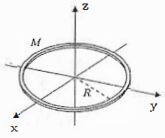
2. A ring of mass M and radius R is shown in the right. What is the moment of inertia along the x-axis? (A) πMR² (B)(C) 2MR² (D) MR² (E)
3. The position of a block attached to a string oscillates as x(t) = x₀ cos(ωt), where x₀ is the amplitude, ω is the angular frequency, and t is time. Therefore, the kinetic energy of the block is also a periodic function of time. What is the period of the kinetic energy? (A)(B)(C)(D)(E)
4. A wire is stretched from L to L + ΔL. The Young's modulus of the wire is Y and the density of the wire is ρ. What is the speed of a transverse wave propagated through the wire? (A)(B)(C)(D)(E)
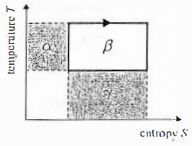
5. The Temperature(T)-Entropy(S) diagram of the Carnot cycle is shown in the right figure (solid line). What area in the T-S diagram represents the work done by the system in each cycle? (A) α (B) β (C) γ (D) α + β (E) β + γ
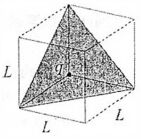
6. A charge q sits at the back corner of a cube, as shown. The length of the edge of the cube is L and the permittivity constant is ε₀. What is the flux of electric field E through the shaded surface of the figure? (A)(B)(C)(D)(E)
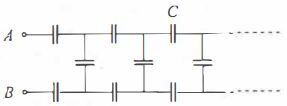
7. The pattern of capacitors of equal value C shown in the right figure is repeated indefinitely. What is the effective capacitance between the terminals A and B? (A)(B)(C)(D)(E)
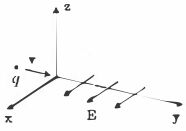
8. As shown, a charge particle q is inject into a space with uniform electric field E = E₀ x, where E₀ is the absolute value of the electric field and x is the unit vector along the x-axis. The initial velocity of the particle is v = v₀y, where y is the unit vector along the y-axis. A magnetic field B is applied into the same space to maintain the velocity of the particle. Which one of the following fields is the correct one? (A) B =(B) B = (C) B =(D) B =(E) B =
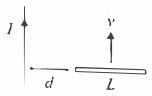
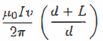
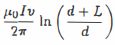
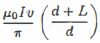
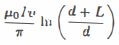
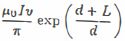
9. A long, straight wire carries a constant current I. A metal rod of length L moves at velocity v relative to the wire, as shown. The distance between the wire and rod is d. What is the potential difference between the ends of the rod? (A)(B)(C)(D)(E)
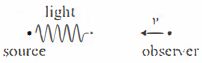
10. A light source emits a light wave with frequency ∫₀ to an observer. At the same time, the observer moves toward the light source with speed v = 1/2 c, where c is the speed of light. What is the frequency observed by the observer? (A) (B)(C) f₀ (D)(E)
11. Consider an ideal gas system. Which ones of the following physical quantities are "state variables"? (A) internal energy (B) volume (C) entropy (D) temperature (E) pressure
12. Which ones of the following statements of the second law of thermodynamics are wrong? (A) No cyclical heat engine has a greater efficiency than a reversible engine operating between the same two temperatures. (B) It is impossible for a cyclical device to transfer heat continuously from a hot body to a cold body without the input of work or other effect on the environment. (C) It is impossible for a heat engine that operates in a cycle to convert its work input completely into heat. (D) In a reversible process the entropy of an isolated system stays constant; in an irreversible process the entropy decreases. (E) In a reversible process the entropy of an isolated system increases; in an irreversible process the entropy stays constant.
13. Which ones of the following principles can be used to explain the propagation of light? (A) Fermat's principle of least time (B) Hooke's law of elasticity (C) Pauli's exclusion principle (D) Heisenberg's uncertainty principle (E) Huygens' principle of wave
14. Which ones of the following concepts must be applied to explain the features the Compton scattering effect? (A) quantization of the bound electron energy levels in atom (B) quantization of the electron spin (C) quantization of the energy of the electromagnetic field (D) quantization of the angular momentum of the electromagnetic field (E) quantization of the linear momentum of the electromagnetic field
15. Which ones of the following process are nuclear reactions? (A) alpha particle emission from ²²⁶Ra (B) proton emission from ⁸⁷Br (C) fusion of ¹H to be ⁴He (D) ionization of ¹H to be electron and proton (E) combination of H₂ and O₂ to be water
 阿摩線上測驗
登入
 (A) πMR² (B)
 (C) 2MR² (D) MR² (E)

 (B)
 (C)
 (D)
 (E)

 (B)
 (C)
 (D)
 (E)

 (A) α (B) β (C) γ (D) α + β (E) β + γ
 (A)
 (B)
 (C)
 (D)
 (E)

 (A)
 (B)
 (C)
 (D)
 (E)

 (A) B =
 (B) B =
 (C) B =
 (D) B =
 (E) B =

 (A)
 (B)
 (C)
 (D)
 (E)
 (A)
 (B)
 (C) f₀ (D)
 (E)
