所屬科目:研究所、轉學考(插大)◆經濟學原理
1. The study of how firms interact in a market is a(A) waste of time(B) normative subject(C) microeconomic topic(D) topic in political sciencee. macroeconomic topic
2. If the Consumer Price Index (CPI) increases from 100 to 200 and the nominal wage increases from$100 to $400, what is the change in the real wage in terms of the beginning year's dollars?(A) +$200(B) +$400(C) +$100(D) +$300e. -$200
3. If the prices of domestic consumer goods increased while the prices of imported consumer goodsdecreased, and the demand for each remained the same, which of the following would most likely occur?(A) The GDP price index would decrease while the CPI would increase.(B) Both the GDP price index and the CPI would decrease.(C) The GDP price index would increase more than the CPI.(D) The CPI would increase more than the GDP price index.e. Both the GDP price index and the CPI would increase by the same amount.
4. In one hour, George can fix 4 flat tires or type 200 words. His opportunity cost of fixing a flat tire is(A) 200 words(B) 4 flat tires(C) 1 word(D) 50 wordse. 800 words
5. Figure 4-16 shows five different levels of income for a particular state (in billions of dollars) and thequantity of public higher education demanded there (for a given level of tuition). What is the income elasticityof demand if income rises from $45 billion to $55 billion?(A) 1.00(B) 0.06(C) -1.00(D) 0e. none of these
6. According to the assumption of consumer rationality, a consumer who prefers one head of broccoli toone head of cauliflower, one head of cauliflower to one package of brussels sprouts, and one(A) package of brussels sprouts to one head of cabbage, must prefer a head of cabbage to ahead of cauliflower(B) package of brussels sprouts to one head of cabbage, must prefer a head of broccoli to anyother vegetable(C) package of brussels sprouts to one head of cabbage, must prefer a package of brusselssprouts to a head of cauliflower(D) package of brussels sprouts to one head of cabbage, must prefer a head of cauliflower to ahead of cabbagee. head of cabbage to one package of brussels sprouts, must prefer the package of brusselssprouts to a head of broccoli
7. If all consumers satisfy economists' assumptions regarding utility, then(A) they will each choose a consumption bundle that is inside the budget line(B) everyone will choose the same consumption bundle(C) everyone will have the same budget line(D) all consumers will react in the same way to a price changee. each person will choose a consumption bundle on his or her budget line
8. The Jones family is going to Disney World and has set a budget of $2000 for food and souvenirs. IfMr. Jones finds a $50 bill on the ground during their trip and uses it to purchase additional souvenirs, then(A) souvenirs are a normal good(B) food is an inferior good(C) the budget line has shifted to the left(D) the slope of the budget line has changede. souvenirs are a luxury good
9. The demand curve facing the firm has been estimated as follows: Which of the following statements about the firm's total revenue is correct?(A) If the firm sold 3 units of output, it would have revenues totaling $540.(B) If the firm sold 7 units of output, it would have revenues totaling $980.(C) If the firm increased output from 2 units to 3 units, total revenue would decline.(D) If the firm increased output from 6 units to 7 units, total revenue would decline.e. If the firm decreased output from 6 units to 5 units, total revenue would decline.
10. If a firm is able to cover its variable costs by operating in the short run then, at its best output level,the(A) vertical distance between MR and MC is minimized(B) vertical distance between MR and MC is maximized(C) vertical distance between TR and TC is minimized(D) marginal cost curve lies above the marginal revenue curvee. marginal cost curve is minimized
11. For the perfectly competitive firm shown in Figure 8-6,(A) profit rises when the firm raises its price and lowers its output(B) the profit-maximizing output level is 180 units(C) an economic loss occurs at the profit-maximizing output level(D) the profit-maximizing output level is 100 unitse. the firm will earn short-run profits
12. The minimum short-run average total cost for Tony's Barbecue equals $8.50 at an output level of 100meals per day. The market price of each meal is $8. In short-run equilibrium, Tony(A) will suffer an economic loss of $50 per day, serving 100 meals per day(B) cannot avoid an economic loss and should produce where the difference between average total cost andthe price is minimized(C) cannot avoid an economic loss and should serve no meals per day(D) will suffer an economic loss greater than $50 per day, serving more than 100 meals per daye. will suffer an economic loss greater than $50 per day, serving less than 100 meals per day
13. The entry of new firms into a perfectly competitive market in the long run is most likely the result of(A) temporarily above-normal profit, despite the presence of barriers to entry(B) continued above-normal profit, despite the presence of barriers to entry(C) temporarily above-normal profit, combined with the absence of barriers to entry(D) continued above-normal profit, combined with the absence of barriers to entrye. either temporarily or continued above-normal profit, despite the presence of barriers toentry
14.If the perfectly competitive firm pictured in the above graph is maximizing profits, it is currently earning profitper unit of(A) $0.(B) $125.(C) $5.(D) $10.
If the perfectly competitive firm pictured in the above graph is maximizing profits, it is currently earning profitsof(A) $500.(B) $300.(C) $660.(D) $2200
16.The perfectly competitive firm pictured above faces the same costs and demand as other firms in this market.Which of the following will occur in this market?(A) Some firms will exit.(B) Some firms will enter.(C) The number of firms will remain constant.(D) Some firms will go bankrupt.
17. Figure 9-1 shows the demand schedule facing the only gas station in a small Midwestern town. Thestation does not price discriminate. Which of the following statements is correct?(A) The demand curve facing Friendly Stop has a constant price elasticity.(B) If the station increases sales from 100 to 110 gallons, marginal revenue will equal $1.40.(C) If the station increases sales from 100 to 110 gallons, marginal revenue will equal $14.00.(D) Demand is price elastic throughout the demand schedule.e. The owner of the station would be unwilling to charge either $1.00 or $0.90 per gallon.
18. Where is the monopoly supply curve located?(A) above the marginal revenue curve(B) below the marginal revenue curve(C) to the right of the marginal cost curve(D) coincident with the marginal cost curvee. there is no monopoly supply curve
19. In the long run,(A) monopolies will not incur economic losses(B) the demand curve facing the firm is horizontal under monopoly(C) economic profit and loss determines entry and exit into monopoly markets(D) competition always destroys monopolye. government always regulates monopoly
20.At its profit-maximizing output level, the monopolist pictured above earns economic profit of(A) $10.(B) $500.(C) $750.(D) $1250.
21. For the firm in monopolistically competitive(A) competition is blocked by barriers to entry(B) limit pricing can forestall competition indefinitely(C) marginal revenue is less than the product's price(D) price discrimination is a key tool(E)marginal revenue is equal to the product's price
22. We may not be able to predict the outcome of a two-player game when(A) each player follows a strategy that negates the strategy of the other player(B) price exceeds marginal cost(C) neither player has a subsistence strategy(D) neither player has a dominant strategy(E) at least one player has a bilateral strategy
23. Sarah and Marisa are the only two baby-sitters available in a small town. Figure 10-14 indicatesdifferent combinations of hourly rates charged by the two teenagers, along with their weekly net earnings. IfSarah and Marisa do not collude, then(A) in equilibrium, both will charge $4 per hour(B) in equilibrium, both will charge $5 per hour(C) in equilibrium, Sarah will charge $5 per hour; Marisa will charge $4 per hour(D) in equilibrium, Sarah will charge $4 per hour; Marisa will charge $5 per hour(E) there is no predictable equilibrium
24. The firm depicted in Figure 10-16 is one of three identical noncollusive oligopolists in an industry,where each charges price P2 and sells Q3. If the three firms form a cartel, the price and output combination forthis firm will involve a(A) higher price and lower output(B) higher price and higher output(C) higher price and the same output(D) lower price and more output(E) lower price and the same output
25. Technological changes that decrease minimum efficient scale(A) reduce concentration(B) increase concentration(C) increase product diversification(D) increase the value of existing assets(E)decrease the exchange rate
26. Given an opportunity cost of 10 bicycles per 1 sewing machine in Germany and 20 bicycles per 2sewing machines in Hungary,(A) Neither country has a comparative advantage in the production of either good.(B) Germany has a comparative advantage in the production of sewing machines.(C) Germany has an absolute advantage in the production of sewing machines.(D) Hungary has an absolute advantage in the production of bicycles.(E) Hungary produces more bicycles than Germany does.
27. In Figure 16-5, which of the following is true?(A) Both countries can benefit from trade if Panama produces bicycles and Costa Rica produces rugs.(B) Both countries can benefit from trade if Panama produces both rugs and bicycles.(C) Both countries can benefit from trade if Panama produces rugs and Costa Rica produces bicycles.(D) Both countries can benefit from trade if Costa Rica produces bicycles and rugs.(E) Neither country can benefit from trade since Panama has an absolute advantage in producing bothbicycles and rugs.
28. If the Consumer Price Index (CPI) increases from 100 to 200 and the nominal wage increases from$100 to $400, what is the change in the real wage in terms of the beginning year's dollars?(A) +$200(B) +$400(C) +$100(D) +$300(E) -$200
29. In which of the following situations would a worker have the greatest real income?(A) She receives a pay cut and her nominal wage falls by 5 percent, while the CPI falls by 20percent.(B) She receives a pay cut and her nominal wage falls by 5 percent, while the CPI increases by10 percent.(C) Her nominal wage remains the same, as does the CPI.(D) She receives a raise and her nominal wage increases by 5 percent, while the CPI increasesby 10 percent.(E)She receives a raise and her salary increases by 5 percent, while the CPI falls by 5 percent.
30. The supply of labor(A) varies inversely with the price level(B) does not vary with the real wage rate(C) does not vary with the price level(D) varies directly with the price level(E) varies inversely with the nominal wage rate
31. Refer to Figure 7-1. What would be the effect if the real wage was $2 above the equilibrium wage?(A) There would be a shortage of 40 million workers and the wage rate would rise.(B) There would be a shortage of 20 million workers and the wage rate would rise.(C) There would be a surplus of 40 million workers and the wage rate would fall.(D) There would be a surplus of 20 million workers and the wage rate would fall.(E)The government would set a minimum wage.
32. If an economy's consumption spending is $5 trillion, investment is $2 trillion, government spendingis $1 trillion, net taxes are $1 trillion and household saving is $2 trillion, total income is(A) $3 trillion(B) $5 trillion(C) $7 trillion(D) $8 trillion(E)$11 trillion
33. Refer to Figure 7-5. What is the equilibrium interest rate?(A) 4 percent(B) 6 percent(C) 8 percent(D) 10 percent(E) It cannot be determined with the information given.
34. Kara is a physician considering an additional year of training in a specialty area. To do so she wouldhave to sacrifice a year's earnings ($50,000 after taxes) and pay $10,000 in educational expenses, but her pretaxincome would increase by $10,000 per year. With a tax rate of 25 percent, what would Kara's annual after-taxrate of return be if she makes this investment in human capital?(A) 12.5 percent(B) 15 percent(C) 16.7 percent(D) 20 percent(E) 75 percent
35. Welfare recipients might not want the government to actively pursue economic growth because(A) they benefit from a program that may be cut in a process of pursuing economic growth(B) they believe that the methods of pursuing growth are not effective(C) they do not understand the benefits of economic growth(D) they will benefit most when the country does not experience economic growthe. the economic growth will not affect their position in society
36. Use the graph shown in Figure 10-5 to determine equilibrium in the economy.(A) $1,000(B) $2,000(C) $3,000(D) $3,250(E)There is no equilibrium in this economy.
37. Use the table below to find autonomous consumption(A) $100(B) $50(C) $150(D) $200
38. The effective demand deposit multiplier is likely to be smaller(A) during periods of economic expansion(B) during periods of recession(C) when banks loan out all excess reserves(D) when people hold more money in deposits and less in cash(E) when the central bank lowers the required reserve ratio
39. Which of the following would be most likely to increase the quantity of money demanded (i.e., tocause a movement along the money demand curve)?(A) a decrease in real income(B) an increase in real income(C) a decrease in the interest rate(D) an increase in the cost of converting other assets into money(E)an increase in the price level
40. The natural rate of unemployment(A) is a specific unemployment rate that can be a target for the central bank(B) changes as the inflation rate changes(C) is natural because it does not change from period to period(D) is a measure of the quality of the central bank’s performance(E) changes as the efficiency of job searches change
 阿摩線上測驗
登入
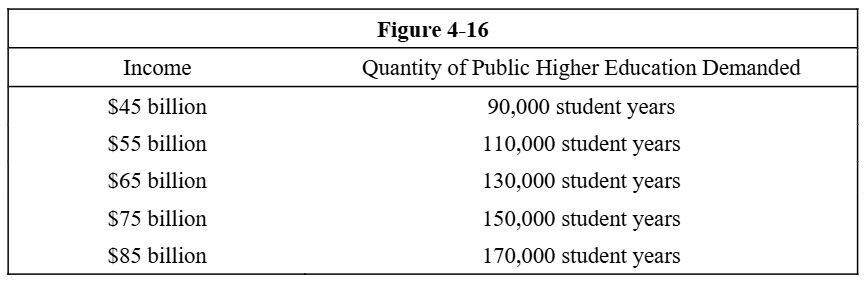 (A) 1.00(B) 0.06(C) -1.00(D) 0e. none of these
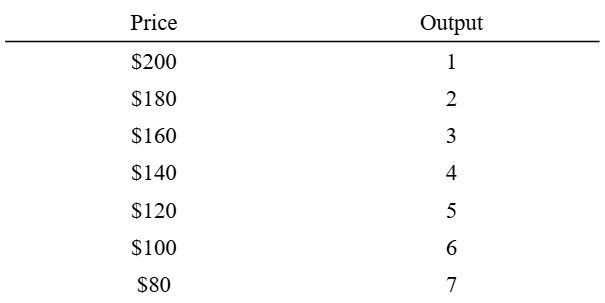
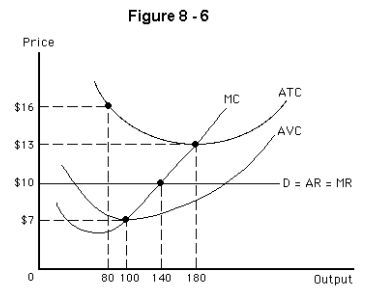 (A) profit rises when the firm raises its price and lowers its output(B) the profit-maximizing output level is 180 units(C) an economic loss occurs at the profit-maximizing output level(D) the profit-maximizing output level is 100 unitse. the firm will earn short-run profits
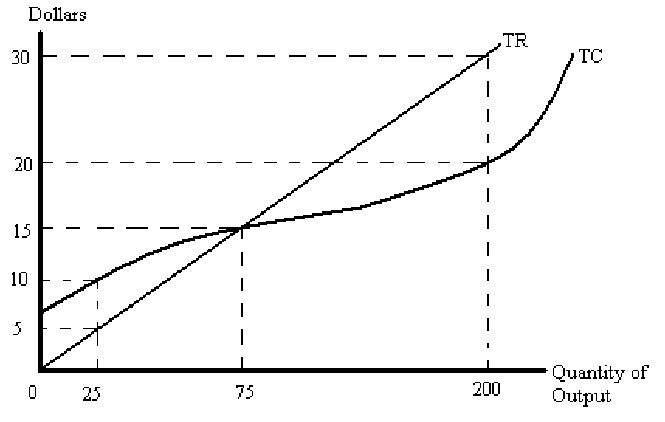 (A) $0.(B) $125.(C) $5.(D) $10.
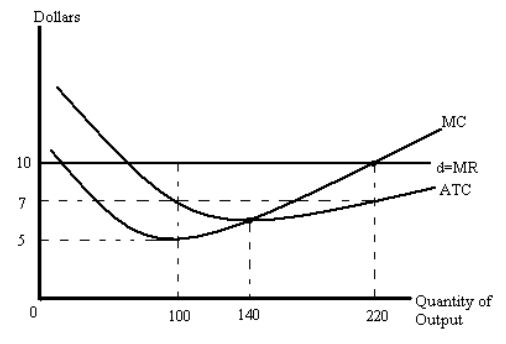
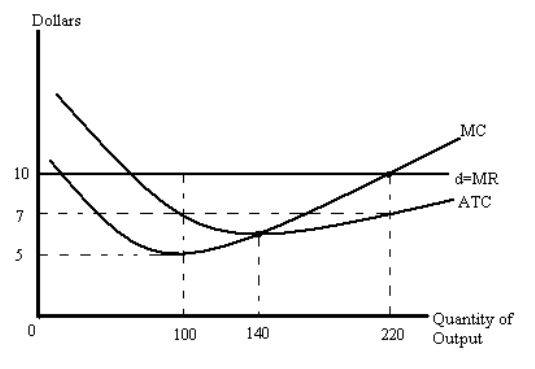 (A) Some firms will exit.(B) Some firms will enter.(C) The number of firms will remain constant.(D) Some firms will go bankrupt.
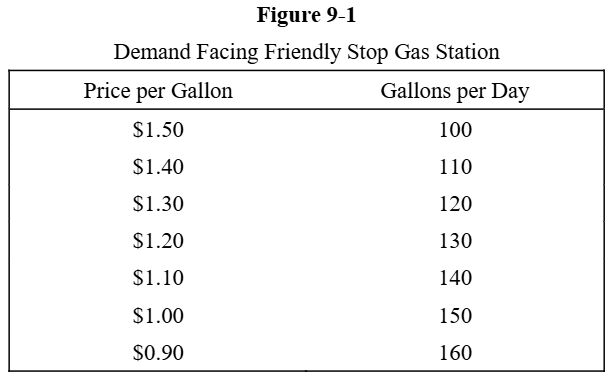 (A) The demand curve facing Friendly Stop has a constant price elasticity.(B) If the station increases sales from 100 to 110 gallons, marginal revenue will equal $1.40.(C) If the station increases sales from 100 to 110 gallons, marginal revenue will equal $14.00.(D) Demand is price elastic throughout the demand schedule.e. The owner of the station would be unwilling to charge either $1.00 or $0.90 per gallon.
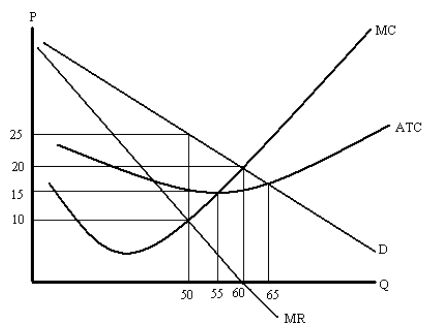 (A) $10.(B) $500.(C) $750.(D) $1250.
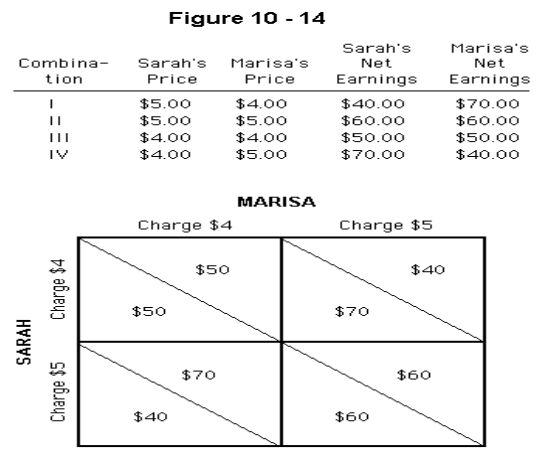 (A) in equilibrium, both will charge $4 per hour(B) in equilibrium, both will charge $5 per hour(C) in equilibrium, Sarah will charge $5 per hour; Marisa will charge $4 per hour(D) in equilibrium, Sarah will charge $4 per hour; Marisa will charge $5 per hour(E) there is no predictable equilibrium
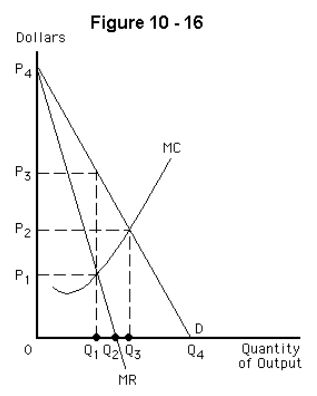 (A) higher price and lower output(B) higher price and higher output(C) higher price and the same output(D) lower price and more output(E) lower price and the same output
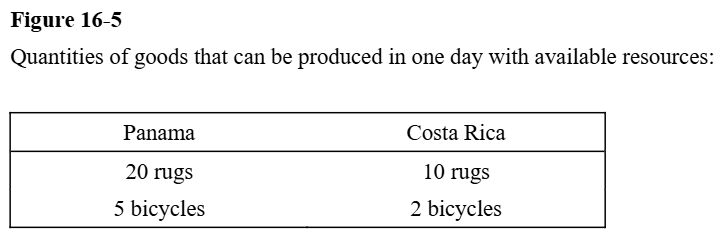 (A) Both countries can benefit from trade if Panama produces bicycles and Costa Rica produces rugs.(B) Both countries can benefit from trade if Panama produces both rugs and bicycles.(C) Both countries can benefit from trade if Panama produces rugs and Costa Rica produces bicycles.(D) Both countries can benefit from trade if Costa Rica produces bicycles and rugs.(E) Neither country can benefit from trade since Panama has an absolute advantage in producing bothbicycles and rugs.
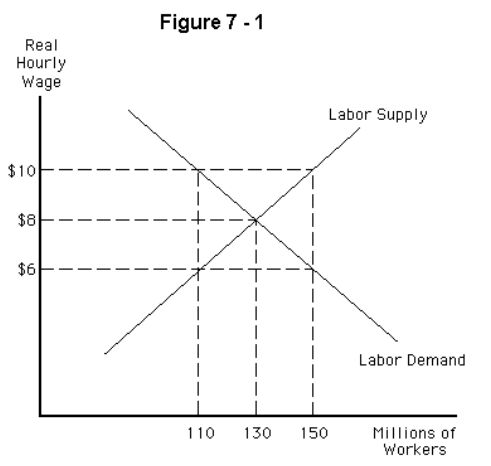 (A) There would be a shortage of 40 million workers and the wage rate would rise.(B) There would be a shortage of 20 million workers and the wage rate would rise.(C) There would be a surplus of 40 million workers and the wage rate would fall.(D) There would be a surplus of 20 million workers and the wage rate would fall.(E)The government would set a minimum wage.
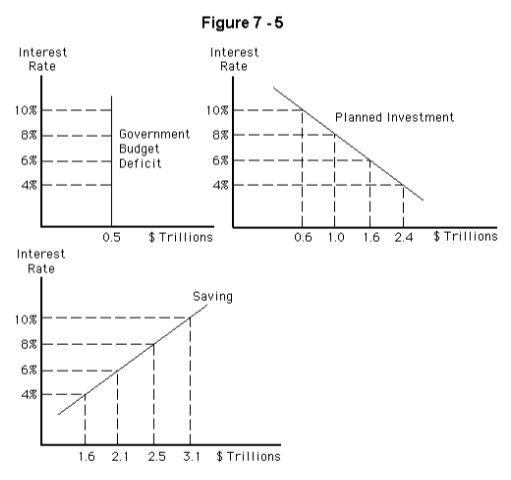 (A) 4 percent(B) 6 percent(C) 8 percent(D) 10 percent(E) It cannot be determined with the information given.
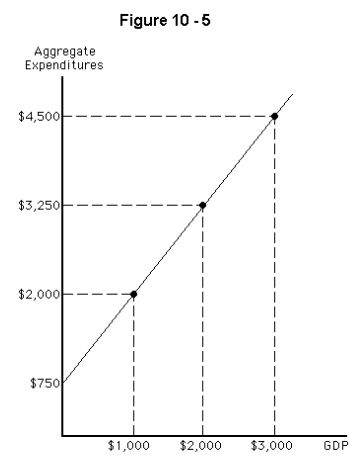 (A) $1,000(B) $2,000(C) $3,000(D) $3,250(E)There is no equilibrium in this economy.
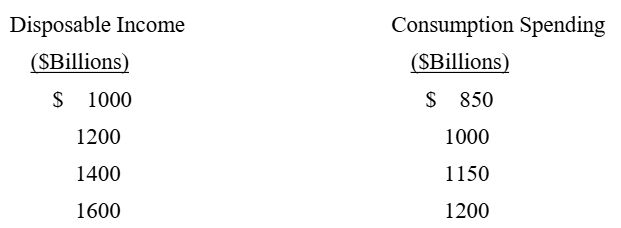 (A) $100(B) $50(C) $150(D) $200