阿摩線上測驗
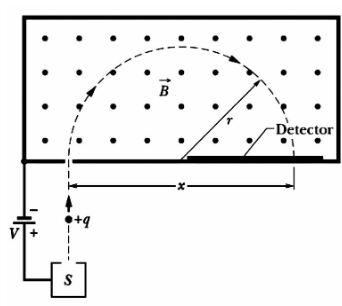
二、The figure below shows the essentials of a mass spectrometer, which can be used to measure the mass of an ion; an ion of mass \( m \) (to be measured) and charge \( q \) is produced in source \( S \). The initially stationary ion is accelerated by the electric field due to a potential difference \( V \). The ion leaves \( S \) and enters a separator chamber in which a uniform magnetic field \( \vec{B} \) is perpendicular to the path of the ion. A wide detector lines the bottom wall of the chamber, and the \( \vec{B} \) causes the ion to move in a semicircle and thus strike the detector. Suppose that \( B=80.000 \text{ mT} \), \( V=1000.0 \text{ V} \), and ions of charge \( q=+1.6022 \times 10^{-19} \text{C} \) strike the detector at a point that lies at \( x=1.6254 \text{ m} \). What is the mass \( m \) of the individual ions, in atomic mass units?
【Hint】:
-
atomic mass units: \( 1 \text{ u} = 1.6605 \times 10^{-27} \text{ kg} \).
-
The SI unit for \( \vec{B} \) : \( 1 \text{ T} = 1 \frac{\text{newton}}{(\text{coulomb/second})(\text{meter})} = 1 \frac{\text{N}}{\text{A}\cdot\text{m}} \).
-
\( F_B = |q|vB \sin \varphi \).
-
\( F = m \frac{v^2}{r} \).