 阿摩線上測驗
-
(15%) Consider three circuits as shown and assume the batteries have no internal resistance. All capacitors (\( C_1 \), \( C_2 \), and \( C_3 \)) are initially uncharged. The resistors and capacitors are all identical with resistance \( R \) and capacitance \( C \), respectively. (a) All switches \( S \) are closed at \( t = 0 \), find the currents in the resistors \( R_2 \), \( R_4 \), and \( R_6 \) at \( t = 0 \)? After the switches are closed for a very long time (\( t \to \infty \)), (b) determine the currents in the resistors \( R_2 \), \( R_4 \), and \( R_6 \) and (c) the stored energies in the capacitors \( C_1 \), \( C_2 \), and \( C_3 \). (d) <u>Rank</u> the time required for the capacitor to reach 50% of its final charge and <u>Explain your answer</u>. (無說明理由將不予計分)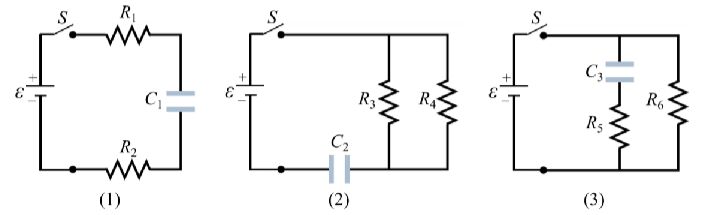
(15%) Consider three circuits as shown and assume the batteries have no internal resistance. All capacitors (\( C_1 \), \( C_2 \), and \( C_3 \)) are initially uncharged. The resistors and capacitors are all identical with resistance \( R \) and capacitance \( C \), respectively. (a) All switches \( S \) are closed at \( t = 0 \), find the currents in the resistors \( R_2 \), \( R_4 \), and \( R_6 \) at \( t = 0 \)? After the switches are closed for a very long time (\( t \to \infty \)), (b) determine the currents in the resistors \( R_2 \), \( R_4 \), and \( R_6 \) and (c) the stored energies in the capacitors \( C_1 \), \( C_2 \), and \( C_3 \). (d) <u>Rank</u> the time required for the capacitor to reach 50% of its final charge and <u>Explain your answer</u>. (無說明理由將不予計分)