所屬科目:轉學考-物理
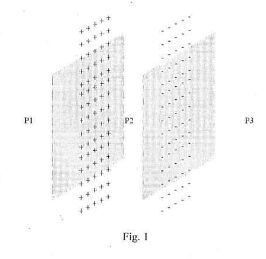
1. (2% for each blank, 12% in total, 本題計算過程不計分)Suppose two infinite planes of charge are parallel to each other (Fig. 1), one positively charged and the other negatively charged. Both planes have the same charge density σ. The direction and the magnitude of electric field at point P1 (to the left of the positively charged plane) are __(1a)__ and __(1b)__, respectively. The direction and the magnitude of electric field at point P3 (to the right of the negatively charged plane) are __(1c)__ and __(1d)__, respectively. The direction and the magnitude of electric field at point P2 (between the two planes) are __(1e)__ and __(1f)__, respectively.
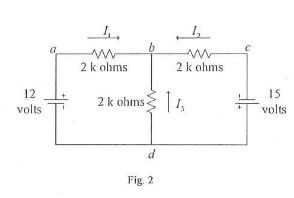
2. (2% for each blank, 6% in total, 本題計算過程不計分)A very simple electric circuit is shown in Fig. 2. Please find I₁ = __(2a)__, I₂ = __(2b)__ and I₃ = __(2c)__.
3. (3% for each blank, 6% in total)Please briefly explain (a) Faraday's Law of Induction:__ (3a)__, and (b) Lenz's Law: __(3b)__.
4. (3%) What is the origin of the magnetic field? Your explanation: __(4)__
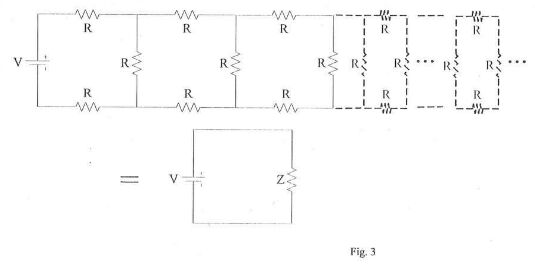
5. (5%, 本題計算過程須計分) Find an equivalent resistor Z = __(5)__ (Fig. 3 lower) for the infinite blocks of resistors (Fig. 3 upper).
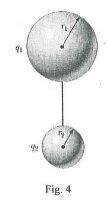
6. (7%, 本題計算過程須計分) Two spherical conductors of radii r₁ and r₂ are separated by a distance much greater than the radius of either sphere. The spheres are connected by a conducting wire as shown in Fig. 4. The charges on the spheres in equilibrium are q₁ and q₂, respectively, and they are uniformly charged. Find the ratio of the magnitude of the electric field at the surface of the sphere 1 to the one of the sphere 2 is__ (6a) (3%)__. Please use the meaning of the ratio to explain the principle of a lightning rod (避雷計). Your explanation: __(6b) (4%)__
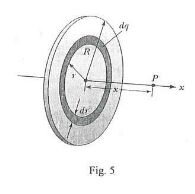
7. (5%,本題計算過程須計分) A disk of radius R has a uniform surface charge density σ (Fig. 5). Prove that magnitude of the electric field at a point P is $$E = 2\pi k_e \sigma \left[ 1 - \frac{x}{(R^2 + x^2)^{1/2}} \right]$$. Note that P lies along the central perpendicular axis of the disk and a distance x from the center of the disk. Your proof:__ (7)__
8. (2 %) What is drift speed in a conductor? Your explanation: __(8)__
9. (4 %) In normal cases, drift speed in a conductor is very slow. But, why a light bulb can be turned on immediately after switch is on? Your explanation:__ (9)__
10. (2 %) What is the back EMF? __(10)__
11. (8 %) Assume a uniformly wound solenoid having N turns and length ℓ, and ℓ is much greater than the radius of the solenoid, prove: (a) the flux through each turn of area A is ΦB = μB NIA / ℓ, and (b) the inductance is L = μ_B N² A / ℓ. Your proofs for (a): __(11a) (4%)__ and for (b)__ (11b) (4%)__
12. (4%) Please explain the Hall effect. Your explanation: __(12)__
13. (4%) Please illustrate the experiment for defining the unit for current by Ampere. Your illustration: __(13)__
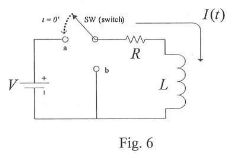
14. (5 %, 本題計算過程須計分) Fig. 6 shows a very simple RL circuit with a resistor \( R \) ohms, an inductor \( L \) henries, and a battery of \( V \) volts. Prove that the current \( I(t) \) after switch is on (\( t = 0^{+} \)) is \( I(t) = (V / R)(1 - e^{-t/(L/R)}) \). Your proof: __(14)__
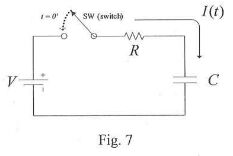
15. (5 %, 本題計算過程須計分) Fig. 7 shows a very simple RC circuit with a resistor \( R \) ohms, a capacitor \( C \) farads, and a battery of \( V \) volts. Prove that the current \( I(t) \) after switch is on (\( t = 0^+ \)) is \( I(t) = (V / R)e^{-t/(RC)} \). Your proof:__ (15)__
(a) Prove that the impedance for an inductor \( (L \) farads) is \( Z_{L} = j\omega L \). Your proof: __(16a) (4%)__
(b) Why low-frequency sinusoidal current is easier to pass through a capacitor? Your explanation: __(16b) (4%)__
(c) What is physical meaning of the term \( j \) in \( Z_{L} \)? Your explanation:__ (16c)__ (4%)
17. (4 %) What are definitions for alternating current (AC) and direct current (DC)? Your explanation: __(17)__
18. (6 %) Explain why electric field is zero everywhere inside a conductor and charge resides on the conductor's surface when the conductor is in electrostatic equilibrium whether the conductor is solid or hollow. Your explanation:__ (18)__
 阿摩線上測驗
登入