所屬科目:研究所、轉學考(插大)-經濟學
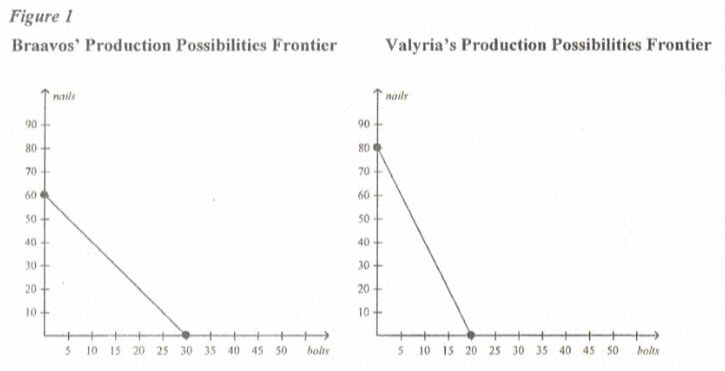
1. If the government removes a binding price ceiling from a market, then the price received by sellers will (A) decrease and the quantity sold in the market will decrease. (B) decrease and the quantity sold in the market will increase. (C) increase and the quantity sold in the market will decrease. (D) increase and the quantity sold in the market will increase. Figure 1 Braavos' Production Possibilities Frontier Valyria's Production Possibilities Frontier
2. Refer to Figure 1. Without trade, Braavos produced and consumed 12 bolts and 36 nails and Valyria produced and consumed 14 bolts and 24 nails. Then, each country agreed to specialize in the production of the good in which it has a comparative advantage and trade 16 bolts for 38 nails. As a result, Braavos gained (A) 2 bolts and 2 nails and Valyria gained 2 bolts and 18 nails. (B) 4 bolts and 2 nails and Valyria gained 2 bolts and 14 nails. (C) 14 bolts and 38 nails and Valyria gained 16 bolts and 42 nails. (D) 16 bolts and 38 nails and Valyria gained 16 bolts and 38 nails.
3. The discovery of a new hybrid wheat would increase the supply of wheat. As a result, wheat farmers would realize an increase in total revenue if (A) the supply of wheat is elastic. (B) the supply of wheat is inelastic. (C) the demand for wheat is inelastic. (D) the demand for wheat is elastic.
4. One economist has argued that rent control is "the best way to destroy a city, other than bombing." Why would an economist say this? (A) He fears that low rents will cause lowincome people to move into the city, reducing the quality of life for other people. (B) He fears that rent control will benefit landlords at the expense of tenants, increasing inequality in the city. (C) He fears that rent control will cause a construction boom, which will make the city crowded and more pollutec. (D) He fears that rent control will eliminate the incentive to maintain buildings, leading to a deterioration of the city.
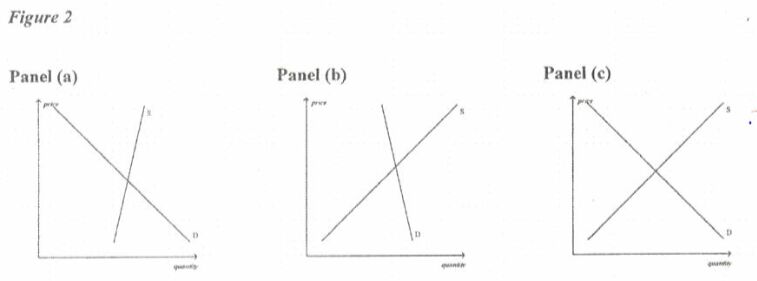
5. Refer to Figure 2. In which market will the majority of the tax burden fall on buyers? (A) market (a) (B) market (b) (C) market (c) (D) All of the above are correct.
6. Suppose that policymakers are considering placing a tax on either of two markets. In Market A, the tax will have a significant effect on the price consumers pay, but it will not affect equilibrium quantity very much. In Market B, the same tax will have only a small effect on the price consumers pay, but it will have a large effect on the equilibrium quantity. Other factors are held constant. In which market will the tax have a larger deadweight loss? (A) Market A (B) Market B (C) The deadweight loss will be the same in both markets. (D) There is not enough information to answer the question.
7. Other things equal, the deadweight loss of a tax (A) decreases as the size of the tax increases. (B) increases as the size of the tax increases, but the increase in the deadweight loss is less rapid than the increase in the size of the tax. (C) increases as the size of the tax increases, and the increase in the deadweight loss is more rapid than the increase in the size of the tax. (D) increases as the price elasticities of demand and/or supply increase, but the deadweight loss does not change as the size of the tax increases.
8. Which of the following statements is correct? (A) Internalizing a negative externality will cause an industry to decrease the quantity it supplies to the market and decrease the price of the good produced. (B) Internalizing a negative externality will cause an industry to decrease the quantity it supplies to the market and increase the price of the good produced. (C) Internalizing a negative externality will cause an industry to increase the quantity it supplies to the market and decrease the price of the good produced.(D) Internalizing a negative externality will cause an industry to increase the quantity it supplies to the market and increase the price of the good produced.
9. Assume that your roommate is very messy. Suppose she gets a $50 benefit from being messy but imposes a $100 cost on you. The Coase theorem would suggest that an efficient solution would be for you to (A) pay your roommate at least $50 but no more than $100 to clean up after herself. (B) pay your roommate at least $101 to clean up after herself. (C) charge your roommate at least $50 to have you clean up after her. (D) charge your roommate at least $100 but no more than $200 to keep you from complaining about the mess.
10. Some goods can be either common resources or public goods depending on (A) whether the good is rival in consumption. (B) whether the good is excludable. (C) the marginal cost of the good. (D) None of the above is correct.
11. Refer to Table 1. Which tax schedules are progressive? (A) Tax Schedule A only (B) Tax Schedule A and Tax Schedule B (C) Tax Schedule A, Tax Schedule B, and Tax Schedule C (D) All four Tax Schedules are progressive.
12. Since the 1980s, WalMart stores have appeared in almost every community in America. WalMart buys its goods in large quantities and, therefore, at cheaper prices. WalMart also locates its stores where land prices are low, usually outside of the community business district. Many customers shop at WalMart because of low prices. Local retailers, like the neighborhood drug store, often go out of business because they lose customers. This story demonstrates that (A) consumers do not react to changing prices. (B) there are diseconomies of scale in retail sales. (C) there are economies of scale in retail sales. (D) there are diminishing returns to producing and selling retail goods.
13. When a competitive firm doubles the amount of output it sells, its (A) total revenue doubles. (B) average revenue doubles. (C) marginal revenue doubles. (D) profits must increase.
14. When a restaurant stays open for lunch service even though few customers patronize the restaurant for lunch, which of the following principles is (are) best demonstrated? (i) Fixed costs are sunk in the short run. (ii) In the short run, only fixed costs are important to the decision to stay open for lunch. (iii) If revenue exceeds variable cost, the restaurant owner is making a smart decision to remain open for lunch. (A) (i) and (ii) only (B) (ii) and (iii) only (C) (i) and (iii) only (D) All are demonstrated.
15. Competitive firms differ from monopolies in which of the following ways? (i) Competitive firms do not have to worry about the price effect lowering their total revenue. (ii) Marginal revenue for a competitive firm equals price, while marginal revenue for a monopoly is less than the price it is able to charge. (iii) Monopolies must lower their price in order to sell more of their product, while competitive firms do not. (A) (i) and (ii) only (B) (ii) and (iii) only (C) (i) and (iii) only (D) (i), (ii), and (iii)
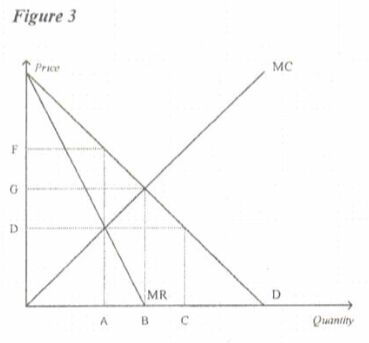
16. Refer to Figure 3. What area represents the total surplus lost due to monopoly pricing? (A) the rectangle (FD)xA (B) the triangle \( 1 / 2[(F D)x(B A)] \) (C) the triangle \( 1 / 2[(F D)x(C A)] \) (D) the rectangle \( (\mathrm{F D})\mathrm{xA} \) plus the triangle \( 1 / 2[(\mathrm{F D})\mathrm{x(B A)}] \)
17. Suppose a market is initially perfectly competitive with many firms selling an identical product. Over time, however, suppose the merging of firms results in the market being served by only three or four firms selling this same product. As a result, we would expect (A) an increase in market output and an increase in the price of the product. (B) an increase in market output and an decrease in the price of the product. (C) a decrease in market output and an increase in the price of the product. (D) a decrease in market output and a decrease in the price of the product.
18. Refer to Table 2. What is Paul's dominant strategy? (A) Paul has no dominant strategy. (B) Paul should always choose Turn. (C) Paul should always choose Drive Straight. (D) Paul has more than one dominant strategy.
19. Refer to Table 2. How many Nash equilibria are there in this Chicken game? (A) 0 (B) 1 (C) 2 (D) 3
20. The marginal propensity to consume represents (A) total income minus total taxes. (B) the change in output caused by a oneunit change in autonomous demand. (C) the change in consumption caused by a oneunit change in disposable income. (D) the level of consumption that occurs if disposable income is zero. e. the ratio of total consumption to disposable income.
21. In 2015, John earned $40,000 at his job at an accounting firm. This year, he receives a $2,000 increase in his salary. If the annual inflation rate for 2016 is 0.4%, the percentage increase in his real income is: (A) \( 5.4\% \) (B) \( 4.6\% \) (C) \( 2.0\% \) (D) \( 1.4\% \)
22. Ellen purchased a house in 1980 for which she borrowed $100,000 at 30year fixed rate. As the inflation rate unexpectedly dropped in the mid1980s, (A) Ellen experienced a loss and her mortgage company experienced a gain (B) Ellen experienced a gain and her mortgage company experienced a loss (C) Both Ellen and her mortgage company experienced a loss (D) Both Ellen and her mortgage company experienced a gain
23. The Fisher Hypothesis states that: (AB) the changes in the nominal interest rate follow changes in the expected inflation rate (AC) the real interest rate changes frequently (AD) the expected inflation rate changes more frequently than the real interest rate (AE) both a. and c. above (BC) both a. and c. above(BD) none of the above
24. In spite of increases in the level of activity after a recession is over, the unemployment rate may (A) increase as the discouraged workers leave the workforce (B) decrease as the discouraged workers enter the workforce (C) increase as the discouraged workers enter the workforce (D) none of the above
25. The inflation rate in the Consumer Price Index is typically (A) a "countercyclical" and a "lagging" variable (B) a "procyclical" and a "lagging" variable (C) a "countercyclical" and a "leading" variable (D) a "procyclical" and a "leading" variable e. none of the above
26. A commercial bank has $80 million in loans and $10 million in excess reserves. The required reserve ratio is 10%. The total deposits of this bank are (A) $90 million (B) $100 million (C) $110 million (D) $900 million
27. What should be CBA's open market operations and what would be the expected result? (A) Purchase the government securities. Fall in the interest rate. (B) Sell the government securities. Fall in the interest rate. (C) Purchase the government securities. Rise in the interest rate. (D) Sell the government securities. Rise in the interest rate.
28. The monetary policy of CBA to fix the economy of Argentina in the short run should (A) shift the aggregate supply curve to the right (B) shift the aggregate demand curve to the left (C) represents a movement to the left along the aggregate demand curve (D) represents a movement to the right along the aggregate supply curve e. none of the above
29. A firm can borrow from its bank at 10% per year. It determines that the return on investment (ROI) on a new machine is also 10%. The firm's decision to buy the new machine seems ______ now. If the central bank next week announces that it is buying large amount of government bonds in an open market operation, it seems more likely that the firm will decide to ______. (A) positive/not buy (B) uncertain/not buy (C) negative/not buy (D) uncertain/buy e. positive/buy
30. Long term economic growth is necessarily accompanied by a rise in (A) the allocation of resources (B) Inflation (C) the productivity of labor (D) transfer payments e. interest rates
a. What is the socially optimal level of production? (2分)
b. How many toys will the firm produce if the court rules that the firm is not liable for the pollution? Assume there is no negotiation between the firm and the residents.(2分)
c. Assume now the residents around the lake can costlessly negotiate with the firm. In addition, the court's decision still stands as in case (b); i.e. the firm is not liable for the pollution it creates. If the residents offer some compensation for the firm to produce at the socially optimal level, what will be the range of payments that residents may offer to the firm? Explain. (4分)
d. In reality, residents and the firm cannot costlessly negotiate. List two reasons that why they might not be able to come up a private solution to produce the socially efficient outcome? (2分)
 阿摩線上測驗
登入
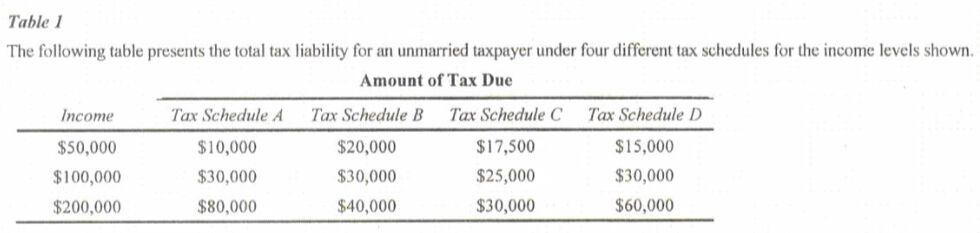 11. Refer to Table 1. Which tax schedules are progressive? (A) Tax Schedule A only (B) Tax Schedule A and Tax Schedule B (C) Tax Schedule A, Tax Schedule B, and Tax Schedule C (D) All four Tax Schedules are progressive.