所屬科目:研究所、轉學考(插大)◆普通物理學
1. An object of mass m is observed to move in a straight line with velocity given by v = bt² − ct, where b and c are positive constants. The expression for the force on the object as a function of time is (A) mbt² − mct (B) 2mbt² − 2mct (C) 2mbt − mc (D) mbt − mc (E) mbt² − 0.5mct
2. A stone of mass 0.2 kg is tied to a string of length 0.8 m. If you hold the end of this string in your hand and whirl the stone around a circle at the rate of 2 revolutions per second, what is the tension in the string? Ignore gravity in this problem. (A) 20 N (B) 25 N (C) 30 N (D) 40 N (E) 45 N
3. A meteoroid (a chunk of rock) is initially at rest in interplanetary space at a large distance from the Sun. Under the influence of gravity, the meteoroid begins to fall toward the Sun along a straight radial line. With what speed does it strike the Sun? (A) 88 km/s (B) 320 km/s (C) 483 km/s (D) 618 km/s (E) 721 km/s
4. A quantity of an ideal gas is compressed to half its initial volume. The process may be adiabatic, isothermal or isobaric. The greatest amount of work is required if the process is: (A) adiabatic (B) isothermal (C) isobaric (D) adiabatic or isothermal (both require the same work; isobaric requires less) (E) isothermal or isobaric (both require the same work; adiabatic requires less).
5. The "Principle of Equipartition of Energy" states that the energy of a gas is shared equally: (A) among the molecules (B) between kinetic and potential energy (C) between translational and vibrational kinetic energy (D) among the relevant degrees of freedom (E) between heat and work.
6. Choose the INCORRECT statement: (A) Gauss's law holds in a vacuum (B) Gauss's law states that the net number of lines crossing any closed surface in an outward direction is proportional to the net charge enclosed within the surface (C) Coulomb's law can be derived from Gauss's law and symmetry (D) Gauss's law applies to a closed surface of any shape (E) according to Gauss's law, if a closed surface encloses no charge, then the electric field must vanish everywhere on the Gaussian surface.
7. A magnetic field CANNOT: (A) exert a force on a charge (B) accelerate a charge (C) change the momentum of a charge (D) change the kinetic energy of a charge (E) change the velocity of a charge.
8. The electric flux through the surface of a sphere is NOT Q/ε₀ if Q is (A) outside the sphere near the surface (B) inside the sphere (C) at the middle of the sphere (D) spread out occupying the whole inside volume of the sphere (E) none of above.
9. In the diagram, assume that all the lines of B generated by coil #1 pass through coil #2. Coil #1 has 100 turns and coil #2 has 400 turns. Then:
(A) the current in coil #1 will be 1/4 that in coil #2 (B) the voltage in coil #2 will be 1/4 that in coil #1 (C) the current will be the same in the two coils (D) the voltage will be the same in the two coils (E) the power supplied to coil #1 is equal to the power delivered by coil #2.
10. Incompressible liquid flows along the pipe as shown in the following. The ratio of the speeds v₂/v₁ is:
(A) A₁/A₂ (B) A₂/A₁ (C) (A₁/A₂)^(1/2) (D) (A₂/A₁)^(1/2) (E) (A₂/A₁)²
11. If an electric field of magnitude 25 V/m makes an angle of 30° with a path of length 10 m, then the integral of E·dl over this path has a value (A) 318 V (B) −318 V (C) 125 V (D) 217 V (E) 150 V.
12. In using Ampere's law, the integral must be evaluated (A) around a circular path (B) around a closed path (C) around a path lies in a plane (D) in a counter-clockwise direction (E) in a clockwise direction.
13. The magnetic field from a current I flowing in a straight segment of wire of length L at a point located a perpendicular distance L from the end of the segment is μ₀I/4πL times (A) 1 (B) 23/2 (C) 21/2 (D) 2-1/2(E) 2-3/2.
14. A cube of side 2a and mass M is sliding on a frictionless surface with uniform velocity v₀, as shown in Fig. a. It hits a small obstacle at the end of the table, which causes the cube to tilt as in Fig. b. Find the minimum value of v₀ such that the cube will fall off the table (g is the gravitational acceleration constant on earth).
(A) (B) (C)(D) (E)
15. A wooden rod of uniform cross section and of length l is hinged at the bottom of a tank which is filled with water to a height h = l/3, as shown in right figure. If the density of wood is 0.45 g/cm³, find the angle θ from the vertical at which the rod is in equilibrium.
(A) θ = 60° (B) θ = 30° (C) θ = 45° (D) θ = 37° (E) θ = 53°
16. The temperatures TC of the cold reservoirs and the temperatures TH of the hot reservoirs for four Carnot heat engines are engine 1: TC = 400 K and TH = 500 K; engine 2: TC = 500 K and TH = 600 K; engine 3: TC = 400 K and TH = 600 K; engine 4: TC = 600 K and TH = 800 K. Rank these engines according to their efficiencies, least to greatest (A) 1→2→3→4 (B) 1 and 2 tie, then 3 and 4 tie (C) 2→1→3→4 (D) 1→2→4→3 (E) 2→1→4→3
17. A source at rest emits light of wavelength 500 nm. When it is moving at 0.90 C (C is light speed) away from an observer, the observer detects light of wavelength: (A) 26 nm (B) 115 nm (C) 500 nm (D) 2200 nm (E) 9500 nm
18. Light with an intensity of 1 kW/m² falls normally on a surface with an area of 1 cm² and is completely absorbed. The force of the radiation on the surface is: (A) 3.3 × 10⁻¹¹ N (B) 1.7 × 10⁻¹⁰ N (C) 3.3 × 10⁻¹⁰ N (D) 6.7 × 10⁻¹⁰ N (E) 1.0 × 10⁻⁴ N
19. The stopping potential for electrons ejected by 6.8 × 10¹⁴-Hz electromagnetic radiation incident on a certain sample is 1.8 V. The kinetic energy of the most energetic electrons ejected and the work function of the sample, respectively, are: (A) 1.8 eV, 2.8 eV (B) 1.8 eV, 1.0 eV (C) 1.8 eV, 4.6 eV (D) 2.8 eV, 1.0 eV (E) 1.0 eV, 4.6 eV
20. The right figure shows the energy levels for an electron in a finite potential energy well. If the electron makes a transition from the n = 3 state to the ground state, what is the wavelength of the emitted photon?
(A) 6.0 nm (B) 5.7 nm (C) 5.3 nm (D) 3.0 nm (E) 2.3 nm
1. The speed of a bullet as it travels down the barrel of a rifle toward the opening is given by v = (−5.00 × 10⁷) t² + (3.00 × 10⁵) t, where v is in meters per second and t is in seconds. The acceleration of the bullet just as it leaves the barrel is zero. Which answers are correct in the followings? (A) The length of time the bullet is accelerated is 6.00×10⁻³ s. (B) The length of time the bullet is accelerated is 3.00×10⁻³ s. (C) The length of time the bullet is accelerated is 2.00×10⁻³ s. (D) The speed at which the bullet leaves the barrel is 900 m/s. (E) The speed at which the bullet leaves the barrel is 450 m/s.
2. Right figure shows a reversible cycle through which 1 mol of a monatomic ideal gas is taken. Assume p = 2p₀, V = 2V₀, p₀ = 1.01 × 10⁵ Pa, and V₀ = 0.0225 m³.
(A) The work done during the cycle is 2.27 kJ. (B) The energy added as heat during stroke abc is 14.8 kJ. (C) The efficiency of the cycle is 0.217. (D) The efficiency of a Carnot engine operating between the highest and lowest temperatures that occur in the cycle is 0.25. (E) The efficiency of Carnot engine is thus greater than the efficiency of the cycle showed in the right figure.
3. In A. J. Dempster's mass spectrometer as shown in right figure, two isotopes with masses m₁ and m₂ are accelerated from rest by a potential difference V₀. They then enter a uniform field B normal to the magnetic field lines. (Assume both isotopes have the same charge q)
(A) Both kinetic energies of the accelerated particles are qV₀ (B) The speed of isotope with m₁ is v₁ = (qV₀/m₁)1/2(C) The radius of the path in the magnetic field for the isotope with m₂ is r₂ = (m₂V₀/qB²)1/2 (D) r₁/r₂ = (m₁/m₂)1/2(E) r₁/r₂ = (m₂/m₁)1/2
4. A particle encounters a position-dependent potential energy as shown in the figure to the right. Choose the CORRECT statement(s):
(A) The maximum kinetic energy of the particle is 4×10⁻²⁰ J when its total energy is E₁. (B) The maximum kinetic energy of the particle is 4×10⁻²⁰ J when its total energy is E₂. (C) The particle experiences no force at r = 2×10⁻¹⁰ m when its total energy is E₁. (D) The particle experiences no force at r = 2×10⁻¹⁰ m when its total energy is E₂. (E) The particle experiences a maximum attractive force at r = 4×10⁻¹⁰ m when its total energy is E₂.
 阿摩線上測驗
登入
 (A) the current in coil #1 will be 1/4 that in coil #2 (B) the voltage in coil #2 will be 1/4 that in coil #1 (C) the current will be the same in the two coils (D) the voltage will be the same in the two coils (E) the power supplied to coil #1 is equal to the power delivered by coil #2.
 (A) A₁/A₂ (B) A₂/A₁ (C) (A₁/A₂)^(1/2) (D) (A₂/A₁)^(1/2) (E) (A₂/A₁)²
 (A)
 (B)
 (C)
 (D)
 (E)

 (A) θ = 60° (B) θ = 30° (C) θ = 45° (D) θ = 37° (E) θ = 53°
 (A) 6.0 nm (B) 5.7 nm (C) 5.3 nm (D) 3.0 nm (E) 2.3 nm
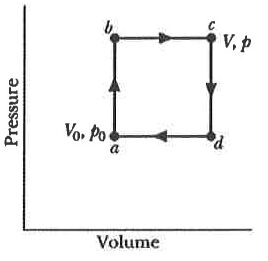 (A) The work done during the cycle is 2.27 kJ. (B) The energy added as heat during stroke abc is 14.8 kJ. (C) The efficiency of the cycle is 0.217. (D) The efficiency of a Carnot engine operating between the highest and lowest temperatures that occur in the cycle is 0.25. (E) The efficiency of Carnot engine is thus greater than the efficiency of the cycle showed in the right figure.
 (A) Both kinetic energies of the accelerated particles are qV₀ (B) The speed of isotope with m₁ is v₁ = (qV₀/m₁)1/2(C) The radius of the path in the magnetic field for the isotope with m₂ is r₂ = (m₂V₀/qB²)1/2 (D) r₁/r₂ = (m₁/m₂)1/2(E) r₁/r₂ = (m₂/m₁)1/2
 (A) The maximum kinetic energy of the particle is 4×10⁻²⁰ J when its total energy is E₁. (B) The maximum kinetic energy of the particle is 4×10⁻²⁰ J when its total energy is E₂. (C) The particle experiences no force at r = 2×10⁻¹⁰ m when its total energy is E₁. (D) The particle experiences no force at r = 2×10⁻¹⁰ m when its total energy is E₂. (E) The particle experiences a maximum attractive force at r = 4×10⁻¹⁰ m when its total energy is E₂.