所屬科目:研究所、轉學考(插大)◆生物化學
1. Which one of the followings is the major lipid of cell membrane? (A) Cholesterol; (B) Phospholipids; (C) Terpene; (D) Eicosanoids
2. Which one of the following descriptions about Oleic acid is incorrect ? (A) Oleic acid has 18 carbon atoms (B) Oleic acid is a monounsaturated fatty acid (C) Oleic acid has only one carbon-carbon double bond (D) The position of carbon-carbon double bond of oleic acid is between C8 and C9
3. The transport of H2O is dependent on which protein? (A) Aquaporin; (B) SERCA; (C) Flippase; (D) Caveolin
4. Which mechanism is related to the glucose transport by GLUT4? (A) Simple diffusion; (B) Facilitated diffusion; (C) Primary transport; (D) Secondary transport
5. Which one of the followings is related to the production of diacylglycerol (DAG) from the membrane lipids? (A) Phospholipase C; (B) Phospholipase A; (C) Phospholipase D; (D) Phospholipase B
6. There are four levels in protein structure: primary, secondary, tertiary, and quaternary. The α-helix is in what level of protein structure? (A) Primary; (B) Secondary; (C) Tertiary; (D) Quaternary
7. The polyampholyte is an important character of a protein. What solution factor has the greatest effect on this protein property? (A) The temperature; (B) The solubility; (C) The ionic strength; (D) The acid-basic condition
8. Regarding to the structure of amino acids, which following description is incorrect? (A) Methionine has a sulfur-containing side chain (B) Phenylalanine is an aromatic amino acid (C) Serine is an aliphatic amino acid (D) Histidine is a basic amino acid
9. The globular protein folding is a thermodynamical process in physiological condition. Which following force of chemical binding interaction does not involve? (A) Van der Walls interactions; (B) Electrostatic interactions; (C) Hydrogen bonds; (D) Polypeptide bonds
10. Regarding to biosynthesis of a protein in eukaryotes, which following description is correct? (A) The molecule of tRNA functions as a template of genetic information, and the rRNA serves as an anti-codon to synthesize specific amino acid (B) Protein synthesis occurs in the ribosome, via a specific aminoacyl-tRNA synthetase (C) The polypeptide synthesis requires an AUG as a start codon, while no specific termination codon is required. (D) The polypeptide chains undergo post-translational modification in endoplasmic reticulum
11. Aspartate transaminase catalyzes an amino group transfer from aspartate to (A) Glycine; (B) Tryptophen; (C) Glutamate; (D) Pyruvate
12. In urea cycle, urea is generated from which molecule? (A) Arginine; (B) Aspartate; (C) Glutamate; (D) Ornithin
13. Which molecule is a substrate of a DNA polymerase? (A) A nucleobase; (B) A nucleoside; (C) A nucleotide with one phosphate; (D) A nucleotide with three phosphates
14. 5-fluorouridine is an anticancer drug that inhibit the reaction of a (A) thymidylate synthase; (B) dihydrofolate reductase; (C) DNA polymerase; (D) Topoisomerase
15. A close circular plasmid DNA has a length of 3000 base pairs. What is its linking number in relaxed form? (A) Around 100; (B) Around 300; (C) Around 30; (D) 0
16. Which of the following description about enzymes is incorrect ? (A) According to the nomenclature system of the systemic name, kinases are belonged to the class of transferases. (B) Coenzymes are also substrates of enzymes. (C) Acylation is one mechanism leading to the formation of a different isoforms of an enzyme. (D) Different isoenzymes must have the same catalytic properties for the same reaction.
17. Which of the following statement is correct about reversible inhibition of enzymatic reactions? (A) Both Vmax and Km are reduced in uncompetitive inhibition. (B) A competitive inhibitor binds at a site on the enzyme molecule other than the substrate-binding site. (C) Km in competitive inhibition is unaffected. (D) At a high concentration of the substrate, the inhibitory effect of the noncompetitive inhibitor can be overcome.
18. Which of the following vitamins are cofactors required for the enzymatic reactions involved in the conversion of homocysteine to methionine? (A) Biotin and pantothenic acid (B) Vitamin B12 and folic acid (C) Vitamin B1 and Vitamin B2 (D) Vitamin D and vitamin K
19. Which of the following matching among (a) the name of vitamin, (b) the major form of vitamer found in human serum, and (c) the biochemical function of that vitamin is correct? (A) (a) vitamin A; (b) niacin; (c) DNA synthesis (B) (a) vitamin E; (b) α-tocopherol; (c) chain-breaking antioxidant (C) (a) vitamin B1; (b) pyridoxal-5'-phosphate; (c) vision (D) (a) vitamin C; (b) retinol; (c) blood clotting
20. Which of the following statement is not correct about the electron carriers in the mitochondrial electron transport chain? (A) Iron-sulfur proteins transfer single electrons but not protons. (B) Cytochrome c is localized within the mitochondrial intermembrane space. (C) The oxidized form of coenzyme is also named as ubiquinol-10. (D) Cytochrome b is part of Complex III.
21. Which of following metabolites can phospholipase C convert phosphatidylinositol 4,5-bisphosphate to? (A) diacylglycerol + inositol + phosphate; (B) diacylglycerol + inositol triphosphate; (C) glycerol + inositol + phosphate; (D) phosphatidyl glycerol + inositol + phosphate
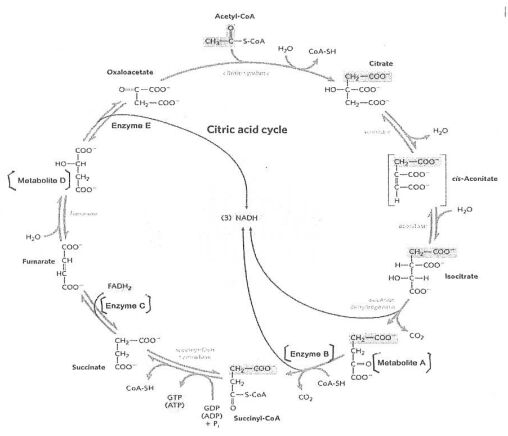
22. What is the metabolite A in the above diagram? (A) β-ketoglutarate; (B) α-ketoglutarate; (C) α-glutarate; (D) valerate
23. What is the enzyme B catalyzing the conversion of metabolite A to succinyl-CoA? (A) valerate decarboxylase; (B) α-ketoglutarate dehydrogenase; (C) β-ketoglutarate dehydrogenase; (D) α-glutarate dehydrogenase
24. What is the enzyme C catalyzing the conversion of succinate to fumarate? (A) fumarate hydrogenase; (B) succinase; (C) succinate dehydrogenase; (D) succinate convertase
25. What is the metabolite D in the above diagram? (A) Malonate; (B) α-hydroxy-malonate; (C) n-hydroxy-succinate; (D) malate
 阿摩線上測驗
登入
 is
 is also named as ubiquinol-10. (D) Cytochrome b is part of Complex III.
 (A) diacylglycerol + inositol + phosphate; (B) diacylglycerol + inositol triphosphate; (C) glycerol + inositol + phosphate; (D) phosphatidyl glycerol + inositol + phosphate