所屬科目:研究所、轉學考(插大)◆生物化學
1. What type of glycosidic linkage does a sucrose molecule (as shown below) have? (A) β-1,3 (B) β-1,2 (C) α-1,3 (D) α-1,2 (E) α-1,4
15. Serine can be converted directly into pyruvate. The reaction, catalyzed by serine dehydratase, requires the coenzyme: (A) pyridoxal phosphate (PLP). (B) biotin. (C). (D) tetrabydrofolate. (E) nicotinamide adenine dinucleotide (NAD).
29. Edman degradation of a polypeptide yielded a chemical structure as follows. What kind ofamino acid is located at the N-terminus of this polypeptide? (A) Cys (B) Phe (C) Ile (D) Leu (E) Tyr
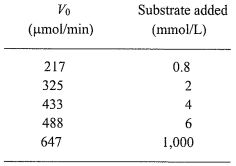
31 . The following data were obtained in a study of an enzyme known to follow Michaclis-Menten kinetics: Substrate added (umol/min) (mmol/L) The Km for this enzyme is approximately: (A) I mM. (B) 2 mM. (C) 1,000 mM. (D) 4 mM. (E) 6 mM.
32. Carbonic anhydrase has two substrates, carbon dioxide and bicarbonate, which are both converted to carbonic acid. Kinetic data for each is given below. While determining the kinetics ofas a substrate, how would the addition of CO2 effect the reaction if the rate were measured by the disappearance of bicarbonate? (A) CO2 would increase the activity of the enzyme. (B) CO2would cause an apparent decrease in the Km for (C) CO2 would act as a competitive inhibitor. (D) CO2 would act as a noncompetitive inhibitor. (E) CO2 would act as an umcompetitive inhibitor.
33. The catalytic mechanism below is an example of: (A) covalent nucleophilic catalysis. (C) specific base catalysis. (B) covalent electrophilic catalysis. (D) general base catalysis. (E) low barrier hydrogen bond catalysis.
35. Which of the following statements concemning the free energy change (△G) is false? (A) The energy change for a reaction depends only on the initial and final states, and is independent of the path taken. (B) A spontaneous reaction is one in which energy is absorbed. (C) The standard state usually used in biochemistry includes all concentrations at 1 M, except for [H+], which is M. (D) The AG values for giycolytic reactions at physiological conditions may be exergonic, even though the at "standard" conditions, may be endergonic. (E) None is false.
39. Thiamine pyrophosphate (TPP) also involves in the formation of acetyl-CoA, in which TPP has to be deprotonated first and then attacks one site of pyruvate. Please identify which site. (A) Site A (B) Site B (C) Site C (D) Site D (E) Site E
46. Besides B-oxidation for lipid ietabolism, there are other ways to catabolize lipid. Which statement is correct? (A) There is NAD-dependent β-oxidation for lipid metabolism in peroxisomes. (B) The B-oxidation in peroxisomes uses O2 to oxidize lipid and produces H2O2. (C) Branched-chain lipids are degraded via co-oxidation. (D) a-Oxidation is the main route to produce dicarboxylic acids. (E) None of the above.
48. Thymidylate synthase methylates dUMP at 5 position to make dTMP. The methyl donor is _________.(A) S-adenosylmethionine (B) methylene-THF (C) 5-methyl-THF (D) taurine (E) creatine.
50. Nitrifying bacteria obtain their chemical energy from: (A) the reduction of NO3 to . (B) the formation of from N2 gas. (C) the oxidation of to N2. (D) the oxidation of to (E) the formation of NO2, from
 阿摩線上測驗
登入
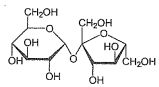 (A) β-1,3 (B) β-1,2 (C) α-1,3 (D) α-1,2 (E) α-1,4
 .
(D) tetrabydrofolate. (E) nicotinamide adenine dinucleotide (NAD).
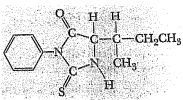 (A) Cys (B) Phe (C) Ile (D) Leu (E) Tyr
 as a substrate, how would the addition of CO2 effect the reaction if the rate were measured by the disappearance of bicarbonate?
 (A) CO2 would increase the activity of the enzyme. (B) CO2would cause an apparent decrease in the Km for
 (C) CO2 would act as a competitive inhibitor. (D) CO2 would act as a noncompetitive inhibitor. (E) CO2 would act as an umcompetitive inhibitor.
 (A) covalent nucleophilic catalysis. (C) specific base catalysis. (B) covalent electrophilic catalysis. (D) general base catalysis. (E) low barrier hydrogen bond catalysis.
 includes all concentrations at 1 M, except for [H+], which is
 M. (D) The AG values for giycolytic reactions at physiological conditions may be exergonic, even though the
 at "standard" conditions, may be endergonic. (E) None is false.
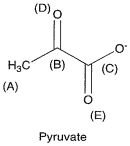 (A) Site A (B) Site B (C) Site C (D) Site D (E) Site E
 methylene-THF (C) 5-methyl-THF (D) taurine (E) creatine.
 . (B) the formation of
 (E) the formation of NO2, from