所屬科目:研究所、轉學考(插大)-經濟學
1. Acme Steel Co. produces 1000 tons of steel. Steel sells for $30 per ton. Acme pays wages of $10,000. Acme buys $15,000 worth of coal, which is needed to produce the steel. Acme pays $2,000 in taxes. Acme's contribution to GDP is (A) 15000. (B) 20000. (C) 30000. (D) 45000.
2. Suppose that GDP is equal to 1000, national saving is equal to 200, the current account deficit is equal to 100, and the government budget deficit is equal to 50. Private savings must equal (A) 150. (B) 200. (C) 250. (D) 300.
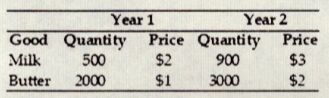
3. The country of Old Jersey produces milk and butter, and it has published the following macroeconomic data, where quantities are in gallons and prices are dollars per gallon. Between Year 1 and Year 2, the percent change in real GDP (based on Year 1 as a base year) was (A) 190%. (B) 130%. (C) 58%. (D) 60%.
4. Suppose the total cost of producing T-shirts can be represented as TC = 50 + 2q. Which of the following statements is true at all levels of production? (A) MC > AFC (B) MC = AC (C) MC = AVC (D) None of the above.
5. How many people are employed if the labor force participation rate is 60%, there are 3 million people unemployed, and there are 30 million people not in the labor force? (A) 48 million (B) 30 million (C) 42 million (D) 54 million
6. An adverse oil-price shock reduces labor demand. What happens to current employment and the real wage rate? (A) Both employment and the real wage rate would increase. (B) Both employment and the real wage rate would decrease. (C) Employment would increase and the real wage would decrease. (D) Employment would decrease and the real wage would increase.
7. Which of the following macroeconomic variables is procyclical and leads the business cycle? (A) Unemployment (B) Industrial production (C) Real interest rates (D) Money supply
8. If a consumer doubles her quantity of ice cream consumed when her income rises by 25%, then her income elasticity of demand for ice cream is (A) 4.0 (B) 0.08 (C) 0.25 (D) 8.0
9. If there is a financial panic and increased uncertainty about the returns in the stock market and bond market, what is the likely effect on money demand? (A) Money demand declines first, then rises when inflation increases. (B) Money demand declines. (C) Money demand rises. (D) The overall effect is ambiguous.
10. A temporary decrease in government purchases causes the real interest rate to underline and the price level to underline in general equilibrium. (A) rise; rise (B) rise; fall (C) fall; rise (D) fall; fall
11. When two goods are substitutes, a shock that raises the price of one good causes the price of the other good to (A) change in an unpredictable manner. (B) increase. (C) remain unchanged. (D) decrease.
12. If the demand function for orange juice is expressed as Q = 2000 - 500p, where Q is quantity in gallons and p is price per gallon measured in dollars, then the demand for orange juice has an unitary elasticity when price equals (A) 2. (B) 4. (C) 1. (D) 0.
13. Which of the following will cause the marginal cost curve of making cigarettes to shift? (A) a $1 per pack tax on cigarettes (B) a $1 million advertising campaign by the American Cancer Society (C) a $5 million penalty charged to each cigarette maker (D) All of the above
14. If Johnny likes homework (H) but hates exercise (E), which of the following might best represent his utility function for homework and exercise? (A) U = H + E (B) U = H/E (C) $U = H^2 * \sqrt{E}$ (D) $U = H^2 + \sqrt{E}$
15. The table below shows the relationship between the amount of labor employed (L) and the average product. Which of the following is the marginal product of labor when L = 3? (A) -1 (B) 2 (C) 4 (D) 6
II. 簡答題 (40%) 1. A firm pays $5 for each unit of capital. Labor costs $5 per hour for the first 10 hours and $10 per hour for every hour thereafter. Draw the isocost curves for total costs of $50 and $100. (6%)
2. Suppose that the cost function of a monopolist is $TC = 100 + 10Q + 2Q^2$, and the demand curve it faces is p = 90 - 2Q. What will be the profit-maximizing price, quantity, and profit for this firm? What is the deadweight loss? (10%)
3. John is indifferent between canned soup and fresh soup. Canned soup sells for $1 per serving, and fresh soup sells for $2 per serving. Assuming that John has allocated $4 toward soup, how will he spend it? Explain your answer by drawing John's budget line and indifference curves. (8%)
4. What is the main conceptual difference between GDP and GNP? How different are GDP and GNP for countries with many citizens who work abroad? Which one is greater? (8%)
(a) purchasing power parity \( (2\%) \)
(b) frictional unemployment \( (2\%) \)
(c) economies of scale \( (2\%) \)
(d) the Phillips curve \( (2\%) \)
 阿摩線上測驗
登入