所屬科目:研究所、轉學考(插大)-普通生物學
1. In the heart conduction system,__________functions as the pacemaker.(A) the atrioventricular node(B) Bachmann's bundle(C) the bundle of His(D) Purkinje fiber(E) the sinoatrial node
2. Increased permeability to__________results in hyperpolarization in a neuron.(A) Ca+(B) H+(C) K+(D) Mg2+(E) Na+
3. Which of the following events is NOT triggered by a calcium second messenger?(A) Propagation of action potential along an axon(B) Cortical reaction resulting in the formation of the vitelline envelope(C) Cortical rotation resulting in the formation of grey crescent in frog egg(D) Muscle contraction(E) Release of neurotransmitters from synaptic vesicles
4. Bohr shift is an effect of pH on_________.(A) the rate of breathing(B) the quantum efficiency of opsin(C) the solubility of protein(D) the affinity of hemoglobin for O2(E) the reabsorption of H2O
5. Among hormones regulating human reproduction, the receptor of_________is NOT a transmembrane protein.(A) follicle-stimulating hormone(B) estradiol(C) gonadotropin-releasing hormone(D) inhibin(E) luteinizing hormone
6. Among vertebrates, single circulation is found in_________.(A) Actinopterygii(B) Amphibia(C) Aves(D) Mammalia(E) Reptilia
7. In animals, a chemical used to communicate with conspecific individuals is called _________.(A) autocrine(B) a ligand(C) a hormone(D) a neurotransmitter(E) a pheromone
8._________is found in Metazoa only and not in other eukaryotes.(A) Alternation of generations(B) Collagen fiber(C) Dikaryon(D) Heterotrophy(E) Multicellularity
9._________is NOT a feature of adaptive immunity.(A) Antibody(B) Clonal selection(C) Humoral immune response(D) Natural killer cell(E) Major histocompatibility complex molecule
10. During vertebrate embryonic development, the retina is derived from _________.(A) forebrain(B) midbrain(C) hindbrain(D) lens placode(E) prechordal mesoderm
11. Which of the following statements about the antidiuretic hormone (ADH) is true?(A) It is a peptide hormone released from the adrenal gland.(B) In the absence of ADH, the ability to reabsorb water in the proximal tubule would be lost.(C) It promotes the excretion of hyperosmotic urine (compared to plasma).(D) Decreased plasma osmolarity stimulates ADH secretion.(E) Blood pressure would increase significantly if a person lost the ability to synthesize ADH.
12. Chronically high levels of glucocorticoids can result in obesity, muscle weakness, and depression, a combination of symptoms called Cushing's syndrome. To determine which gland has abnormal activity in a particular patient, doctors use the drug dexamethasone, a synthetic glucocorticoid that blocks ACTH release. Based on the graph, identify which gland is affected in patient X, whose ACTH level in blood is effectively lowered by dexamethasone.(A) Adrenal medulla(B) Adrenal cortex(C) Anterior pituitary(D) Posterior pituitary(E) Thyroid gland
13. In 1935, Konrad Lorenz observed that ducklings learn to follow real or foster parents at a critical stage soon after hatching. The process, called _________, involves visual and auditory stimuli from the parent object; these elicit a response in the young that affects their subsequent adult behavior. (A) classical conditioning (B) imprinting (C) innate behavior (D) social learning (E) spatial learning
14. Allopatric populations of Geospiza fuliginosa and G. fortis (Darwin's finches) on different islands have similar beak morphologies. However, when the two species are sympatric on the same island, G. fuliginosa has a shallower, smaller beak, and G. fortis has a deeper, larger beak. These changes in beak morphology allow sympatric populations of Darwin's finches avoiding competition for food. This is an example of _________. (A) adaptive radiation (B) Batesian mimicry (C) character displacement (D) Müllerian mimicry (E) reinforcement
15. Significant sexual dimorphism is often found among bird species. Among the European flycatchers of the genus Ficedula, females select their mates based on the appearance of the conspecific male. Males look similar in allopatric populations of Ficedula hypoleuca and F. albicollis (European flycatcher). However, in the sympatric populations, males of the two species look very different. In experiments, females do not select males of other species when selecting between males from sympatric populations. However, they frequently make mistakes when selecting males from allopatric populations. This is an example of_________. (A) adaptive radiation (B) Batesian mimicry (C) character displacement (D) Müllerian mimicry (E) reinforcement
16. Some heterokonts (stramenophiles) are photosynthetic and gained their chloroplasts by:(A) primary endosymbiosis with a photosynthetic cyanobacterium.(B) primary endosymbiosis with a photosynthetic glaucophyte chloroplast.(C) secondary endosymbiosis with a green alga.(D) secondary endosymbiosis with a red alga.(E) secondary endosymbiosis with a dinoflagellate.
17. In fungi, coenocytic hyphae lack:(A) chitin.(B) microtubules.(C) flagellated cells.(D) septa.(E) rhizoids.
18. Which of the following bryophyte structure is haploid?(A) foot.(B) protonema.(C) seta.(D) embryo.(E) capsule.
19. A sorus is a:(A) group of sporangia on the upper side of a fern leaf.(B) group of sporangia on the underside of a fern leaf.(C) group of sporangia along the edge of a fern stem.(D) single sporangium on the underside of a fern leaf.(E) group of fern spores.
20. The mature female gametophyte is called a(n):(A) embryo sac.(B) nucellus.(C) megasporangium.(D) endosperm.(E) ovule.
21. Which of the following statements concerning primary meristems is FALSE?(A) An example is the suspensor.(B) An example is the procambium.(C) An example is the ground meristem.(D) They are formed during embryogenesis.(E) They are meristematic.
22. If a plant produces leaves that are oriented horizontally, which of the following might you expect to find ingreater abundance on the upper side relative to the lower side?(A) stomata.(B) cuticle.(C) spongy mesophyll.(D) epidermal cells.(E) veins.
23. Compared with a C3 plant, a C4 plant: (A) carries out more photorespiration. (B) has a lower photosynthetic efficiency. (C) has more Rubisco. (D) has a higher leaf nitrogen content. (E) needs more ATP to fix CO2.
24. Which of the following does NOT involve the use of tissue culture?(A) micropropagation.(B) clonal propagation.(C) protoplast fusion.(D) hyhroponics.(E) meristem culture.
25. In the process of stomatal closing, which of the following events occurs first?(A) Water moves out of guard cells.(B) Water moves into guard cells.(C) Guard cell turgor pressure decreases.(D) Guard cell solute concentration declines.(E) Guard cell water potential increases.
26. Which of the following is the order in which flower parts are attached to the receptacle, from lowest or highest?(A) Petals > sepals > stamens > carpels.(B) Sepals > petals > stamens > carpels.(C) Sepals > stamens > petals > carpels.(D) Sepals > petals > carpels > stamens.
27. To move sucrose molecules from leaves to roots, the sucrose molecules must enter sieve elements. This involves: (A) moving the molecules through plasmodesmata. (B) the use of ATP to pump sucrose molecules with their concentration gradient across the plasma membrane. (C) the use of ATP to pump sucrose molecules against their concentration gradient across the plasma membrane. (D) the pumping of sucrose molecules across the plasma membrane with their concentration gradient without the use of ATP. (E) the pumping of sucrose molecules across the plasma membrane against their concentration gradient without the use of ATP.
28. Which of the following is a phenolic compound with a structure similar to aspirin?(A) systemin.(B) florigen.(C) brassinosteroids.(D) salicylic acids.(E) jasmonic acid.
29. Which of the following events is NOT associated with seed germination?(A) imbibition.(B) activation of existing enzymes.(C) synthesis of new enzymes.(D) synthesis of food reserves.(E) initiation of cell division and cell enlargement.
30. Which of the following statements about tropical rainforests is FALSE?(A) They contain plants that are either evergreen or leafless for short periods.(B) There is strong competition for light.(C) There is abundant plant cover beneath the trees.(D) The trees have an abundance of epiphytes.(E) They occur where temperatures and rainfall are relatively consistent.
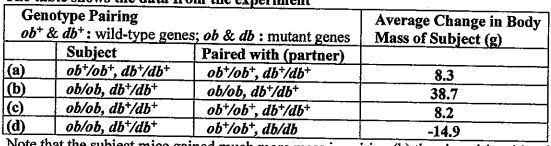
1. Researchers hypothesized that ob and db genes participate in a hormone pathway that suppresses appetite when caloric intake is sufficient. To test this hypothesis, they measured the mass of young mice ("subject mice") of various genotypes and surgically linked the circulatory system of each subject mouse to that of a partner mouse (parabiosis). This procedure ensured that any long-lasting substance circulating in the bloodstream of either mouse would be transferred to the other, but not the glucose or fatty acids that metabolized quickly. No new nerve growth was found between the two mice. All of the subject mice were given unlimited access to food and water. After eight weeks, the researchers again measured the mass of each subject mouse.The table shows the data from the experimentNote that the subject mice gained much more mass in pairing (b) than in pairing (a), whereas the subject mice in pairing (d) lost mass. It has been known that the ob+ gene produces the hormone leptin in adipose cells, and the db gene produces the receptors for leptin in some tissues. Give an explanation for the result of pairing (d) about the change in body mass of subject mice and the expected change in body mass of paired partner mice.
2. The colonization of land by plants and is a significant event in the history of life on Earth. The transition from water to land was a gradual process that occurred over millions of years. It involved numerous adaptive changes that allowed plants to thrive in terrestrial environments. Today, land plants play a crucial role in terrestrial ecosystems, providing oxygen, food, and habitat for a diverse array of organisms. How does Alternation of Generations contribute to the survival of land plants in challenging environments?
 阿摩線上測驗
登入