所屬科目:研究所、轉學考(插大)-普通生物學
1. Which type of growth is responsible for the increase in the length of stems and roots in plants? (A)Secondary growth(B) Tertiary Growth(C)Primary/Apical Growth(D) Lateral Growth
2. What is the primary function of the vascular cambium in plants undergoing secondary growth? (A)Producing secondary xylem towards the inside(B) Producing secondary phloem towards the inside (C)Increasing the length of stems and roots(D) Developing the epidermis in young plant tissues
3. What is the primary driving force for the upward transport of water and minerals in xylem vessels? (A)Transpiration pull (B) Osmosis (C)Pressure flow (D) Capillary action
4. Which vascular tissue is responsible for the bidirectional transport of organic nutrients, especially sugars, in plants? (A)Epidermis (B) Xylem (C)Phloem (D) Cambium
5. Which statement correctly distinguishes between active and passive transport in plant cells? (A)Active transport does not require energy and moves substances from higher to lower concentration areas. while passive transport requires energy and moves substances against their concentration gradient. (B) Active transport requires energy and moves substances against their concentration gradient, while passive transport does not require energy and moves substances from higher to lower concentration areas. (C)Active and passive transport requires energy, but active transport moves substances from lower to higher concentration areas, while passive transport moves substances from higher to lower concentration areas. (D) Active and passive transport are identical processes, with the only difference being the types of substances transported.
6. What distinguishes channels from pumps in the context of membrane transport in plant cells? (A)Channels facilitate passive transport and move substances against their concentration gradient, while pumps are involved in active transport and move substances from higher to lower concentration areas. (B) Channels are involved in active transport and move substances from lower to higher concentration areas, while pumps facilitate passive transport and move substances from higher to lower concentration areas. (C)Channels and pumps perform identical functions, and the terms can be used interchangeably in the context of membrane transport. (D) Channels are passive transport proteins that allow substances to move down their concentration gradient, while pumps are active transport proteins that move substances against their concentration gradient.
7. What is the primary role of an H⁺/sucrose symporter in plant cells? (A)Facilitating the movement of water across the cell membrane (B) Assisting in the transport of sucrose across the cell membrane (C)Pumping protons out of the cell (D) Synthesizing sucrose within the cell
8. How is sucrose transport by an H⁺/sucrose symporter typically energized? (A)Movement of sodium ions (B) Movement of chloride ions (C)Movement of protons (H+ ions) (D) Movement of potassium ions
9. Which part of the chloroplast is primarily responsible for the light reactions of photosynthesis? (A)Stroma (B) Thylakoid membrane (C)Outer membrane (D) Inner membrane
10. What is the primary function of the electron transport chain in the thylakoid membrane during light reactions? (A)Production of glucose (B) Splitting of water molecules (C)Synthesis of ATP and NADPH (D) Fixation of carbon dioxide
11. During light reactions, what is the byproduct of the process that involves the splitting of water molecules? (A)Carbon dioxide (B) Glucose (C)Oxygen (D) NADPH
12. Which enzyme is responsible for carbon dioxide fixation in the Calvin Cycle? (A)Ribulose-1,5-bisphosphate carboxylase/oxygenase (RuBisCO) (B) ATP synthase (C)NADP reductase (D) Phosphofructokinase
13. What is the final product of the Calvin cycle? (A)Glucose (B) G3P (C)3-PGA (D) RuBP
14. What is the role of oxygen in aerobic respiration? (A)It serves as a substrate in glycolysis. (B) It is directly involved in the production of ATP. (C)It acts as a coenzyme in the citric acid cycle. (D) It is the final electron acceptor in the electron transport chain.
15. Which two organelles produce ATP through chemiosmosis? (A)Chloroplasts and mitochondria (B) Chloroplasts and lysosomes (C)Mitochondria and lysosome (D) Vacuoles and chloroplasts
16. Where does the proton accumulate that drives ATP synthesis through chemiosmosis in cellular respiration? (A)Mitochondrial matrix (B) Intermembrane space of the mitochondria (C)Cytoplasm (D) Nucleus
17. In the electron transport chain of photosynthesis and cellular respiration, what is the ultimate source of electrons that drives the proton pumping and ATP synthesis through chemiosmosis? (A)Carbon dioxide (B) Oxygen (C)Glucose (D) Water
18. In the alternation of generations, what stages or structures are haploid? (A)Sporophyte, spores, gametes (B) Gametophyte, gametes, zygote (C)Spores, gametophyte, gametes (D) Spores, gametes, zygote
19. Please arrange the following phenomena in accordance with the order of plant hormones: Auxin-GA-ABA- ethylene. W: Stomata closure X: Triple response Y: Phototropism Z: Stem elongation (A)W-X-Y-Z (B) X-Z-W-Y (C)Y-X-W-Z (D) Y-Z-W-X
20. Which of the following statements about second messengers is correct? (A)Second messengers are used in communication between cells. (B) Each chemical class of second messengers produces the same physiological response in all cell types. (C)Second messengers are water-soluble small molecules. (D) Second messengers are constantly found at high concentrations in the cytoplasm.
21. Kinetochore is a structure that _____.(A)allows spindle microtubules to attach to the chromosome centromere (B) organizes the microtubule cytoskeleton (C)allows homologous recombination during meiosis (D) promotes the formation of replication fork
22. Which of the following statements about genetic drift is not correct? (A)Genetic drift can cause the fixation of deleterious alleles. (B) Genetic drift can cause allele frequencies to change at random. (C)Genetic drift can lead to a loss of genetic variation in a population. (D) Genetic drift is more significant in a large population than in a small population.
23. The biological species concept relies on a disruption of which aspect of population genetics? (A)mutation (B) selection (C)gene flow (D) genetic drift
24. Prokaryotes lack some parts found in eukaryotic cells, including which item? (A)A nuclear membrane (B) DNA (C)One or more chromosomes (D) A plasma membrane
25. Which of the following is characteristic of the lytic cycle in the bacteriophage life cycle? (A)Viral DNA is incorporated into the host genome. (B) A large number of phages are released at a time. (C)Many bacterial cells containing viral DNA are produced. (D) The viral genome replicates without destroying the host.
26. If the mitochondria and chloroplasts in eukaryotic cells resulted from endosymbiosis, what features might we expect these organelles to contain? (A)Plasma membrane, nucleus, and ribosomes (B) Plasma membrane, DNA, and ribosomes (C)Plasma membrane, nucleus, and cilia (D) Nucleus, ribosomes, and cilia
27. Dikaryon is a feature found in _____ during sexual reproduction, and is a consequence of _____. (A)bryophytes; karyogamy (B) bryophytes; plasmogamy (C)fungi; karyogamy (D) fungi; plasmogamy
28. ____ is a characteristic that is unique to Metazoa. (A)Heterotrophy (B) Multicellularity (C)An ability to move (D) Having neurons and muscles
29. Which of the following characteristics is found in Phylum Chordata but not unique to this phylum? (A)Notochord (B) Neural tube (C)Pharyngeal slits (D) Cnidocytes
30. ____ is a plesiomorphy of mammals. (A)Placenta (B) Tricolor vision (C)Opposable thumb (D) Endothermy
31. Hydrochloric acid in the stomach _____. (A)activates pepsinogen into pepsin (B) splits fats into fatty acids and glycerol (C)digests polypeptides into amino acids (D) is secreted by chief cells in the gastric gland
32. In humans, blood pressure is lowest in ____. (A)arteries (B) capillaries (C)venae cavae (D) ventricles
33. Which of the following statements best describes the effect of the Bohr shift? (A)Carbon oxide has a higher affinity to hemoglobin than oxygen. (B) Hemoglobin has a red color, while hemocyanin has a blue color. (C)Breathing rhythm increases when blood CO2 concentration elevates. (D) Hemoglobin releases a higher amount of O2 in places where CO2 production is greater.
34. Which of the following statements about mammalian nephron is correct? (A)Reabsorption of water relies on active transport of water. (B) The ascending limb of the loop of Henle is impermeable to water. (C)Osmolarity in the kidney cortex is higher than that in the medulla. (D) Salt reabsorption takes place in the descending limb of the loop of Henle.
35. In amniotes, ____ is the extraembryonic membrane responsible for gas exchange. In eutherian mammals, it develops into a part of placenta. (A)allantois (B) amnion (C)chorion (D) yolk sac
36. Which of the following cell types is responsible for humoral immune response? (A)B cells (B) Macrophage (C)Cytotoxic T cells (D) Helper T cells
37. Viral infection of the thyroid gland can cause short-term hyperthyroidism. Which of the following conditions is expected for patients with viral hyperthyroidism? (A)Reduced level of thyroid hormone (B) Reduced level of parathyroid hormone (C)Increased level of thyroid-stimulating hormone (D) Reduced level of thyrotrophin-releasing hormone
38. Inhibitory postsynaptic potential refers to to (A)depolarizing graded potential; (B) hyperpolarizing graded potential; in a postsynaptic cell, which is caused by increased permeability (C)depolarizing graded potential; (D) hyperpolarizing graded potential;
39. In vertebrate photoreceptor cells, which of the following responses occurs when light stimulation is present? (A)The photoreceptor becomes depolarized. (B) The photoreceptor cell releases the neurotransmitter glutamate. (C)The G-protein signaling activity of opsin is shut down in the photoreceptor cell. (D) The cGMP-gated sodium channel on the plasma membrane of the photoreceptor cell closes.
40. Pavlov demonstrated that if he always rang a bell just feeding a dog, the dog would eventually salivate when the bell sounded. This is an example of (A)associative learning (B) imprinting (C)fixed action pattern (D) problem solving
二、簡答題41. What chemical bond results in the cohesion between water molecules?
42. What is the driving force for water movement within the plants?
43. What vascular tissues or cells contain this H³/sucrose symporter?
44. Which photosystem is responsible for water splitting?
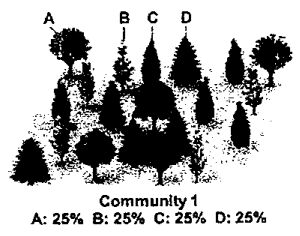
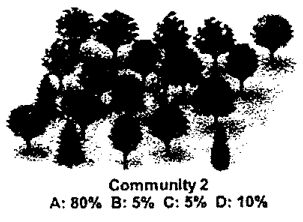
(1) What is the "species richness" in these two communities?
(2) Which community has a higher level of diversity?
46. What is the evolved biological function of the CRISPR/Cas system in bacteria? How does the CRISPR/Cas system work in gene editing?
47. Allopatric populations of two different Darwin's finches show similar beak morphology. However, there are signs of character displacement in sympatric populations of these two species. What does "character displacement" mean? What is the most likely driving force for character displacement?
 阿摩線上測驗
登入
 (B) hyperpolarizing graded potential;
 in a postsynaptic cell, which is caused by increased permeability (C)depolarizing graded potential;
 (D) hyperpolarizing graded potential;