所屬科目:【阿摩】未分類題庫
(a) If the row reduced echelon form of matrix A involves free variables, then the system Ax=b will have infinitely many solutions.
(b) det(ABT) = det(ATB)
(c) A triangular matrix is nonsingular if and only if its diagonal entries are all nonzero.
(d) If x1, x2, ..., xk span a vector space V, then they are linearly independent.
(e) Let {u1, u2}, {v1, v2}, and {w1, w2} be bases for \( \mathbb{R}^2 \). If X is the transition matrix corresponding to a change of basis from {u1, u2} to {v1, v2} and Y is the transition matrix corresponding to a change of basis from {v1, v2} to {w1, w2}, then Z = XY is the transition matrix corresponding to a change of basis from {u1, u2} to {w1, w2}.
(f) If L: V → V is a linear transformation and L(v1) = L(v2), then v1 - v2 ∈ ker(L).
(g) Any two matrices with the same trace are similar.
(h) If {u1, u2, ..., uk} is an orthonormal set of vectors in R^n and U = (u1, u2, ..., uk), then UUT = In (the n × n identity matrix).
(i) If A is symmetric and det(A) > 0, then A is positive definite.
(j) Let λ1, λ2, ..., λn be the eigenvalues of matrix A, then det(A) = λ1 + λ2 + ... + λn.
2. (10%) Let A = [1 1; 1 1; 0 0] Compute the singular values and singular value decomposition of A.
(a) Compute A-1.
(b) Compute the LU factorization of A.
(c) Use the LU factorization to determine the value of det(A).
(d) Solve the linear system using x = A-1b.
(e) Solve x1 of the linear system using Cramer's Rule.
(a) Are \( \pmb{v}_1, \pmb{v}_2 \), and \( \pmb{v}_3 \) linearly independent?
(b) If \( L(\pmb{v}_1) = \begin{bmatrix} 2 \\ 4 \end{bmatrix} \) and \( L(\pmb{v}_2) = \begin{bmatrix} 3 \\ 5 \end{bmatrix} \), find the value of \( L(\pmb{v}_3) \).
5. (10%) Solve the recurrence relation \( a_{n} = a_{n - 1} + 2n + 3 \) where \( a_0 = 5 \).
6. (10%) Simplify the following compound proposition to minimize the number of "and", "or", and "not" operations. $$(p \wedge q \wedge r) \vee (\neg p \wedge \neg r \wedge \neg s) \vee (\neg p \wedge \neg q \wedge s) \vee (\neg p \wedge q \wedge s) \vee (\neg p \wedge r \wedge \neg s)$$
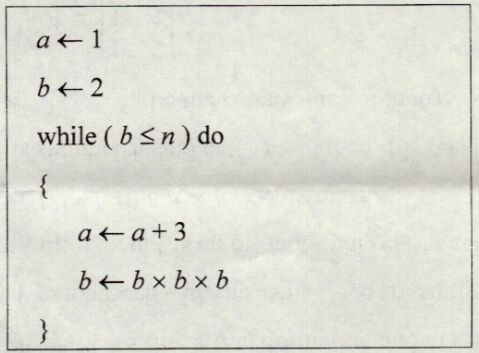
7. (10%) Consider the following program segment. Let n be a positive integer. Find the final values of a and b as functions of n.
8. (20%) Find all integer solutions for x and y such that $x \equiv 2 \pmod{3}$, $x \equiv 4 \pmod{5}$, $x \equiv 6 \pmod{7}$ and $y \equiv 4 \pmod{15}$, $y \equiv 7 \pmod{21}$, $y \equiv 14 \pmod{35}$.
 阿摩線上測驗
登入