 阿摩線上測驗
題組內容
一、 請閱讀以下文章,並回答問題: ※請以中文作答
ABSTRACT
The history of any field of study is an important topic, but few authors have taken on the task of writing the history of service research since the early 1990s. We attempt to fill this gap by providing a comprehensive account on the general course of the service literature from 1993 to
now. We propose an extension of the evolutionary metaphor originally proposed by Fisk et al. (1993). Drawing on an extensive multidisciplinary literature, we paint a portrait of the evolution of the service literature over three new stages termed Racing Ahead(1993-1999), Looking Back and Moving Forward (2000-2003), and Airborne (2004-Now). Within each era, we first identify key observations that make it distinguishable from the other stages, and then specifically highlight the major contributions that were made. We also underscore and provide some recommendations for further consideration by interested thinkers in the field for moving it
forward.
INTRODUCTION
The history of the service field has been the subject of several examinations all of
which date back to the early 1990s (Berry & Parasuraman 1993; Fisk et al. 1993; Swartz et al. 1992). Of these, the one proposed by Fisk et al. (1993) represents perhaps the most attractive and has widely been accepted. Using a biological evolutionary metaphor as a
framework, Fisk and colleagues traced the progress of the “services marketing literature” from its embryonic beginnings in 1953 to its stance as a well-established field of study yet firmly ensconced within the marketing discipline in 1992. They identified three stages
in that evolution that were termed: Crawling Out (pre-1980),Scurrying About (1980-1985), and Walking Erect (1986-1992) (see Figure 1). 
Source:Inspired from Fisk et al. (1993).
Figure 1.Original Stages in the Evolution of the Services Marketing Thought
However, the field (i.e., both practice and academia) has undergone massive changes since then. Currently, the service sector makes up almost 80% of the gross domestic product (GDP) of established countries like the United Kingdom or the United States and developing nations such as Tunisia or Uruguay are not too far behind (US Central Intelligence Agency 2009). Many service firms (e.g., retailers, banks, and telecommunication operators) are now seeking new opportunities and are expanding into international markets.Manufacturing and goods dominated companies are trying to grow and be more competitive through services (Ostrom et al. 2010). Information technology infusion in services is currently providing opportunities as well as challenges for service managers (Bardhan et al. 2010; Connolly & Olson 2001). All of these have led to the exponential growth of interests in service research among marketing,
management, and information systems scholars (Furrer & Sollberger 2007; Smith et al. 2007; Rai & Sambamurthy 2006). Indeed, the knowledge infrastructure of the field has been considerably strengthened via the inception of new service research centers (e.g.,
the Center for Excellence in Service at the University of Maryland in 2000), special interest groups (e.g., the American Marketing Association [AMA] Services Marketing Special Interest Group [SERVSIG]in 1993), sections (e.g., the Institute For Operations Research and
Management Sciences [INFORMS] Service Science Section in 2007), and peer-reviewed journals (e.g., Journal of Service Science 2009). Numerous intriguing insights have also been developed (e.g., Lovelock & Gummesson 2004; Sampson & Froehle 2006; Vargo & Lusch 2004a). Service articles have noticeably sharpened both theoretically and methodologically (e.g., Paul et al. 2009; Xia & Dube 2007). Presently, it is more appropriate to talk about a science of service
that has its own distinct identity and research priorities (Ostrom et al. 2010). In short, the picture is wholly different today from what it was in 1992. But despite all the aforesaid facts, there have been relatively scant efforts directed to examining the evolution of the service field from 1993 to 2010.
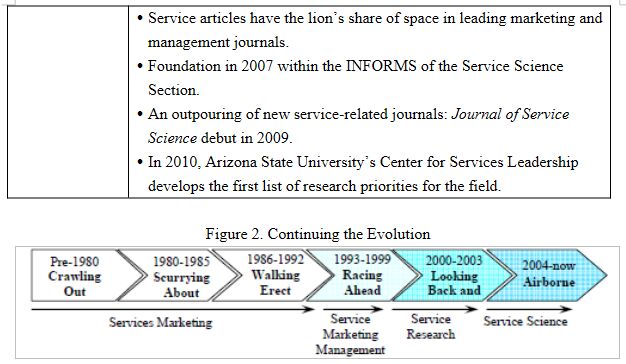
The aim of this paper, therefore, is to fill this gap. It picks up where Fisk and colleagues (1993) had left off and continues tracing the development of the service literature. Table 1 provides a detailed description of what we consider to be the three new stages in the evolution of the service field from 1993 until now (i.e., 2010): Racing Ahead (1993-1999); Looking Back and Moving Forward (2000-2003); and Airborne (2004-Now). The periodizationexhibited in Figure 2 represents our conclusion based on the study of a variety of documents spanning multiple
disciplines-including journal articles, editorial notes, citation analyses,commentaries,
literature reviews, working papers, textbooks, edited volumes, and conference proceedings-that were published during the period under scrutiny. It should be recognized, however, that in choosing the names of the stages we were inspired by Agarwal (2001) and Cronin(2003).
In what follows, we will address the three new stages of the service field evolution in chronological order. For each stage, we first identify some key observations that make it distinguishable from the other stages, and then specifically highlight the major contributions that were made. Then a discussion indicates some issues that need careful examinations by service thinkers. Finally, we conclude by highlighting this literature review contributions.
Table 1. The Proposed Three New Stages in the Evolution of Service Research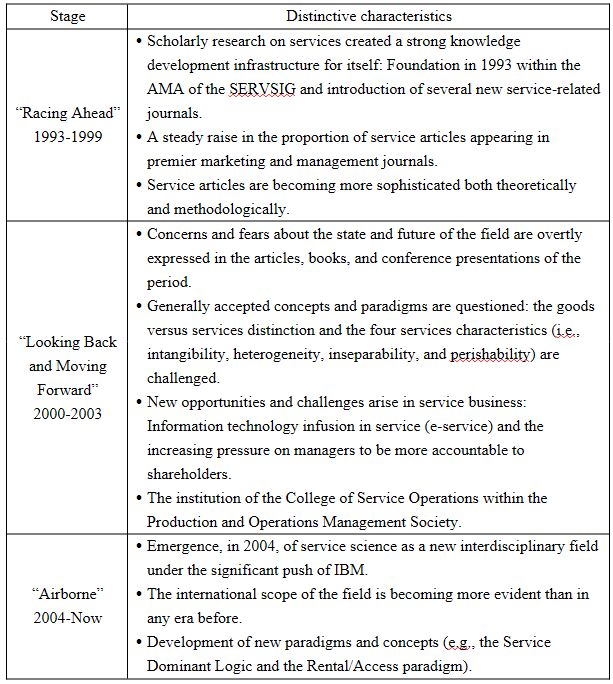
2. 請為本文訂定一個適當的研究標題(title)。(5%)